
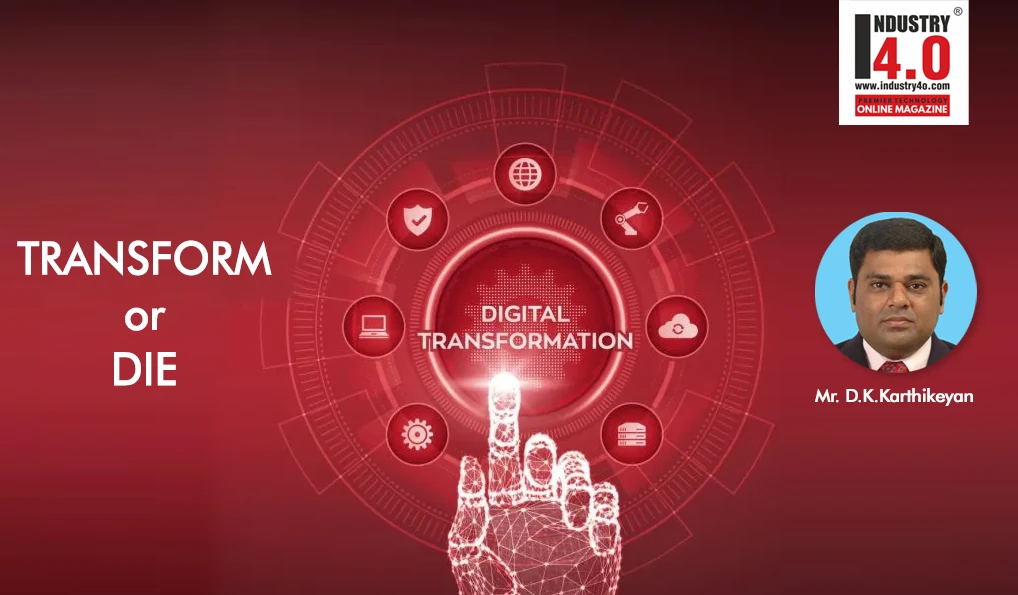
Will DIGITAL TRANSFORMATION Play a Crucial Role in Enterprise ?
Yes, digital transformation is playing a crucial, non-optional role in enterprises, driving massive gains in efficiency, quality, cost reduction & competitiveness by integrating technologies like AI, IoT, and cloud computing to create smart, resilient & data-driven operations, enabling everything from predictive maintenance to personalized products and optimized supply chains. It’s essential for survival and growth in the modern, competitive landscape, with leading firms seeing 10-30% throughput increases and up to 50% less downtime

Digital transformation uses technology to fundamentally reimagine business processes, customer experiences & operational models, resulting in increased value, efficiency and revenue.
Digital transformation is the strategic, ongoing integration of digital technologies, data & processes across all areas of an organization to fundamentally change how it operates and delivers value to customers. It is as much a cultural shift as a technological one, requiring organizations to continuously challenge the status quo, experiment & get comfortable with failure.
Key Facets of Digital Transformation
 Business Process Transformation : Streamlining workflows and optimizing operations using technologies like Robotic Process Automation (RPA) and AI to reduce manual tasks, errors & costs.
Business Model Transformation : Reimagining how value is created, delivered & captured, such as transitioning from product sales to subscription or software-as-a-service (SaaS) models.
Domain Transformation : Leveraging technologies (like cloud and IoT) to move into new, related markets or create entirely new offerings.
Cultural/Organizational Transformation : Shifting mindset, behaviours & structures to foster collaboration, agility & a “digital-first” mentality
Foundational Technologies
 Cloud Computing : The backbone of digital transformation, providing flexible, scalable & cost-effective infrastructure.
Artificial Intelligence (AI) & Machine Learning (ML) : Used for advanced data analytics, predictive insights & automated decision-making.
Internet of Things (IoT) : Connecting devices to gather real-time data, enabling predictive maintenance and smarter operations.
Data & Analytics : Transforming vast amounts of data into actionable insights for better decision-making.
Generative AI : The latest frontier, used for producing content, improving chatbots & custom software creation.
Key Drivers
✅ Customer Experience (CX) : Meeting and exceeding modern customer expectations for speed, convenience, and personalization.
✅ Operational Efficiency: Reducing costs, minimizing errors, and accelerating service delivery.
✅ Agility & Resilience: Building the ability to rapidly respond to market disruptions, such as pandemic-related shifts.
✅ Increased Revenue: Unlocking new revenue streams through innovative digital products and services
 Core Technologies Enabling this Shift:
✅ Internet of Things (IoT): Connects devices for real-time monitoring and data collection.
✅ Artificial Intelligence (AI) & Machine Learning (ML): Drives automation, predictive maintenance and analytics.
✅ Cloud Computing: Offers scalable, cost-effective data storage and access, democratizing advanced tools
✅ Big Data & Analytics: Transforms raw data into actionable insights.
✅ Digital Twins & Industrial Metaverse: Allows for virtual simulation and optimization before physical production.
Key Benefits & Impacts:
✅ Enhanced Efficiency & Productivity: Automation, AI, and real-time data minimize errors, optimize workflows, and reduce machine downtime significantly.
✅ Superior Product Quality: Advanced sensors and automated testing improve quality control at every production stage, reducing defects.
✅ Cost Reduction: Proactive issue resolution via IoT and optimized resource use lowers operational expenses and waste.
✅ Supply Chain Resilience: Real-time visibility and data-driven forecasting allow for better planning, inventory management, and supplier collaboration.
✅ Personalization: Enables mass customization to meet evolving customer demands.
✅ Sustainability: Optimizes energy consumption and minimizes environmental footprint.
✅ Improved Decision-Making: Real-time analytics provide insights for better strategic and operational choices.
✅ Future-Proofing: Builds resilience and adaptability in unpredictable markets

Challenges and Strategies
✅ Cultural Resistance:Employee resistance to new ways of working is a major hurdle.
✅ Lack of Strategy: Many initiatives fail due to a lack of a clear, overarching and CEO – supported vision.
✅ Skills Gaps: A shortage of talent with necessary digital skills.
✅ Legacy Systems: Integrating modern, agile technology with rigid, outdated infrastructure
Framework for Success
Successful digital transformation requires a roadmap, starting with discovery, defining a clear vision, assessing digital maturity, and identifying capability gaps. It is crucial to start with the business problem, rather than the technology itself.
In essence, digital transformation isn’t just an upgrade; it’s a fundamental strategic imperative for manufacturers to remain competitive, innovative and sustainable in the digital age, affecting everything from design to customer delivery.
 Crafted & Edited by :

Mr. D.K. Karthikeyan
Editorial Director – Industry4o.com
Director – Texas Ventures
Leader ( Strategic Selection ) – Thought Leadership 4.0
Mr. D.K. Karthikeyan can be contacted at :
LinkedIn | FaceBook | Twitter | Instagram | E-mail (1) | E-mail (2)
Mobile : +91 97860 12122
Also Read Mr. D.K. Karthikeyan earlier article :