
How agentic AI may unbundle capital markets, and where the profits will move next
It goes without saying that capital markets are the fulcrum of any economy. They move savings into investment and they price risk. For decades, much of the value sat in the middle: the brokers, advisers, research desks and operations teams that connect investors to markets. Agentic AI may change that. It does not just answer questions. It plans, decides and acts. Citi (2025) stated that AI and agentic AI could have a bigger impact on the economy and finance than the internet era. Let us try and understand why, through a lens that suits this kind of shift well.
The lens: disruption and modularity
Christensen, Raynor and McDonald (2015) stated that disruption is a process in which a smaller firm with fewer resources successfully challenges established incumbents, usually starting at the low end of the market or in a new market. Christensen and Raynor (2003) added a second idea, the law of conservation of attractive profits. It says that when modularity and commoditization make profits disappear at one stage of the value chain, the chance to earn attractive profits usually emerges at an adjacent stage. In simple words, profits do not vanish. They move to whatever is still not good enough.

As I understand it, this second idea explains the agentic shift better than most. The question is not only who wins. It is where the money goes.
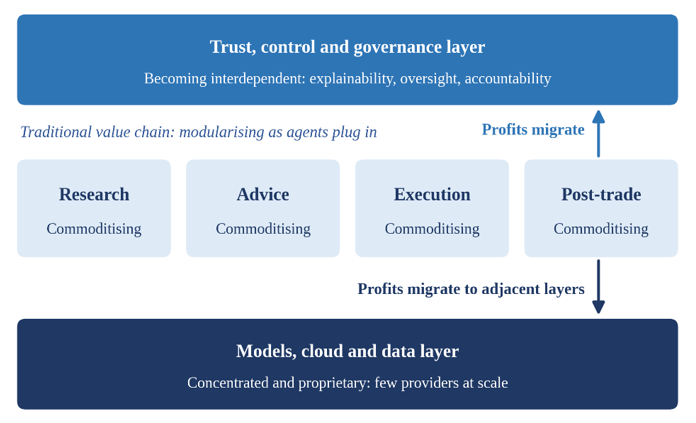
Figure 1: How agentic AI may modularise the capital markets value chain (author’s view, based on Christensen and Raynor, 2003)
Step one: disruption finds a foothold
The IMF (2024) stated that hedge funds, proprietary trading firms and other nonbanks may gain a further structural advantage in AI, as they are more agile and face fewer regulatory constraints than large banks. Citi (2025) stated that competition will pick up as start-ups grow, and that 37% of venture capital funding in 2024 went to AI start-ups. The footholds are forming at the edges, just as Christensen would expect.
Step two: the middle turns modular
 Agents work best when tasks have clear inputs and outputs. That pushes the value chain towards modules that plug together. Citi (2025) stated that tasks outsourced today to contractors or third parties will increasingly be done by agentic AI. It also stated that users will have their own AI agents to help them choose products and execute transactions. Once an investor’s agent can compare and switch in seconds, research, advice and execution start to look like commodities.
Speed is already going this way. The IMF (2024) found that the share of AI content in patent applications for algorithmic trading rose from 19% in 2017 to over 50% each year since 2020. When everyone is fast, speed stops being a source of profit.
Step three: profits move to adjacent layers
If the middle melts, where do profits go? The law points to two layers. The first lies below the value chain: models, cloud and data. These are still proprietary and hard to copy. The Bank of England and FCA (2024) found that the top three third-party providers account for 73% of cloud, 44% of model and 33% of data providers reported by UK financial firms. The FSB (2024) stated that this kind of service provider concentration could raise systemic risk. Concentration is a warning, but it is also a sign of where pricing power now sits.
 The second layer lies above: trust, control and governance. This is what is clearly not good enough today. The Bank of England and FCA (2024) found that 46% of firms have only a partial understanding of the AI they use, against 34% with a complete understanding. Gartner (2025) stated that over 40% of agentic AI projects will be cancelled by the end of 2027 because of rising costs, unclear value or weak risk controls. In my view, firms that make agents explainable, auditable and safe may earn the next attractive profits.
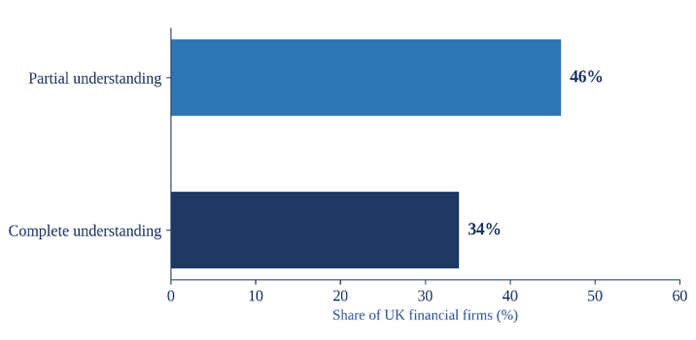
Figure 2: How well UK financial firms understand the AI they use. Source: Bank of England and FCA (2024)
The other side of the coin
Modular markets can also be fragile markets. The IMF (2024) noted that several AI-driven ETFs raised their turnover during the March 2020 turmoil, which points to herd-like selling under stress. The FSB (2024) listed market correlations, cyber risk and model risk as key concerns.
A point estimate, not a verdict
Let me be honest about the limits of this view. It is a qualitative reading, not a measured result. Quantifying the shift needs extensive empirical work. We must identify the right parameters and test the relationships between them at a granular level. Many of these are intriguing research topics for my scholar friends and colleagues, and I know some of them have already started.

Whatever we conclude today will mostly be a point estimate. The future will unravel new information that may change the direction entirely. Still, Christensen gives us one useful warning. Incumbents rarely lose because they miss the new technology. They lose because they keep defending the layer where profits used to be.
About the Authors :
 Mr. Radha Mohan De
IBM Master Inventor
Service Reliability Engineering – IBM Global Services

Mr. Radha Mohan De holds over 35+ Patents in IT specific ideas.
Mr. Radha Mohan De is Working in Openshift Container Platform for last
few years.
Mr. Radha Mohan De is an expert in EFK, Prometheus-Grafana stack, Velero Backup Management, istio Service Mesh Management, OCS/ODF for Multizone Cluster Storage Management, Vyatta 5600 NAT/Firewall setup.
Mr. Radha Mohan De can be contacted at :
 Mr. Raja Basu
INDUSTRY STRATEGY & GTM
IBM Consulting
Mr. Raja Basu is a Senior Consulting professional in a leading MNC.
Mr. Raja Basu works as a business architect and helps global banking and financial markets clients to enable their digital transformation journey.
Mr. Raja Basu has special interest in responsible use of AI and sustainability.
Mr. Raja Basu is also pursuing his doctoral studies (PhD) from XLRI Jamshedpur.
Mr. Raja Basu is based out of Kolkata, India.
Mr. Raja Basu is an experienced leader in both technology and business, he has a proven track record of defining and implementing technology-driven transformations for clients in the global banking and financial markets.
Mr. Raja Basu focus lies in automation, particularly artificial intelligence (AI), and its impact on climate and sustainability (SCR).
Mr. Raja Basu possess a deep understanding of value-driven advisory practices, which have played a significant role in building strong client relationships. Throughout his career, he has actively contributed to numerous transformation programs involving complex applications for international clients across the United States, Canada, Europe, and Singapore.
Mr. Raja Basu is Bestowed with the following Licenses & Certifications :
https://www.linkedin.com/in/ba
Mr. Raja Basu is Volunteering in the following International Associations & Institutions :
https://www.linkedin.com/in/ba
Mr. Raja Basu is Accorded with the following Honors & Awards :
https://www.linkedin.com/in/ba
Mr. Raja Basu can be contacted at :
Also read Mr. Raja Basu’s earlier article :