
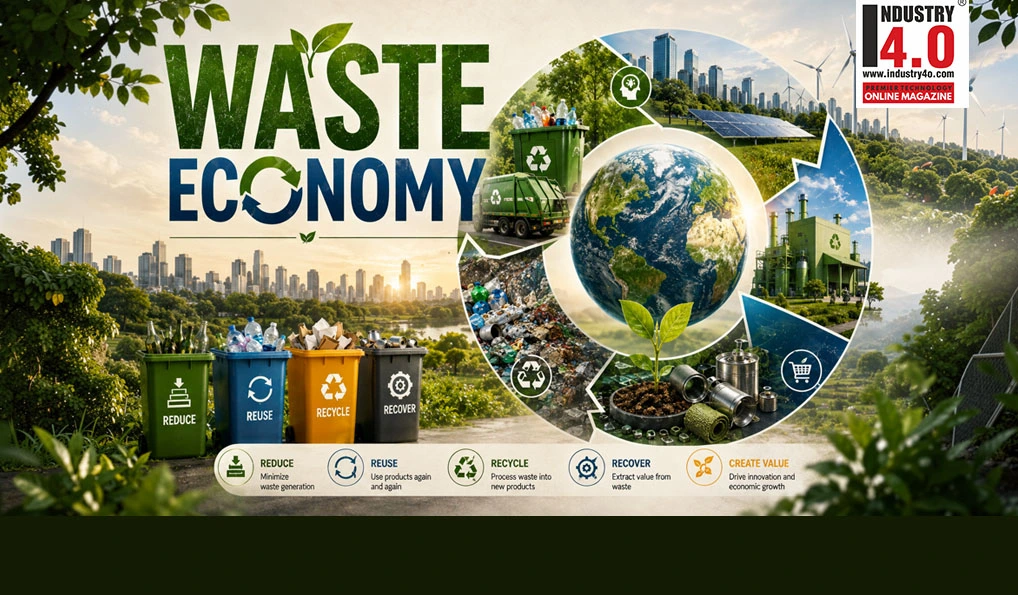
The Waste Economy: India’s Quiet USD 12 Billion Opportunity
Garbage, for most investors and business leaders, remains one of India’s least examined infrastructure stories. Yet beneath the country’s approximately 62 million tonnes of municipal solid waste generated every year, a resource-recovery industry projected to reach nearly USD 12 billion by 2030 is taking shape. The businesses that learn to design and integrate this system, rather than merely service individual parts of it, could define the sector’s next decade.
When we decided to dedicate this year’s edition of LogiPulse to waste management, a few people quietly raised an eyebrow. Logistics and supply chains were readily accepted as serious commercial subjects, but waste was still seen mainly as a sanitation or environmental issue. That reaction convinced us that the sector deserved closer attention. Across conversations with investors, operators and policymakers, we repeatedly encountered the same underlying problem: regulations existed, capital was available and technology could be sourced, but the operating system connecting these elements was incomplete.
 A manufacturer could not fulfil its Extended Producer Responsibility obligation because there was no authorised recycler within an economically viable distance. A hospital was paying a substantial premium for biomedical-waste disposal because the nearest Common Biomedical Waste Treatment Facility was three districts away. A waste-to-energy project had capital, technology and a municipal contract, but poor feedstock quality restricted the plant to approximately 40% of its designed capacity. The problem was not a lack of intent or investment. The system architecture was broken.
The global context makes this failure more striking. The world generates nearly 2.24 billion tonnes of municipal solid waste annually, but less than one-fifth undergoes meaningful recovery. The recoverable value permanently destroyed, including metals, plastics, organics and rare earths, is estimated at USD 80–120 billion every year. At the same time, the global waste-management industry is valued at approximately USD 2.08 trillion. An industry of this scale spends enormous capital on collection, transportation and disposal while recovering only a fraction of the value embedded in the material it handles. This is no longer merely an operational-efficiency issue; it is a systems-level design failure and, simultaneously, one of the largest untapped opportunities within the circular economy.
India presents a particularly important paradox. The country has established the Solid Waste Management Rules 2016, E-Waste Management Rules 2022, Biomedical Waste Management Rules 2016, Plastic Waste Management Rules 2022 and Battery Waste Management Rules 2022. Yet only around 30% of municipal solid waste undergoes formal processing. The regulatory architecture is substantially in place, but the enforcement and processing infrastructure required to activate it remains inadequate. Formal capacity being developed today is therefore being built ahead of a demand wave that regulation has already created, but has not yet fully delivered.
International experience shows that technology alone does not determine performance. Germany recovers approximately 67% of materials and has made landfill use almost negligible, while the European Union average is close to 48%, supported by formal collection exceeding 90%. The difference lies in consequence-driven enforcement, producer accountability through EPR, sustained infrastructure investment and the integration of informal workers into the formal system. These are the institutional foundations on which recovery technologies become economically effective.
 India’s waste value chain is fragmented across segregation, collection, transfer, sorting, processing and final disposal. These activities are managed by different institutions operating with different incentives, data systems and performance measures. A weakness at one stage degrades the economics of every stage that follows. The annual losses identified in our analysis include USD 8–12 billion of material value from inadequate source segregation, USD 1.5–3 billion of revenue from the collection gap, USD 1–1.5 billion of avoidable transfer and transportation costs, USD 1.5–2 billion from sorting and Material Recovery Facility discounts, USD 0.7–1.2 billion from processing assets operating at only 40–60% utilisation, and more than USD 2.4 billion in deferred liabilities arising from non-compliant disposal sites.
The most important intervention is source segregation. When organic waste is mixed with dry recyclable material at the point of generation, contamination progressively becomes irreversible. India’s urban source-segregation compliance rate is approximately 45%. Every 10-percentage-point improvement in compliance can reduce downstream processing costs by 15–20%, while simultaneously increasing the value of recovered material. This demonstrates why processing plants cannot be evaluated independently of their upstream collection and feedstock architecture.
The sector’s economics are equally counterintuitive. The most visible activities are not necessarily the most profitable. Collection and transportation generally operate at EBITDA margins of 5–10%. Margins rise to 15–25% in Material Recovery Facilities, 20–30% in waste-to-energy, 25–40% in e-waste processing, and 30–40% in pharmaceutical and biomedical waste management. Technology platforms and the integration layer can potentially generate margins exceeding 40% at scale. Mid-chain recovery opportunities, including e-waste, biomedical waste, battery recycling, MRF networks and EPR-compliance platforms, offer indicative target IRRs ranging from 22% to 40%.
E-waste illustrates this value-recovery opportunity particularly clearly. Global e-waste generation reached approximately 62 million tonnes in 2022, growing at 4–5% annually, while only 22.3% was formally collected and recycled. India generates around 3.2 million tonnes of e-waste each year, making it the world’s third-largest generator. This annual stream contains more than USD 2.4 billion of embedded recoverable value at 2025 prices, yet formal recyclers capture less than 20% of it.
The concentration of recoverable metals is remarkable. Mobile phones contain approximately 0.4 kilograms of gold per tonne of devices, compared with only 1–4 grams per tonne of mined gold ore. Urban mining can therefore offer gold concentrations 50–100 times higher than conventional mining. The decisive competitive differentiator is processing technology: hydrometallurgical systems can achieve gold recovery rates of 95–99%, compared with 60–80% through conventional smelting. When this capability is combined with EPR-backed processing fees, the resulting business model becomes more defensible. Compliance revenue can form the base case, while recovered-metal sales provide commodity-linked upside.
 Attero Recycling provides an operating example of this model, with 500,000 tonnes of licensed capacity, more than 250 EPR clients across 12 export markets, and a hydrometallurgical processing backbone. Its significance lies not merely in scale, but in the combination of technology, regulatory compliance and multiple revenue streams.
Battery recycling is the next extension of the urban-mining opportunity. The first substantial wave of end-of-life electric-vehicle batteries is expected between 2028 and 2032. Operators investing in lithium-ion recycling capacity today are positioning themselves ahead of a regulation-driven feedstock cycle that is likely to expand significantly. The estimated window to build ahead of this wave is only three to four years. Early investment can create advantages in technology, approvals, feedstock relationships and EPR-compliance infrastructure.
Waste-to-energy presents a different investment proposition. India currently has 14 operational plants against an estimated requirement of more than 200, while utilisation of available potential remains at approximately 6%. The bottleneck is not simply capital or technology; it is the sequence in which infrastructure is being developed and the quality of contractual risk allocation.
Mixed Indian municipal waste frequently has calorific value below 1,200 kcal per kilogram, while most plants require approximately 1,500–2,000 kcal per kilogram. Large-scale energy conversion cannot operate reliably unless segregation and Refuse-Derived Fuel preprocessing are established first. RDF also creates an independent off-take opportunity through the cement industry, which is targeting a 25% thermal substitution rate by 2030. Municipal concessions must additionally provide longer tenors, indexed tipping fees, assured feedstock standards and enforceable payment-security mechanisms. Waste-to-energy is therefore best understood as a sequencing and contract-design challenge, rather than merely a technology problem.
Biomedical and pharmaceutical waste have a more structurally protected demand profile. India generates approximately 800–900 tonnes of biomedical waste every day, with volumes growing at 7–8% annually. Around 198 Common Biomedical Waste Treatment Facilities are registered, although the gap between registration and active operation remains significant outside major cities.
Hospitals cannot avoid generating biomedical waste, nor can they use informal disposal channels without exposure to criminal liability. Standard biomedical waste commands approximately ₹8–15 per kilogram, while specialised pharmaceutical streams, including cytotoxic compounds, hormones and expired injectables, command ₹25–50 per kilogram. The authorisation process for a new treatment facility takes approximately 18–24 months, creating a meaningful regulatory moat. Consequently, EBITDA margins of 30–40% among leading facilities are not merely the result of exceptional operating performance; they are supported by captive demand, route density, compliance-led pricing and high barriers to entry.
Technology is also changing the economics of the entire chain. AI-based route optimisation has produced 20–25% savings in fuel and maintenance in Indian smart-city pilots. IoT-enabled bins have improved collection efficiency by 20–40% and reduced overflow incidents by 60–70%. AI-driven optical sorters can process more than 80 items per minute with accuracy exceeding 95%, while blockchain-based EPR traceability is improving the credibility of compliance certificates and could eventually enable them to develop into tradeable financial instruments.
The larger opportunity, however, is not any single technology. It is the integration layer connecting material-flow tracking, incentive coordination, compliance management, processing capacity and data monetisation within one operating architecture. The future waste-management company may resemble a technology and financial-information platform that also manages the physical movement of material. The data generated by that network could ultimately become more valuable than the tipping fees collected.

The risks should not be underestimated. Feedstock quality remains the highest-probability and highest-impact risk across waste-to-energy, composting, RDF and MRFs. Municipal contracts can weaken otherwise viable projects through inadequate tenors, poor tariff design and uncertain payment security. Technology investments may underperform in operating environments without adequate training and accountability. Non-EPR e-waste and battery-recycling volumes remain exposed to commodity prices, while poorly planned formalisation can displace informal workers without securing the collection networks they currently support.
None of these risks is a structural reason to avoid the sector. They are reasons to design investments more carefully. Stronger models will secure feedstock before deploying capacity, build close to regulatory moats, treat compliance-linked income as the base case, structure commodity revenue as upside and create long-term contractual protection around capital-intensive assets.
India does not require another round of broad regulation. It requires credible enforcement, wider development of transfer stations and systematic replication of successful municipal systems such as the Indore model. For operators, the economically sound sequence is to begin with high-value recovery and then integrate backwards to secure feedstock. For capital providers, the opportunity lies in identifying where regulatory demand, infrastructure scarcity, processing capability and data ownership converge.
The fundamental shift is from waste handling to system integration, from compliance administration to capital formation, and from treating discarded material as a disposal problem to designing it as a resource-recovery system. The companies and cities that make this transition first will not merely participate in India’s waste economy. They will shape how it operates for the next several decades.
About the Author :

 Mr. Sanjeev Jain
Managing Partner,
Amicus Growth Advisors

Mr. Sanjeev Jain is a Fellow Chartered Accountant and Registered Insolvency Professional with over 30 years of strategic finance and governance leadership across logistics, telecom, manufacturing, and infrastructure.
As former CFO of GATI and AFL / FedEx, Mr. Sanjeev Jain has led EBITDA improvement, business transformation, and operational efficiency programs for mid-to-large enterprises, and brings strong expertise in financial strategy, M&A, dispute resolution, and regulatory matters.
As Managing Partner at Amicus Growth Advisors, Mr. Sanjeev Jain leads CFO and Board Advisory engagements covering turnarounds, fundraising and investor relations, due diligence, and performance improvement.
Mr. Sanjeev Jain also serves on the boards of high-growth companies in the logistics and infrastructure sectors, supporting long-term strategy and value creation for promoters and leadership teams.
Mr. Sanjeev Jain can be contacted at:
About Amicus Growth Advisors :


At Amicus Growth Advisors, we help businesses unlock growth, improve performance, and build lasting value.
From business transformation and operational turnaround to M&A, fundraising, and board advisory, Amicus Growth Advisors partner closely with founders, boards, and investors to navigate complexity and deliver measurable results.
With decades of experience across logistics, manufacturing, infrastructure, and services, Amicus Growth Advisors team combines strategic insight with hands-on execution.
Whether you’re scaling up, restructuring, or preparing for your next phase of growth, Amicus Growth Advisors is there to help you move forward with clarity and confidence.
Amicus Growth Advisors can be contacted at :
Website | E-mail | LinkedIn | Instagram | Facebook | WhatsApp | Phone : +91 98200 75360