
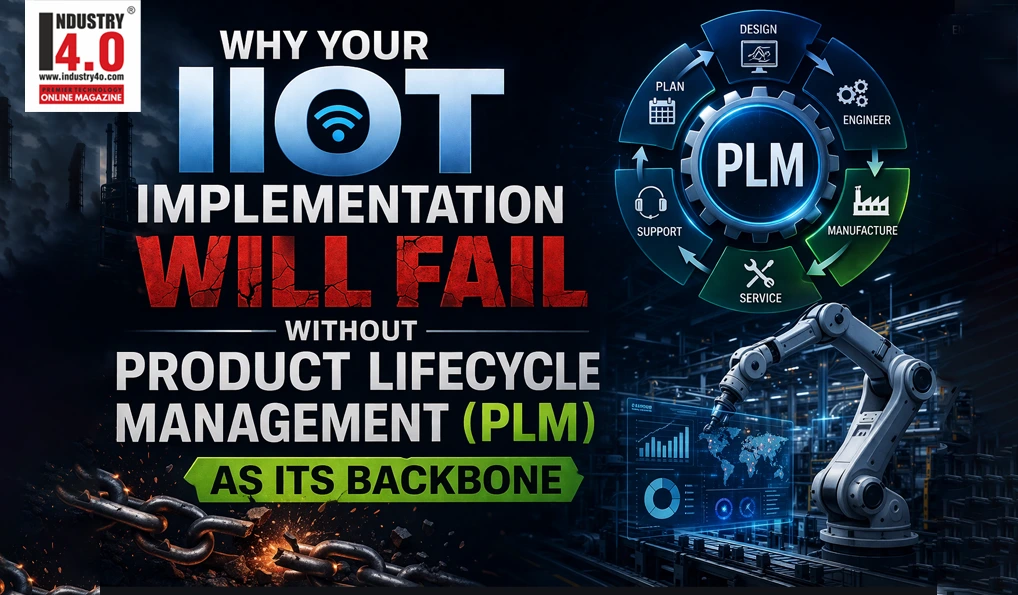
Why your IIoT Implementation will fail without PLM as its Backbone.
In my experience spanning IIoT implementations in electronics and industrial manufacturing, PLM engagements across automotive, medical, and general manufacturing, and advisory and workshop engagements across multiple sectors, I have seen a framework so consistent it has become predictable.
An organisation invests in IIoT. Sensors go on machines. A platform ThingWorx, Ignition, AWS IoT, gets deployed. Dashboards appear. Management is impressed. Six months later, the dashboards are still running. Nobody is acting on them.

The technology worked. The transformation did not.
The reason is almost never the IIoT platform. It is what was missing underneath it.
IIoT gives you data. PLM gives it meaning.
IIoT tells you what is happening on the shop floor right now, machine states, cycle times, and energy consumption. This is powerful, but it’s only half the story. To derive actual value, you must answer: What should be happening? The expected cycle time for a specific product variant, the approved digital work instructions, the engineering change released last shift, and the Bill of Materials tolerances, this information doesn’t live in your IIoT platform. It lives in your PLM system.
Without a “Digital Thread” connecting PLM to the shop floor, your IIoT implementation is a window into a process whose definition is scattered across email threads and institutional memory. You aren’t measuring against a standard; you’re measuring against noise.
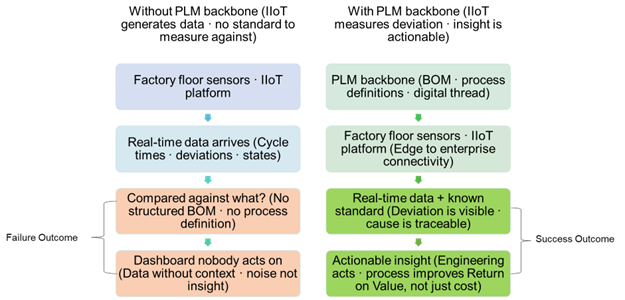
You are not measuring against a standard. You are measuring against nothing.
Field Evidence: The High-Mix Production Challenge
During an IIoT integration for a global electronics manufacturing leader’s High-Mix Low-Volume lines, I saw this play out. Their assembly process generated mountains of data, but decisions were still being made on retrospective reports compiled days later. By implementing a unified dashboarding (Thingworx) environment, we integrated data from the factory floor edge to the enterprise level, connecting MES, Asset Management, and Inventory. The “moment of clarity” didn’t come from the sensors, but from the standardization. Because their product data was structured in PLM, the IIoT dashboard could finally show deviation from a known engineering standard.
 This methodology is a cornerstone of my work, documented in my book, “Product Lifecycle Management (PLM): A Digital Journey Using Industrial Internet of Things (IIoT).” This work, recognized with the 2020 Taylor & Francis Award for Outstanding Professional Book, validates that the “Digital Thread” is only as strong as its weakest link. If your PLM backbone is non-existent, your IIoT journey has no destination.
When it goes wrong
This is not always how it goes. Earlier in my career, I worked with a global appliance manufacturer that had invested significantly in Windchill, a capable, enterprise-grade PLM platform. Senior leadership set a Go-Live date and drove toward it. What they did not do was map the existing processes, align the engineering stakeholders, or build the organisational readiness to use what they had deployed. The result was predictable: engineers bypassed the system, CAD data errors proliferated, and change management collapsed. The platform was running. The discipline was absent. Those two things are not the same and confusing them is the most expensive mistake a manufacturer can make.
The ownership problem that nobody names
In most organisations, IIoT is treated as an IT project. Corporate IT claims the implementation, connects the sensors, builds the dashboards, and hands it over.
I have seen this up close. In one engagement, I told the Engineering team directly: you are the runner. This process, this data, this implementation, it belongs to you. Within days, corporate IT arrived and overruled that position. They would drive the implementation.
 Sensors got connected. Dashboards got built. But the people who understood what the data meant, who knew what a deviation in cycle time actually indicated about the process, which engineering change had introduced a new variable, which BOM revision applied to today’s production run, those people had been moved aside.
The result? A technically successful implementation that produces data nobody trusts enough to act on. For Industry 4.0 to move into Industry 5.0 (Human-Centricity), a concept I explore in my book Industry 5.0: The Future of the Industrial Economy, the practitioner must own the data. It is about human-machine collaboration, not human replacement by automated dashboards.
IIoT without Engineering ownership is a window nobody is looking through. PLM without Engineering ownership is a database nobody maintains. Both fail for the same reason; the wrong function is driving.
The Industry 4.0 readiness question nobody asks
Before any manufacturer invests in IIoT, sensors, or smart factory infrastructure, there is one question that should come first. I ask it in every initial engagement:
Can you give me a complete picture of your current CAD, PLM, ERP, and PLC environment?
The answer tells me everything about whether an Industry 4.0 initiative will succeed. Not the technology answer, the confidence of the answer. Whether the people in the room know immediately what systems they have, who owns the data in each, and how those systems currently talk to each other.
 In most SME engagements, the honest answer is: we cannot fully describe it. The systems exist. The discipline connecting them does not.
You cannot build a smart factory on top of that. You can connect sensors to machines. You can build dashboards. But without a disciplined PLM backbone, clean product data, structured BOMs, traceable process definitions, your IIoT implementation will generate noise instead of insight.
Industry 4.0 does not begin with sensors. It begins with structured product knowledge. PLM is where that structure lives.
Three things to check before your next IIoT investment
If you are planning an IIoT initiative or wondering why your current one has not delivered, ask these three questions before spending another rupee or dollar on connectivity:
- Does your engineering BOM reliably reach your ERP without manual intervention? If not, your product data foundation is already broken. IIoT will not fix it, it will expose it.
- Do your process instructions on the shop floor reflect the latest engineering release, automatically, not manually? If not, your IIoT platform is measuring against outdated standards.
- Does Engineering own your IIoT implementation, or does IT? If IT owns it, the people who understand your process are not driving the transformation. And the dashboards will stay beautiful and unactioned.
PLM is not the trendy part of Industry 4.0. Nobody puts it on a conference keynote slide next to cobots and digital twins. But it is the backbone that determines whether everything else works. Without it, your smart factory is smart infrastructure built on fragile foundations.
 About the Author :

Mr. Uthayan Elangovan
Founder & CEO – Neel SMARTEC

Author of the PLM & IIoT Trilogy
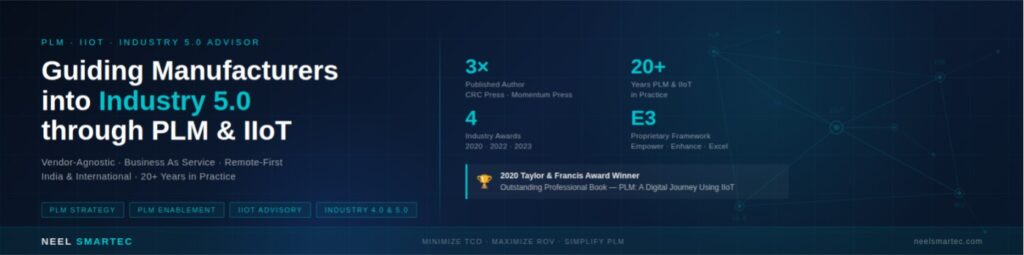
Mr. Uthayan Elangovan is the Founder of Neel SMARTEC, a strategic advisory practice specializing in PLM, IIoT, and Industry 5.0 transformation. With 20+ years of hands-on experience, he provides vendor-agnostic guidance to help manufacturers bridge the gap between engineering discipline and shop-floor reality.
Mr. Uthayan Elangovan is definitive trilogy on industrial digital transformation includes:
Smart Automation to Smart Manufacturing: Industrial Internet of Things (Named one of the “Best Manufacturing Automation books of all time” by BookAuthority).
Product Lifecycle Management (PLM): A Digital Journey Using Industrial Internet of Things (IIoT) (2020 Taylor & Francis Award Winner for Outstanding Professional Book).
Industry 5.0: The Future of the Industrial Economy.
Mr. Uthayan Elangovan is currently authoring the forthcoming Handbook of Product Lifecycle Management (PLM): Fundamentals, Components, and Implementation Best Practices (CRC Press, Taylor & Francis).
Mr. Uthayan Elangovan is Bestowed with the following Licenses & Certifications:
https://www.linkedin.com/in/uthayanelangovan/details/certifications/
Mr. Uthayan Elangovan is Accorded with the following Honors & Awards:
https://www.linkedin.com/in/uthayanelangovan/details/honors/
Mr. Uthayan Elangovan can be contacted at :
LinkedIn | E-mail | Instagram | Blog
About Neel SMARTEC
Neel SMARTEC is a founder-led, vendor-agnostic consulting practice helping manufacturers accelerate Industry 4.0 and Industry 5.0 adoption – through PLM strategy, IIoT integration, and ERP alignment.
Neel SMARTEC founded in 2018 by Mr. Uthayan Elangovan – author of three published books on PLM, IIoT, and Industry 5.0, and winner of the Taylor & Francis Award for Outstanding Professional Book – the practice is built on one principle: you get senior expertise on every engagement, not a delegated junior.
Neel SMARTEC operate as a Business-as-a-Service model — on-demand, remote-first, with no vendor partnerships, no commission incentives, and no bloated overhead. Recommendations are based purely on what fits your business, budget, and goals.
What Neel SMARTEC do:
→ PLM Strategy, Assessment & Implementation (Windchill, OpenBOM etc)
→ ERP Advisory & Implementation (Katana ERP)
→ IIoT Integration & Smart Manufacturing
→ NPD/NPI Process Governance & Automation
→ Vendor-Agnostic Platform Selection
→ Industry–Academia Collaboration & Research
Who Neel SMARTEC work with:
Manufacturers across automotive, electrical, medical, industrial, and electronics sectors — from global OEMs to growth-stage SMEs — in India and internationally.
Neel SMARTEC can be contacted at:
Support | E-mail | Partnership | E-mail (2) | Website | LinkedIn | X | Medium | Pinterest | FaceBook | Phone : +91-95380 47356