
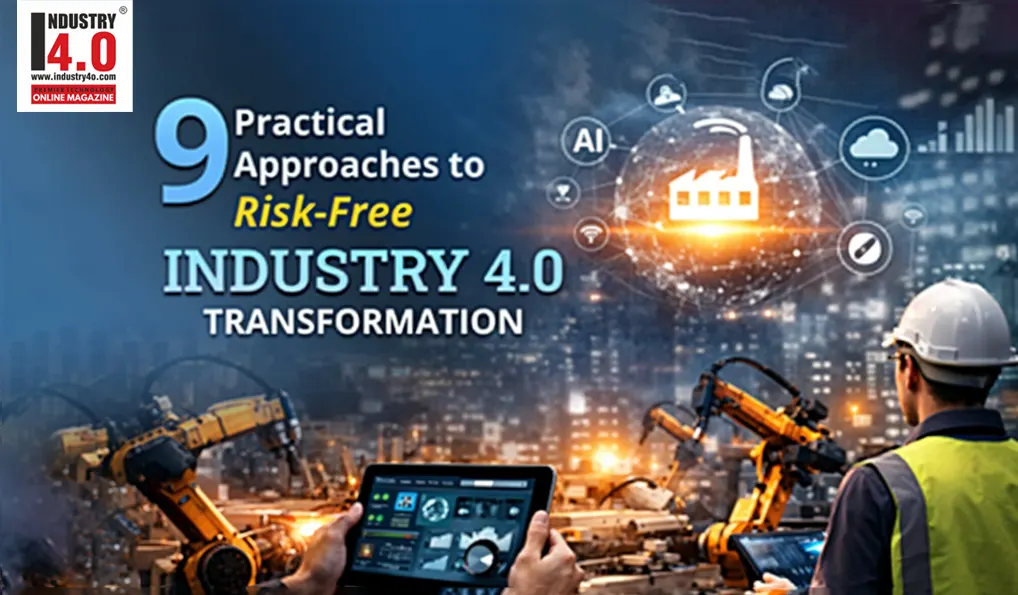
9 Practical Approaches to Risk-Free Industry 4.0 Transformation
Introduction: The Industry 4.0 Paradox on the Shop Floor
Industry 4.0 has reshaped how manufacturing leaders think about competitiveness. Real-time data, connected assets, advanced analytics, and artificial intelligence promise unprecedented visibility and control. Yet, despite growing awareness and investment, many manufacturers find themselves caught in a paradox: the urgency to transform versus the risk of disrupting operations that must run continuously.
Unlike digital-native industries, manufacturing cannot afford trial-and-error at scale. Production schedules, customer commitments, compliance requirements, and workforce dependencies leave little room for experimentation that interrupts output. As a result, some organizations delay transformation entirely, while others rush into technology adoption only to encounter instability, resistance, and fragmented systems.
 The question facing manufacturers today is not whether to adopt smart manufacturing—but how to do it without compromising operational continuity. The answer lies in treating Industry 4.0 not as a single initiative, but as a structured, production-first journey.
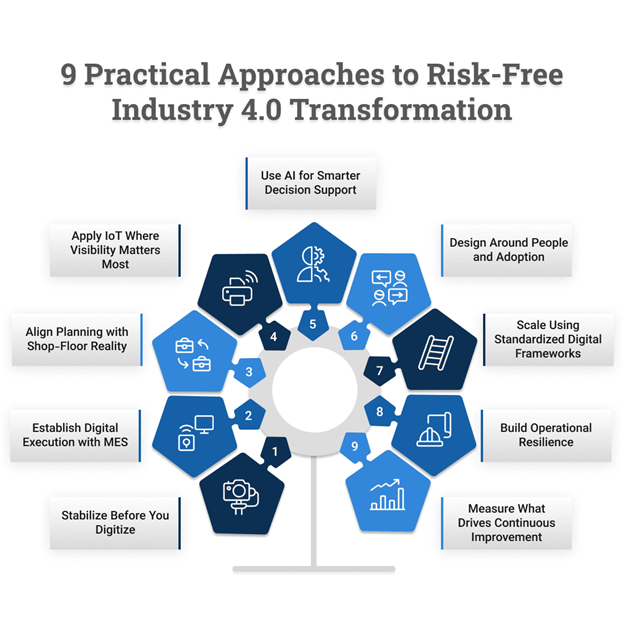
Moving Beyond the “Technology-First” Mindset
A common misconception is that smart manufacturing begins with technology selection. In practice, technology is an enabler—not the driver—of transformation. When digital initiatives are launched without a clear operational foundation, the result is often disconnected tools that add complexity rather than clarity.
A disruption-free Industry 4.0 strategy starts by reframing transformation as an evolution of execution, not a replacement of it. This means strengthening the way production decisions are made, executed, and measured before layering on advanced capabilities.
Manufacturers that succeed typically follow a simple principle: stabilize, digitize, and then optimize.
Establishing Operational Truth Through Digital Execution
 Every smart factory depends on a reliable understanding of what is happening on the shop floor in real time. Without this, even the most advanced analytics or AI models operate on assumptions rather than facts.
This is where Manufacturing Execution Systems (MES) become foundational. An MES does not exist to replace ERP or planning tools—it exists to close the gap between intent and execution. By digitizing production orders, capturing machine and operator data, and standardizing performance metrics, MES creates a shared operational truth across shifts, lines, and departments.
With execution data digitized and contextualized, manufacturers gain:
- Accurate production status without manual reporting
- Consistent definitions of downtime and losses
- Real-time quality and process visibility
- Faster root-cause analysis
Most importantly, MES enables improvement efforts to be based on reality rather than anecdote.
 Synchronizing Planning with Reality Using Integrated MRP
One of the most persistent sources of inefficiency in manufacturing is the disconnect between planning systems and shop-floor conditions. Material plans may look optimal on paper, yet fall apart when machines go down, yields fluctuate, or priorities change.
Integrating MRP and production planning systems with live execution data allows plans to evolve dynamically rather than remain static. When planners have access to current WIP levels, machine availability, and labor capacity, schedules become achievable rather than aspirational.
This synchronization reduces:
- Firefighting and last-minute rescheduling
- Excess inventory buffers
- Missed delivery commitments
- Stress on operators and supervisors
 Smart manufacturing, at its core, is about closing feedback loops between planning and execution.
Applying IoT Selectively for High-Impact Visibility
Industrial IoT is often associated with large-scale sensor deployments, but value comes from selective connectivity, not saturation. Connecting every machine without a clear purpose creates data overload without insight.
High-performing manufacturers start by identifying where visibility gaps hurt the most—typically around bottlenecks, critical assets, or energy-intensive processes. IoT data becomes powerful when combined with execution and contextual data from MES, quality systems, and maintenance logs.
This integration allows manufacturers to:
- Identify micro-stoppages and hidden losses
- Track performance drift over time
- Understand machine behavior under varying conditions
- Improve energy and resource efficiency
By grounding IoT initiatives in operational priorities, organizations avoid unnecessary complexity and focus on measurable gains.

Using AI to Tackle Manufacturing Complexity, Not Replace Expertise
Artificial intelligence is most effective in manufacturing when it addresses problems characterized by variability, scale, and speed—areas where human decision-making alone struggles.
When applied on top of structured, high-quality data, AI can:
- Predict equipment failures before downtime occurs
- Detect quality deviations that exceed rule-based thresholds
- Optimize process parameters across multiple variables
- Highlight patterns invisible to traditional reporting
Crucially, AI should function as a decision-support layer, not an opaque black box. Engineers and operators must understand why a recommendation is made to trust and act on it.
Organizations that succeed with AI focus less on sophistication and more on operational relevance.
Designing Digital Systems Around the Workforce
Technology adoption fails when it ignores how work actually gets done. Operators, supervisors, and maintenance teams operate under time pressure, safety constraints, and accountability for output. Digital tools that add friction—extra screens, manual inputs, or unclear alerts—are quickly bypassed.
A people-centered smart manufacturing approach emphasizes:
- Simple, role-based interfaces
- Visual management instead of dense reports
- Automated data capture wherever possible
- Training embedded into daily workflows
When digital systems reduce manual effort and improve problem resolution speed, adoption follows naturally. Over time, the workforce shifts from reactive firefighting to proactive improvement.
Scaling Smart Manufacturing Without Losing Control
Initial success often creates pressure to scale quickly. However, unstructured expansion can reintroduce chaos, especially across multiple plants or regions.
Effective scaling relies on standardization with flexibility:
- Common data models and KPIs
- Reusable dashboards and workflows
- Modular system architecture
- Clear governance and ownership
Rather than reinventing solutions at each site, manufacturers replicate proven patterns while allowing local adaptation. This approach accelerates deployment while preserving consistency and control.
Building Operational Resilience Through Digital Foundations
Disruptions—whether from supply chain volatility, workforce shortages, or equipment failures—are inevitable. Smart manufacturing strengthens resilience by improving situational awareness and response capability.
Digital foundations enable:
- Early warning indicators instead of post-event reporting
- Faster containment of quality or process issues
- Traceability for audits and compliance
- Scenario-based decision-making
Resilient operations are not defined by the absence of problems, but by the speed and effectiveness of response.
Measuring Impact Beyond Traditional KPIs
Industry 4.0 enables a shift from lagging indicators to leading signals. Instead of asking why targets were missed, manufacturers can see risks forming in real time.
Advanced performance measurement includes:
- Predictive indicators for downtime and quality
- Correlation between process changes and outcomes
- Continuous improvement tracking across shifts and plants
- Transparent performance ownership
Metrics become tools for learning and alignment, not just reporting.
Conclusion: Industry 4.0 Is a Discipline, Not a Disruption
Smart manufacturing is not achieved through a single platform, pilot, or investment cycle. It is built through disciplined progression—strengthening execution, integrating systems, applying intelligence with purpose, and bringing people along.
Manufacturers that succeed with Industry 4.0 respect the realities of production while steadily modernizing how decisions are made and executed. They do not chase technology trends; they build capabilities that compound over time.
Transformation does not need to be disruptive. With the right structure, it becomes predictable, scalable, and sustainable.
Take the Next Step
If your organization is exploring smart manufacturing—whether through MES, MRP, industrial IoT, advanced analytics, or AI-driven optimization—a structured, production-first approach can unlock value without operational risk.
Contact us to learn how smart manufacturing solutions can be designed around your processes, your people, and your production goals—delivering measurable results without disruption.
About the Author :

Mr. Ranjith Kumar Diraviyam
Founder & CEO
Bevywise Networks INC.

Ranjith Kumar Diraviyam is the Founder & CEO of Bevywise Networks, an IoT and Industry 4.0 solutions company that enables manufacturers and enterprises to drive digital transformation. With over two decades of experience in product development and technology leadership, Ranjith brings a unique blend of technical expertise and business vision.
Before founding Bevywise in 2016, Ranjith was spent 14 years at Zoho Corporation, where Ranjith was part of the core team that built Zoho Writer and later led multiple large-scale product initiatives, including a graph database-based authorization system. Ranjith’s deep background in building scalable frameworks and enterprise tools laid the foundation for Bevywise’s product suite.
At Bevywise, Ranjith has bootstrapped the company into a global player, delivering MQTT frameworks, IoT simulators, MES solutions, energy management systems, and smart factory platforms. The company today serves more than 100 customers worldwide, including Johnson & Johnson, Celiker Holding, IITs, and large manufacturing enterprises.
Ranjith is also passionate about education and mentorship, running an academy in Tirunelveli to train and recruit students in IoT and Industry 4.0 technologies. Ranjith‘s vision is to build solutions that connect devices, people, and processes—making data-driven decision-making accessible to businesses of all sizes.
Mr. Ranjith Kumar Diraviyam can be contacted at:
LinkedIn | Email |Mobile : +9198407 87678
About Bevywise Networks Inc.,
 Transforming Industries with IoT, AI, and Smart Solutions
At Bevywise Networks, we lead the charge in digital transformation, offering advanced MQTT-based IoT platforms, smart factory solutions, AI-driven manufacturing enhancements, and innovative educational tools. Our mission is to empower businesses and educational institutions to thrive in the connected era by providing tailored solutions that drive operational efficiency and academic excellence.
Our Expertise: MQTT-based IoT Platform: Enabling seamless, real-time communication across devices with scalable IoT connectivity, enhancing data exchange and system integration. Smart Factory Solutions: Revolutionizing manufacturing with intelligent solutions that optimize production, Traceability, Quality, Data Management, and operational performance.
AI Implementation for Manufacturing: Leveraging artificial intelligence to refine manufacturing processes, improve quality control, and provide plan annalysis and effective planning, driving smarter, more efficient operations.
Educational Tools: Developing state-of-the-art tools for colleges and institutions to enrich learning, streamline administration, and enhance educational outcomes.
Flexible Solutions: We offer both SaaS (Software-as-a-Service) and on-premise models to meet the unique needs of our clients, providing flexibility in deployment and management. Why Choose Bevywise Networks?
Expert Team: Our professionals bring extensive experience in IoT, AI, smart manufacturing, and educational technologies, delivering proven results across various industries.
Customized Approach: We craft bespoke solutions that align with your specific business or educational goals, ensuring optimal performance and impact. Commitment to Excellence: We uphold the highest standards of quality and integrity, continuously innovating to stay at the forefront of technological advancements. We are Open for Collaboration to enhance the world into much productive place.
Bevywise Networks Inc., can be contacted at:
X | FaceBook | YouTube | LinkedIn | E-mail
Also read Bevywise Networks Inc., earlier articles: