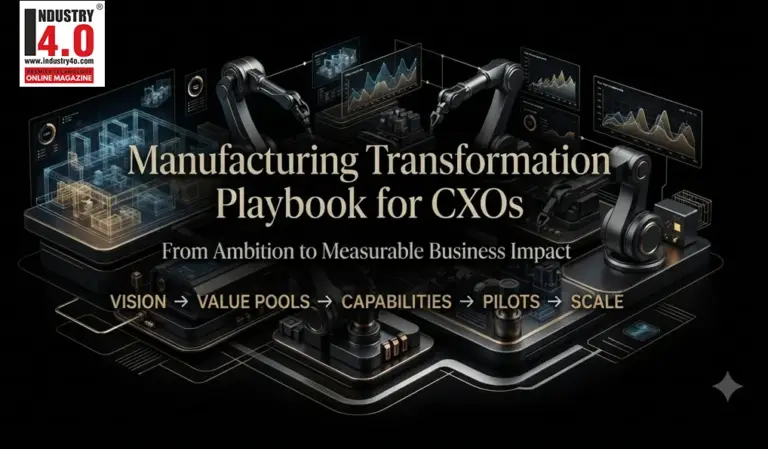

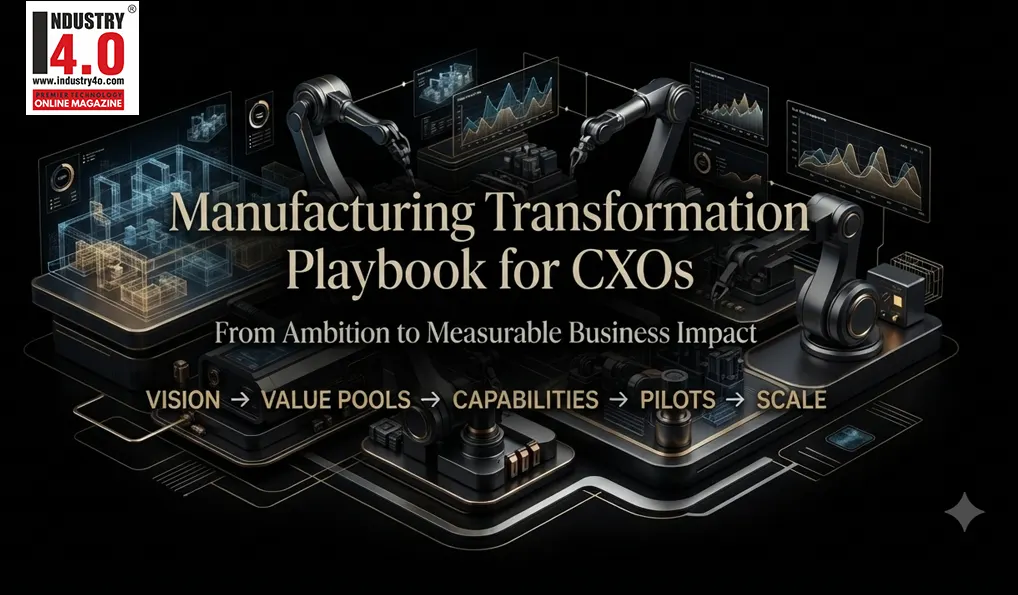
Manufacturing Transformation Playbook for CXOs
A practical framework to move from transformation ambition to measurable business impact
👉 Manufacturing transformation rarely fails because companies lack technology.
It fails because strategy, value, capabilities and execution are not connected.
Many organizations have a long list of initiatives : AI, automation, Industry 4.0, digital twins, MES, analytics, robotics, but struggle to answer a basic CXO question:
 “Which transformation initiatives will materially change our business, and how do we scale them?”
A transformation playbook should make that answer explicit.
My approach is a simple five-stage framework:
VISION → VALUE → CAPABILITIES → PILOTS → SCALE
1️⃣ VISION : Define the transformation ambition
Start with the business, not the technology.
✅ Define where the organization needs to be in 3–5 years across:
- Growth
- Cost and productivity
- Quality
- Customer responsiveness
- Resilience
- Sustainability
Then translate the ambition into a small number of strategic outcomes.
For example:
“Improve manufacturing productivity by 20% while increasing flexibility and reducing quality losses.”
🔖 This is more useful than:
“Become an AI-powered smart factory.”
Technology is an enabler. The business outcome is the destination.
2️⃣ VALUE POOLS : Find where transformation can pay
Not every process deserves a transformation program.
✅ Map the value pools across the manufacturing value chain:
Demand → Planning → Procurement → Production → Quality → Maintenance → Logistics → Customer
Then identify the biggest opportunities.
Typical value pools include:
⚙️ Productivity Reduce losses, downtime and cycle time.
🧪 Quality Reduce defects, scrap and rework.
📦 Working Capital Improve inventory and asset utilization.
🚚 Service Improve OTIF and responsiveness.
🔧 Reliability Reduce unplanned downtime.
🌱 Sustainability Reduce energy, waste and resource intensity.
🔖 The key question:
Where can digital and AI create measurable economic value?
3️⃣ CAPABILITIES : Build what the transformation needs
This is where many transformation programs underestimate the challenge.
✅ A pilot can succeed with exceptional people and manual workarounds.
Scaling cannot.
Assess the capabilities required across:
▪️Technology
Cloud • Data • AI • OT/IT integration • Cybersecurity
▪️Operations
Process standards • Lean • Automation • Digital workflows
▪️People
Skills • Leadership • Change management • Digital literacy
▪️Data
Quality • Governance • Architecture • Accessibility
▪️Organization
Product teams • Ownership • Decision rights • Transformation governance
🔖 The objective is not to build technology for its own sake.
Build the capabilities that make the strategic outcomes repeatable.
4️⃣ PILOTS : Prove value, not technology
✅ A good pilot should answer three questions:
 Can it work? Does it create measurable value? Can we scale it?
Avoid pilots selected because the technology is exciting.
Instead, select opportunities with:
High business value + Feasible data + Strong ownership + Scalable architecture
Examples:
- AI-assisted quality investigation
- Predictive maintenance
- Production scheduling optimization
- Energy optimization
- Computer vision inspection
- GenAI engineering or maintenance Copilots
🔖 Every pilot should have a baseline, target KPI, business owner and scale hypothesis.
5️⃣ SCALE : Move from “one factory” to enterprise capability
This is where transformation creates, or destroys value.
✅ A successful pilot does not automatically become a scalable solution.
Before scaling, ask:
Is the process standardized? Is the data reliable? Can the technology integrate with existing systems? Are people ready? Is the business case repeatable? Can governance and cybersecurity scale?
Then establish a repeatable model:
Prove → Standardize → Industrialize → Replicate → Optimize
🔖 The goal is not hundreds of disconnected digital projects.
The goal is a transformation system that continuously creates value.
See content credentials
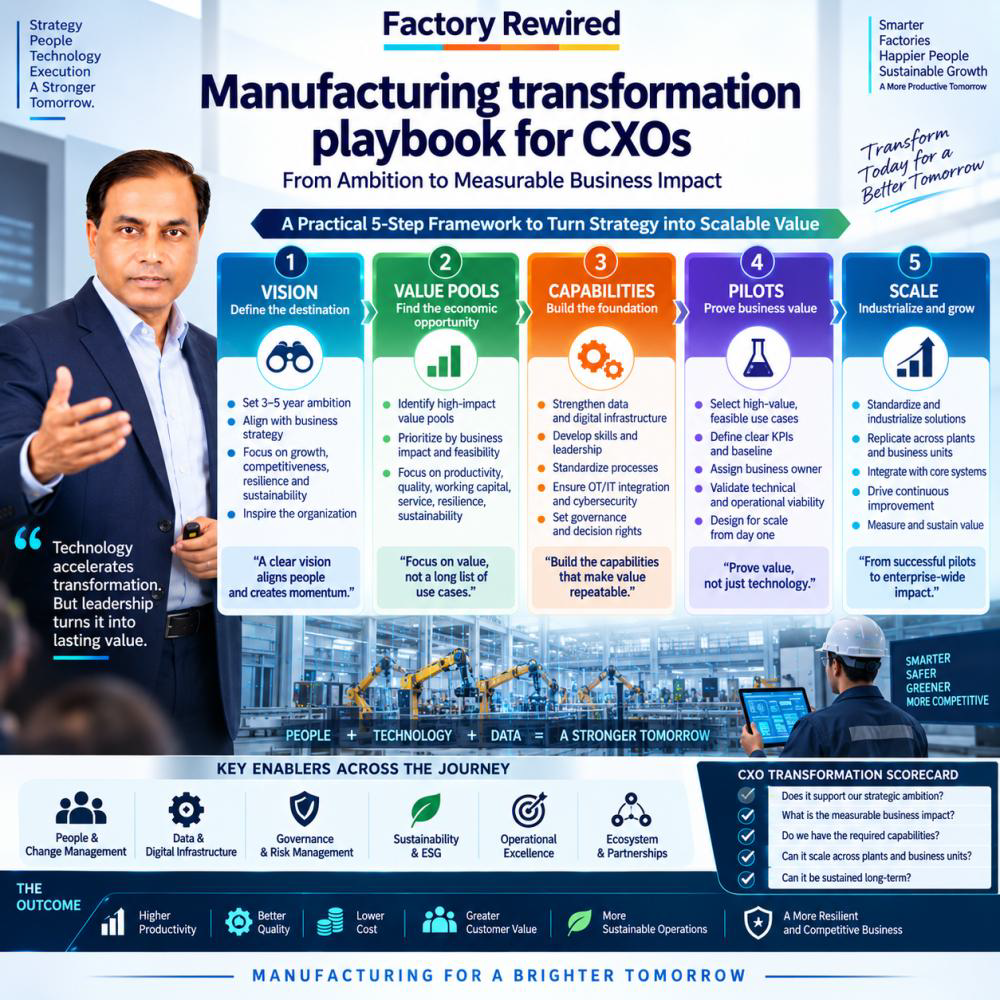
🎯 The CXO Transformation Scorecard
I would evaluate every major initiative across five dimensions:
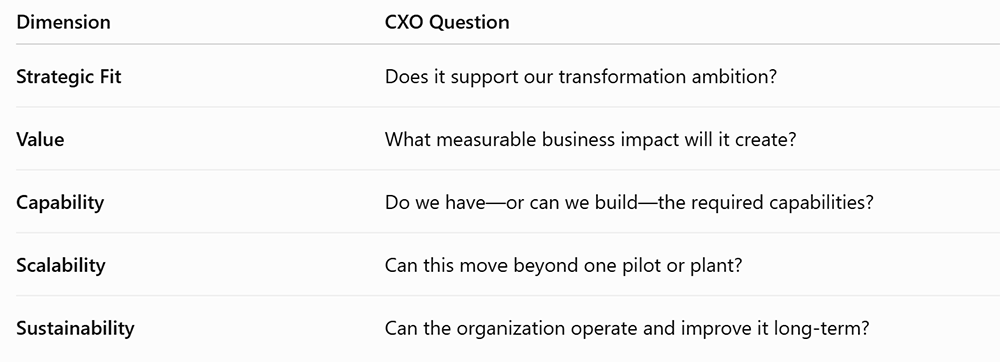 An initiative that scores well technically but poorly on value or scalability should not become a transformation priority.
🚨 What CXOs Should Stop Doing
❌ Launching technology-first pilots without a business owner
❌ Measuring transformation by the number of use cases
❌ Treating every plant as a separate digital experiment
❌ Scaling pilots before standardizing processes and data
❌ Assuming technology adoption equals business transformation
 ✅ Instead:
- Start with the value.
- Design the capability.
- Prove the use case.
- Industrialize the solution.
- Scale what works.
☸️ The Transformation Flywheel
✅ The strongest manufacturing organizations create a continuous loop:
VISION ↓
VALUE POOLS ↓
CAPABILITIES ↓
PILOTS ↓
SCALE ↓
MEASURE VALUE ↓
REFINE THE VISION
🔖 This turns transformation from a one-time program into an organizational capability.
🚀 The CXO Takeaway
Manufacturing transformation is not a technology roadmap.
🔖 It is a business transformation system.
The real test is not:
“How many digital initiatives have we launched?”
It is:
“How much measurable business value have we created, and how consistently can we reproduce it?”
👉 The companies that answer that question clearly will have a significant advantage as AI, automation and Industry 5.0 reshape manufacturing.
Transform less for technology. Transform more for value.
🎤 What is the biggest transformation challenge in your organization today, defining the vision, identifying value pools, building capabilities, proving pilots, or scaling across plants?
🗨️ I’d be interested to hear how other CXOs and manufacturing leaders are approaching it.
 About the Author :
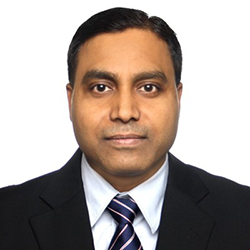 Mr. Gulshan Kumar (Saini)
Senior Director
Samsung Electronics

Mr. Gulshan Kumar Saini is a manufacturing transformation leader, experienced in scaling plants across India, Korea, USA/Mexico, Russia & Vietnam.
Mr. Gulshan Kumar Saini is a global manufacturing, operations excellence, and smart factory transformation leader with over 30 years of leadership experience at Samsung Electronics, spanning senior roles across India, Vietnam, Korea, Russia, and the United States.
Mr. Gulshan Kumar Saini currently serves as Senior Director – Smart Factory at Samsung Electronics India, where Mr. Gulshan Kumar Saini spearheads enterprise-wide digital transformation initiatives across advanced manufacturing lines for consumer electronics and durables.
Mr. Gulshan Kumar Saini leads the deployment of AI-driven manufacturing systems, industrial robotics, IIoT platforms, machine vision, advanced analytics, and Digital Twin technologies to drive next-generation factory performance.
Mr. Gulshan Kumar Saini is widely recognized for delivering large-scale automation, step- change productivity improvements, and sustainable cost, quality, and efficiency gains in high-volume, high-complexity manufacturing environments. Across his career, Mr. Gulshan Kumar Saini has successfully led global NPI programs, greenfield and brownfield plant setups, capacity expansions, lean transformations, and multi-country manufacturing excellence programs.
Mr. Gulshan Kumar Saini is a PMP-certified professional and Six Sigma Black Belt, Mr. Gulshan Kumar Saini also holds an MBA in FinTech from BITS Pilani, combining strong digital, financial, and operational acumen to translate technology into measurable business outcomes.
Mr. Gulshan Kumar Saini is Bestowed with the following Licenses & Certifications:
https://www.linkedin.com/in/gulshan-kumar-saini/details/certifications/
Mr. Gulshan Kumar Saini is Accorded with the following Honors & Awards:
https://www.linkedin.com/in/gulshan-kumar-saini/details/honors/
Mr. Gulshan Kumar Saini can be contacted at:
Linked In | E-mail (1) | E-mail (2)