

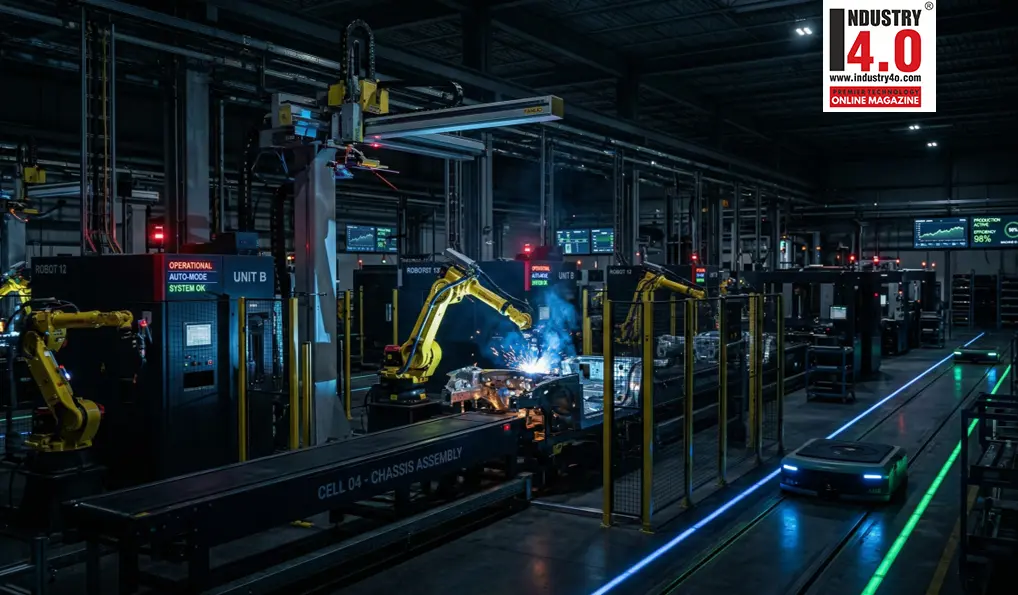
Lights-Out Manufacturing: Reality, Myth, and Leadership Implications
For decades, manufacturing leaders have pursued a simple dream: a factory that never stops. A facility where machines run 24/7, productivity never sleeps, and operations continue even when the lights are off.
📌 Today, with robotics, AI, and autonomous systems advancing rapidly, lights-out manufacturing is no longer science fiction. It’s technically possible.
 ➡️ But here’s the real question.
👉 If machines can run the factory… who runs the decisions?
Because the true challenge of lights-out manufacturing is not turning off the lights.
🔹 It’s redesigning leadership, operations, and decision-making for a world where machines operate independently, but strategy, governance, and resilience still depend on human judgment.
The conversation is no longer about automation.
👉 It’s about how far autonomy should go, and what role leadership must play in shaping it.
🚩Lights-Out Manufacturing Isn’t Sci-Fi, It’s a Strategic Frontier
🔹 Subtitle: Separating operational truth from hype in autonomous production.
• What it is: Highly automated production environments where human presence is minimal or nonexistent, even capable of running in the dark.
• Why it matters now: IoT, AI, advanced robotics, and industrial automation are converging to make autonomous operations technically feasible today in high-volume, standardized processes.
• Common allure: Round-the-clock operations, fewer human errors, major OEE and cost gains.
➡️ So what? Lights-out manufacturing isn’t futuristic fantasy, it’s a pragmatic competitive strategy that leaders must assess now.’
 🚩 The Reality: Lights-Out Exists, But Not Everywhere
🔹 Subtitle: Autonomous factories are real, but full automation remains the exception, not the rule.
• Many facilities automate discrete cells or processes, especially in high-volume sectors.
• Examples like FANUC’s robot-building factory show true lights-out operation at scale.
• Most implementations today are partial or phased, humans still play key roles in maintenance, setup, exception handling, and quality decisions.
➡️ So what? Lights-out is within reach in controlled contexts, but industrywide deployment still requires planning, skill, and system integration.
🚩The Myth: “No People, No Problems”
🔹 Subtitle: Lights-Out doesn’t eliminate humans, it shifts where human
value matters.
• Automation doesn’t mean zero human involvement; remote supervision, programming oversight, and maintenance decision roles remain essential.
• Fully flexible automated systems are still constrained by design complexity and product variation, many tasks defy full automation.
• Misinterpreting “lights-out” as labor replacement risks underestimating investment in robot programming, integration, cybersecurity, and predictive maintenance systems.
➡️ So what? The myth of “no humans needed” distracts from the real leadership challenge of augmenting human capability with automation.
 🚩 Leadership Imperatives: What Separates Winners from the Rest
🔹 Subtitle: Lights-Out isn’t about robots, it’s about decisions, culture, and capability.
• Strategic alignment: Leadership must tie automation goals to enterprise outcomes, productivity, quality, safety, and resilience.
• Workforce transformation: Reskilling and upskilling become mission-critical, from maintenance analysts to automation programmers.
• Governance and risk management: Lights-out operations amplify cybersecurity, standards, and compliance needs.
• Phased implementation over “big bang”: Gradual scaling reduces risk and improves adoption.
➡️ So what? Leaders must integrate technology with people, process, and governance, or automation fails to deliver on its promises.
🚩 The Payoff: Lights-Out Isn’t a Goal, It’s a Competitive Advantage Lever
🔹 Subtitle: When done right, lights-out manufacturing rewires the cost, quality, and growth equation.
• Productivity & throughput: Autonomous cells and production lines run 24/7, boosting capacity without linear cost increases.
• Quality & consistency: Reduced variability from machines yields tighter specs and better yields.
• Safety & energy gains: Fewer humans in hazardous environments, with potential energy savings from optimized operations.
• But risk & complexity are real, success requires balanced investments and clear operational ownership.
➡️ So what? Lights-out manufacturing is not just automation, it’s a strate
 📌Core Takeaway
👉 Lights-Out Manufacturing should be seen not as a “lights off” end state, but as a disciplined journey where technology, people, and leadership converge to create enterprise-scale operational advantage.
➡️ The question is no longer: “Can we automate this process?”
➡️ The better question is: “Are we redesigning our operating model to thrive in an autonomous environment?”
Because in the coming decade, the competitive gap won’t be between automated and non-automated factories.
It will be between organizations that lead autonomy strategically, and those that implement it tactically.
📌 What’s your view?
👉 Is lights-out a cost play in your organization, or a strategic capability
shift?
It is a leadership discipline  About the Author :
 Mr. Gulshan Kumar Saini
Senior Director
Samsung Electronics

Mr. Gulshan Kumar Saini is a manufacturing transformation leader, experienced in scaling plants across India, Korea, USA/Mexico, Russia & Vietnam.
Mr. Gulshan Kumar Saini is a global manufacturing, operations excellence, and smart factory transformation leader with over 30 years of leadership experience at Samsung Electronics, spanning senior roles across India, Vietnam, Korea, Russia, and the United States.
Mr. Gulshan Kumar Saini currently serves as Senior Director – Smart Factory at Samsung Electronics India, where Mr. Gulshan Kumar Saini spearheads enterprise-wide digital transformation initiatives across advanced manufacturing lines for consumer electronics and durables.
Mr. Gulshan Kumar Saini leads the deployment of AI-driven manufacturing systems, industrial robotics, IIoT platforms, machine vision, advanced analytics, and Digital Twin technologies to drive next-generation factory performance.
Mr. Gulshan Kumar Saini is widely recognized for delivering large-scale automation, step- change productivity improvements, and sustainable cost, quality, and efficiency gains in high-volume, high-complexity manufacturing environments. Across his career, Mr. Gulshan Kumar Saini has successfully led global NPI programs, greenfield and brownfield plant setups, capacity expansions, lean transformations, and multi-country manufacturing excellence programs.
Mr. Gulshan Kumar Saini is a PMP-certified professional and Six Sigma Black Belt, Mr. Gulshan Kumar Saini also holds an MBA in FinTech from BITS Pilani, combining strong digital, financial, and operational acumen to translate technology into measurable business outcomes.
Mr. Gulshan Kumar Saini is Bestowed with the following Licenses & Certifications:
https://www.linkedin.com/in/gulshan-kumar-saini/details/certifications/
Mr. Gulshan Kumar Saini is Accorded with the following Honors & Awards:
https://www.linkedin.com/in/gulshan-kumar-saini/details/honors/
Mr. Gulshan Kumar Saini can be contacted at:
Linked In | E-mail (1) | E-mail (2)
Also read Mr. Gulshan Kumar Saini‘s earlier articles:
 |
 |
 |
 |
 |