
How AI Is Reshaping the Consumer Enterprise: From Supply Chains to Customer Experience
Artificial intelligence has moved well beyond experimentation in the consumer industry. Organisations are already using AI to improve demand forecasting, personalise customer interactions, accelerate product development, optimise supply chains and help employees make better-informed decisions.

Generative AI has accelerated this shift further. Capabilities that once required specialised technology teams are becoming accessible acros functions, from marketing and product teams to operations and customer service.
Yet there is an important distinction between adopting AI and becoming an AI-native enterprise. An organisation can deploy multiple AI tools and still operate largely as it did before. Processes may remain fragmented, data may remain locked in disconnected systems, and AI may simply become another layer added to an existing operating model.
For consumer enterprises, the larger opportunity is to rethink how intelligence can be embedded across the business—from understanding changing customer demand and developing products to planning supply, managing operations and creating more relevant experiences.
THE CONSUMER ENTERPRISE IS BECOMING MORE COMPLEX
 Consumer businesses operate at the intersection of rapidly changing customer expectations, shorter product lifecycles, volatile supply conditions, expanding digital channels and pressure to innovate while maintaining operational discipline.
AI can contribute across each of these areas, but individual use cases rarely transform an enterprise on their own. A recommendation engine can improve personalisation. Predictive models can improve forecasting. Generative AI can accelerate content creation. AI-assisted analytics can help teams interpret information faster.
The greater opportunity lies in connecting these capabilities across the enterprise and ensuring that intelligence informs real busines decisions.
FROM ISOLATED USE CASES TO AN AI-NATIVE OPERATING MODEL
The early enterprise AI conversation often began with a simple question: Where can we apply AI? Consumer organisations are increasingly asking a broader question: How should we operate when intelligent capabilities are available throughout the business?
That shift changes the focus from individual tools to the operating model. Customer signals, product information, supply-chain events, commercial data and market intelligence can become inputs to a more continuous cycle of sensing, learning and responding.
The objective is not automation for its own sake. It is to create an organisation that can make better decisions, respond faster and coordinate intelligence across functions.
SUPPLY CHAINS ARE A MAJOR OPPORTUNITY
Few areas demonstrate the potential of enterprise AI more clearly than the consumer supply chain. Organisations must balance demand, inventory, production capacity, transportation, supplier performance and customer expectations, often while responding to unexpected disruption.
AI can support a move toward more dynamic planning. Demand signals can be analysed continuously, potential disruptions can be identified earlier, and organisations can explore scenarios before making operational decisions.
The critical point is that an accurate prediction creates value only when it influences an action. AI insight must therefore be connected to business processes and operational execution.
CUSTOMER EXPERIENCE IS MOVING BEYOND PERSONALISATION
Personalisation has already become familiar across digital commerce. Generative AI introduces a broader possibility: using context, customer signals and organisational knowledge to support more relevant interactions and empower employees to respond more effectively.
This can move customer experience from reactive personalisation toward more contextual engagement. At the same time, the importance of trust increases. Customers need confidence that their information is handled responsibly and that AI-enabled experiences operate within appropriate boundaries.

Responsible AI is therefore not simply a technology or compliance consideration. It increasingly forms part of the customer experience itself.
PRODUCT INNOVATION CAN BECOME MORE CONNECTED TO MARKET SIGNALS
Consumer product development depends on understanding changing needs, market behaviour, operational constraints and commercial opportunities. AI can help teams bring together larger volumes of information and explore patterns or scenarios more quickly.
The opportunity is particularly significant when product, customer and supply-chain intelligence are connected rather than treated as separate streams. This can help organisations move from periodic analysis toward a more continuous understanding of the market.
AI-NATIVE DOES NOT MEAN HUMAN-FREE
Becoming AI-native should not be confused with removing people from the operating model. The more useful perspective is the combination of human judgement, organisational knowledge, data and AI capabilities.’
Employees can use AI to analyse information, explore alternatives, automate repetitive activities and support decision-making. Leaders, meanwhile, need to determine where AI can create genuine business value and where human judgement should remain central.
RESPONSIBLE AI MUST SCALE WITH ADOPTION
As AI becomes more deeply embedded in consumer operations, governance becomes increasingly important. Questions around privacy, security, bias, accountability, transparency and responsible use cannot remain afterthoughts.
Consumer enterprises interact directly with customers and employees, making trust particularly important. The goal should therefore not simply be to deploy AI faster, but to scale AI in ways that are responsible, explainable where appropriate and aligned with business and customer expectations.
THE NEXT COMPETITIVE ADVANTAGE MAY BE ORGANISATIONAL
AI capabilities are becoming increasingly accessible. This raises an important strategic question: if competitors can access similar model and technologies, where will sustainable advantage come from?
Part of the answer may lie in the organisation itself—the combination of proprietary data, strong processes, domain expertise, integrated technology, effective governance and human-AI collaboration.
The competitive advantage may therefore shift from simply having AI to knowing how to operate effectively with AI.

MOVING THE CONVERSATION FORWARD
The enterprise AI conversation has progressed from “Should we use AI?” to “Where can we use AI?” The next question is increasingly: What would our organisation look like if AI were embedded into the way we operate?
For consumer enterprises, becoming AI-native is unlikely to be a single technology implementation or a one-time transformation programme. It is better understood as an ongoing evolution across strategy, data, technology, operations, people and customer experience.
Organisations that approach AI in this broader way may be better positioned not merely to adopt the next generation of technology, but to reshape how they create value.
A RELEVANT RESOURCE
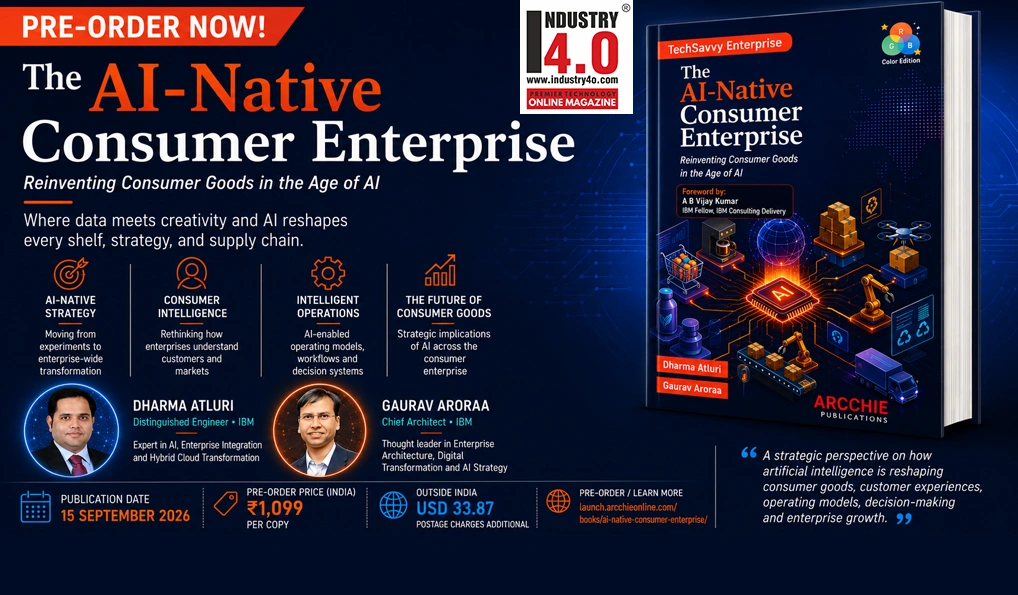
These themes are explored in greater depth in The AI-Native Consumer Enterprise: Reinventing Consumer Goods in the Age of AI, authored by Dharma Atluri and Gaurav Aroraa. The book examines the intersection of Generative AI, consumer businesses, product innovation, supply chains, customer engagement and AI-native ways of operating. The book is scheduled for release on 15 September 2026.
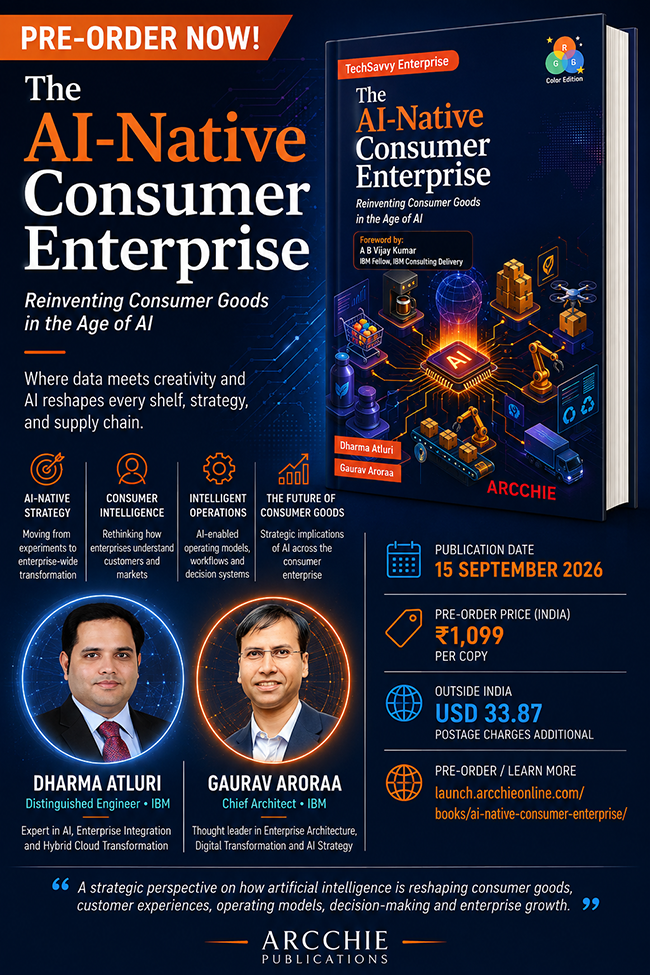
Pre-Order:
https://launch.arcchieonline.c
Dharma Atluri and Gaurav Aroraa explore the intersection of technology, artificial intelligence and consumer enterprise transformation, with a focus on translating emerging technologies into practical business outcomes.
About the Authors :

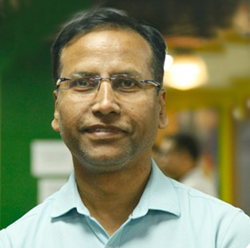
Dr. Gaurav Aroraa
Lead Solutions Architect, IBM

Dr. Gaurav Aroraa is passionate about shaping the future of technology, leadership, and innovation, with nearly three decades of experience in AI, Security, strategic transformation, and many more.
Dr. Gaurav Aroraa journey blends innovation, mentorship, and thought leadership to help individuals and organisations adapt, thrive, and lead in an ever-changing world.
Dr. Gaurav Aroraa with a career spanning global technology leadership, innovation at scale, and over 100 published books,his focus is on translating complex ideas into practical, future-ready solutions.
Dr. Gaurav Aroraa as a TEDx speaker, IBM Senior Inventor, and strategist, he work at the intersection of technology and leadership guiding organisations toward sustainable growth and impactful change.
Dr. Gaurav Aroraa mission is to inspire future leaders and drive innovation by merging purpose, vision, and action.
Dr. Gaurav Aroraa is committed to building a legacy of leadership that not only delivers organisational success but shapes the future of technology, ethics, and human empowerment.
Through collaboration, mentorship, and strategic insight, Dr. Gaurav Aroraa aim to create a world where innovation is guided by clarity, ethics, and lasting impact.
Dr. Gaurav Aroraa is a Regional Mentor of Change – AIM–ATL & Member of IEEE (101113086) & Computer Society of India (I1500851)
Dr. Gaurav Aroraa is Bestowed with the following Licenses & Certifications :
https://www.linkedin.com/in/dr
Dr. Gaurav Aroraa is Accorded with the following Honors & Awards :
https://www.linkedin.com/in/dr
Dr. Gaurav Aroraa can be contacted at :
LinkedIn | Blog | E-mail (1) | E-mail (2) | X | Orcid | Google Scholar
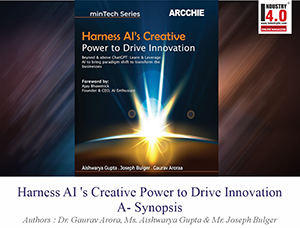
Also read Dr. Gaurav Aroraa Earlier Articles :



Mr. Dharma Teja Atluri is a Global Chief Technology Officer – SAP Manage Services, RISE with SAP & ManagePlus, Inventor and Artificial Intelligence / Machine Levangelist at IBM. He has more than 19 years of experience working in advanced analytics with both SAP and non-SAP product lines. He has provided strategic direction to clients globally regarding the adoption of SAP and non-SAP advanced analytics products for artificial intelligence/machine learning operationalization, data management, information management, and analytics. He has also carried out multiple platform comparison initiatives for reporting, ETL, data warehousing, and data science products across IBM, Microsoft Azure, Google, Amazon Web Services, and SAP. He has led the SAP analytics (reporting and enterprise information management) portfolio for IBM India, and designed client architectures for analytics with SAP and IBM capabilities. Dharma is an IBM master certified data scientist, architect, and technical specialist, and also an IBM thought leader certified consultant. His most recent SAP Data Intelligence sprint was featured for global consumption by clients and nominated for SAP Innovation Awards.
Mr. Dharma Teja Atluri is currently leading the RISE with SAP as a Chief Architect enabling Technical Managed Services on IBM Cloud along with Other Hyperscalers to support the clients on their journey towards Hybrid Cloud with Automation, Data and Intelligent Workflows driven by Artificial Intelligence (AI).
Mr. Dharma Teja Atluri is the Chapter Lead & Co-Chair of TEC India & Member of IBM Academy of Technology.
Mr. Dharma Teja Atluri is bestowed with the following License & Certifications :
https://www.linkedin.com/in/dh
Mr. Dharma Teja Atluri has received following Honors & Awards :
https://www.linkedin.com/in/dh
https://www.credly.com/users/dharma-teja-atluri/badges
Mr. Dharma Teja Atluri can be Contacted at :
Email | LinkedIn | Twitter | Skype : darma.teja
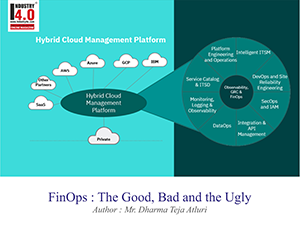
Also read Mr. Dharma Teja Atluri’s earlier articles:


About the Authors
Dr. Gaurav :
https://industry4o.com/2026/07
Dharma Atluri :
https://industry4o.com/2023/12