
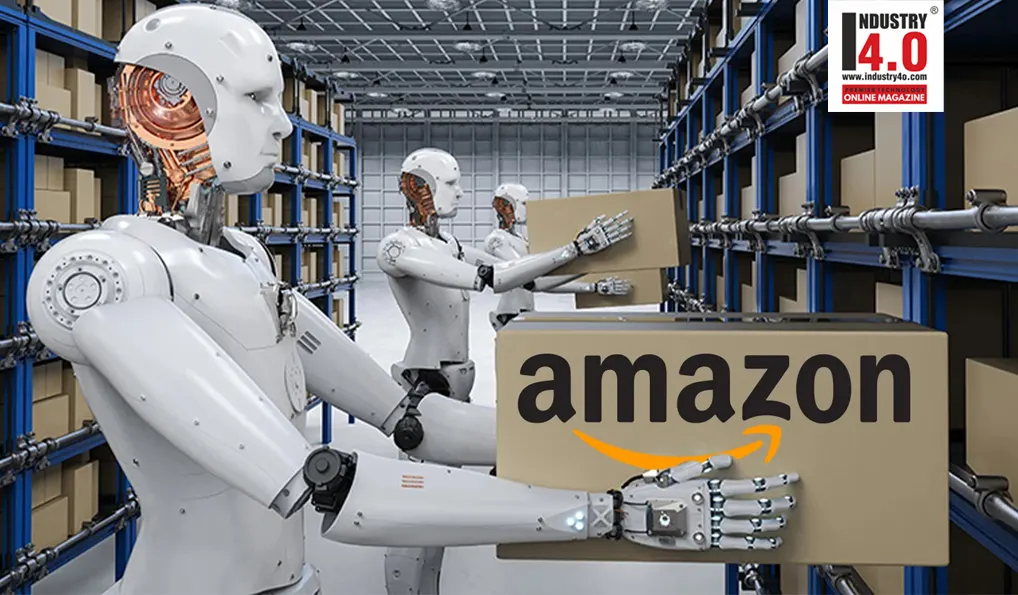
AI Robots have transformed Amazon warehouses and enablement centers. They never tire, no strikes, no wage increase, just work 24×7 …
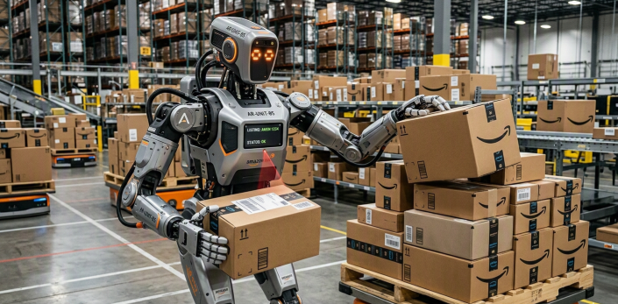
What are Vulcan, Hercules, Proteus, Blue Jay, Sequoia, Titan, Cardinal, Sparrow, and Robin? They are the names of nine types of 1,000,000 specialized AI robots deployed at Amazon warehouses.
Amazon AI robot systems use several emerging technologies such as machine learning, reinforcement learning, neural networks, computer vision, LiDAR, Multi-Agent Coordination, Predictive Analytics, Edge AI, Sensor Fusion, Optimization Algorithms, Autonomous Navigation, and advanced algorithms. These systems are integrated and managed by a central network console.
 Why has Amazon introduced robots? The organization claims that it has invested or plans to invest $200 billion+ by 2027. The fleet of new-generation AI robots provides high precision, adaptability, workplace safety, and unprecedented efficiency.
At the same time, the average number of human employees in a certain fulfilment center has reduced by 25%. By 2033, Amazon will automate 75% of its operations and remove the need to hire 600,000 US workers.
So, will an AI robot remove all human workers? No. New jobs and roles requiring different skill sets will be needed. This article examines the technical details and specs of AI Robot systems deployed in Amazon warehouses.
What functions do AI Robots perform at Amazon warehouses?
AI robots at Amazon warehouses perform specific tasks and functions. These tasks are not interchangeable, and one robot type cannot do the work that another type does. However, they do help each other and are part of the warehouse systems.
Figure 2 shows the functions that the robots perform.
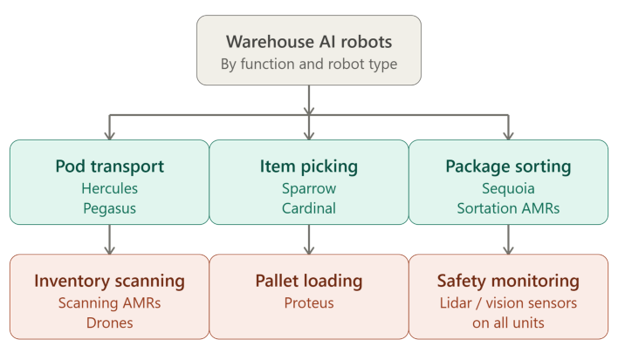
Figure 2. Functions and tasks done by Amazon AI robots (Shashi Kadapa with Claude AI)
Types of AI Robots at Amazon
Amazon has a diverse fleet of AI-powered warehouse robots, each designed for a specific role in fulfillment, sorting, transportation, and inventory management. The following table presents details of these robots.
Table 1. Types of AI robots at Amazon and their capabilities
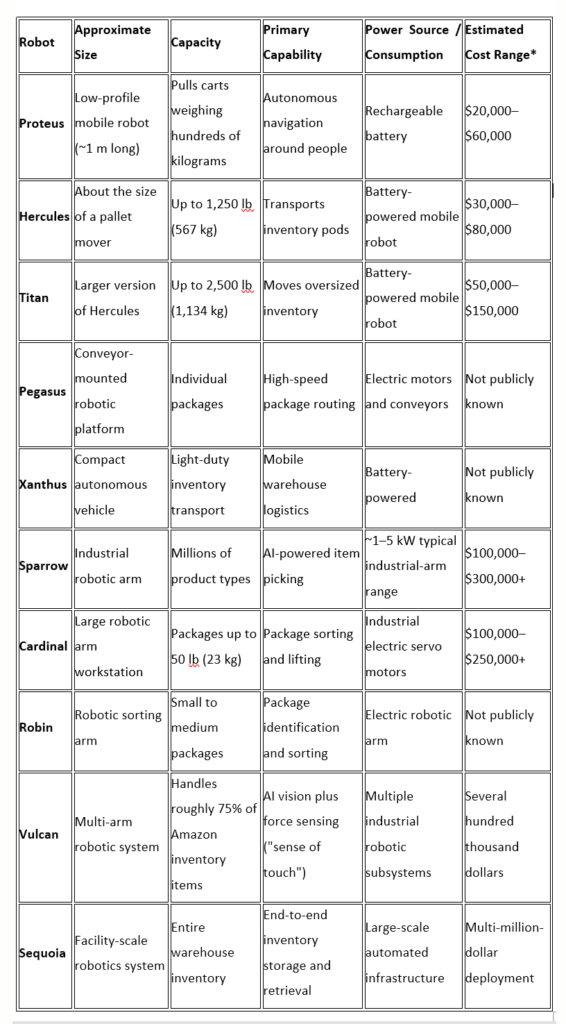
Vulcan is the most sophisticated warehouse robot because it combines: computer vision, machine learning, force-feedback sensors, adaptive grasping, and continuous learning from physical interactions.
Sequoia is not a single robot but an integrated robotics platform. It combines mobile robots, gantries, robotic arms, AI inventory systems, and ergonomic workstations. It can store and identify inventory up to 75% faster than previous systems.
 Amazon AI Robots Architecture Layers
Amazon‘s robot ecosystem is created as a layered AI architecture. These layers allow for perception, decision-making, coordination, and execution systems to work together in real time. It uses a Dual-Loop Framework that is integrated with Edge Autonomy and Cloud Training. The objective is to transform raw sensor data into learned and coordinated physical actions.
The following figure illustrates the Amazon AI robot architecture layers.
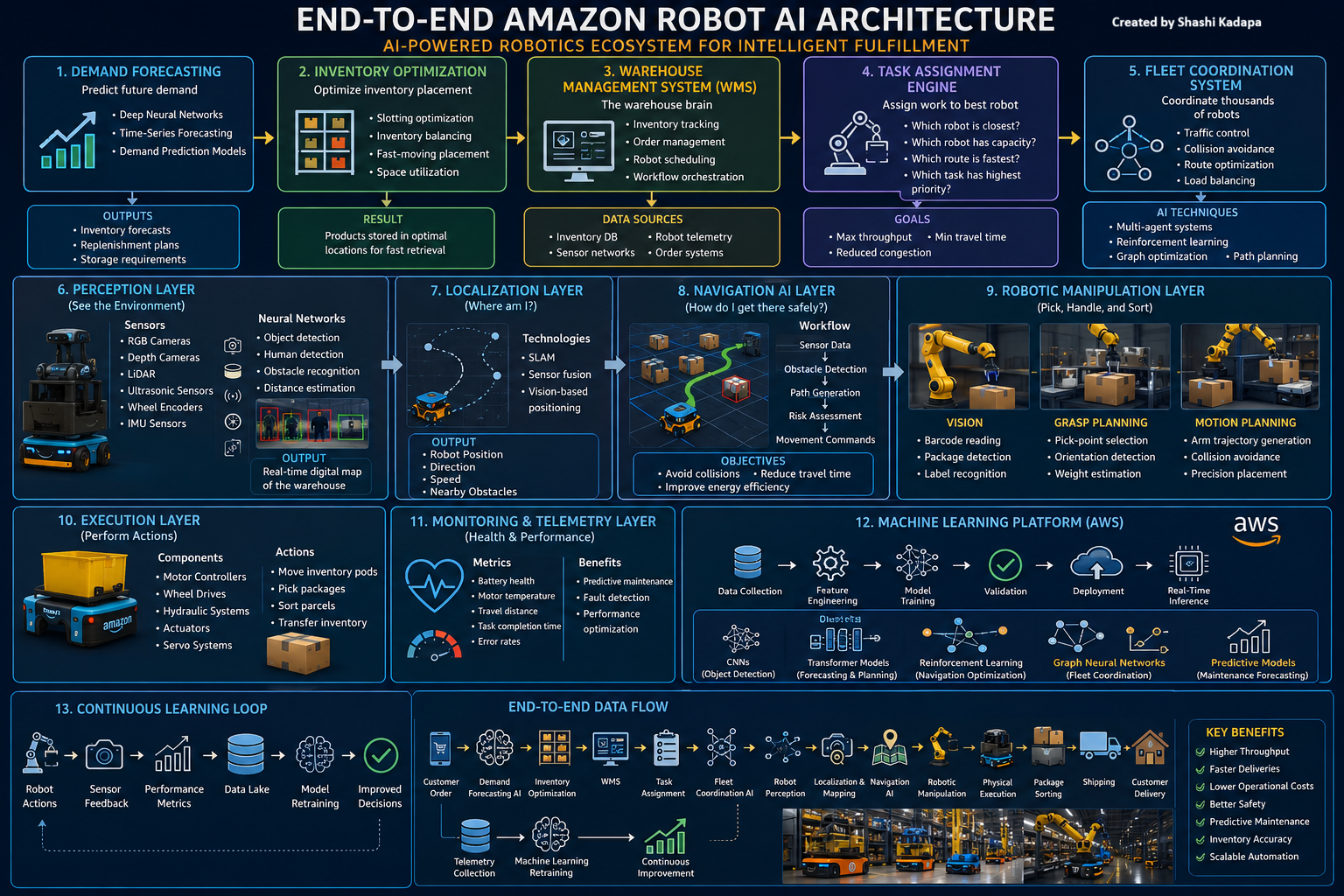 Figure 3. Amazon AI Robot Architecture Layers (Shashi Kadapa with Claude AI)
How are Amazon AI bots controlled and programmed?
Amazon operates one of the world’s largest fleets of warehouse robots through Amazon and its robotics division, Amazon Robotics. These robots are not controlled individually by humans. They operate through a combination of AI, centralized fleet management, real-time optimization software, sensors, and cloud-based computing.
The following graphic presents the detailed workflow of the 13 components:
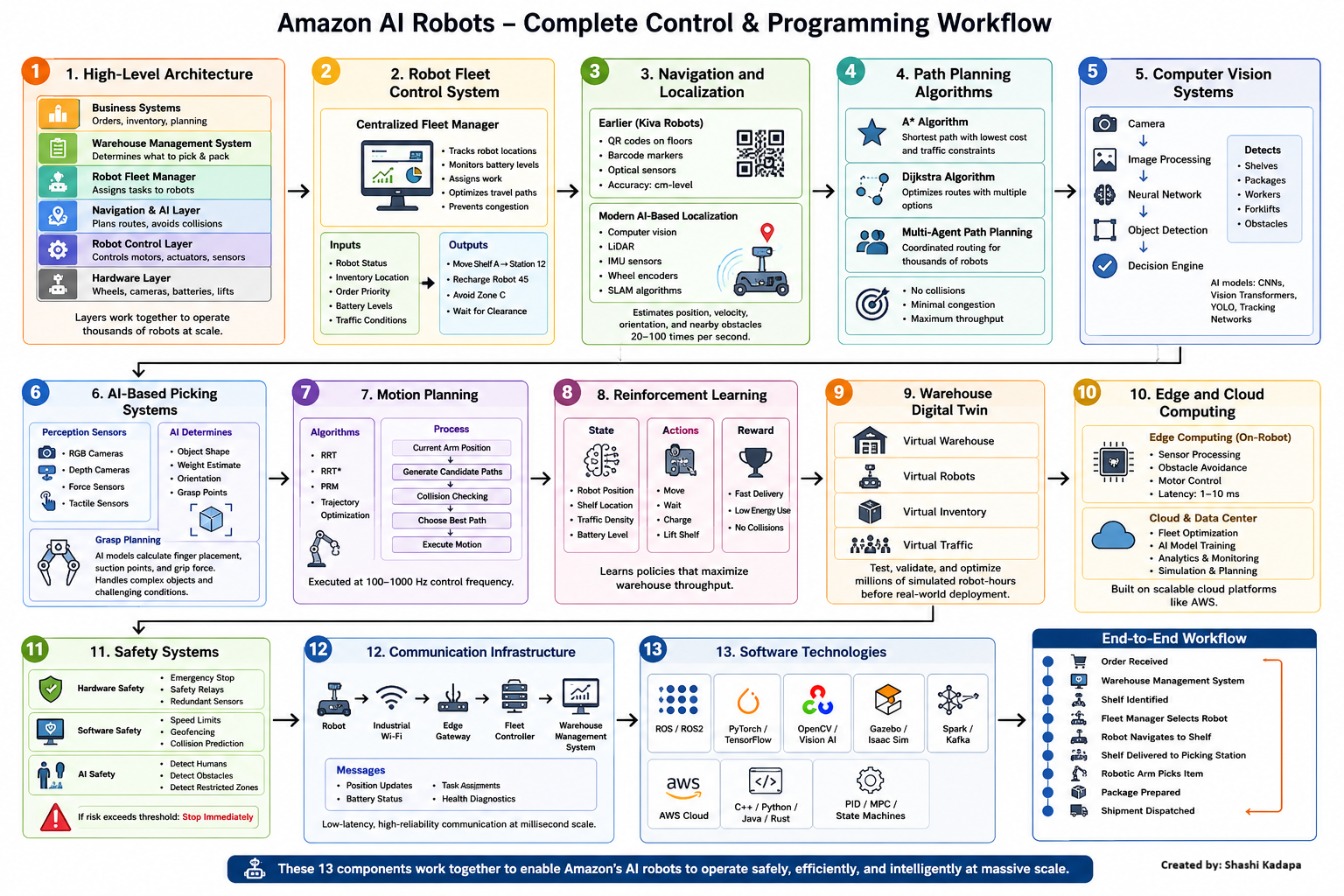
Figure 4. Workflow of the 13 components (Shashi Kadapa with Claude AI)
The workflow is described in detail in the next sections.
1. High-Level Architecture
Amazon’s robotics system typically follows a layered architecture:
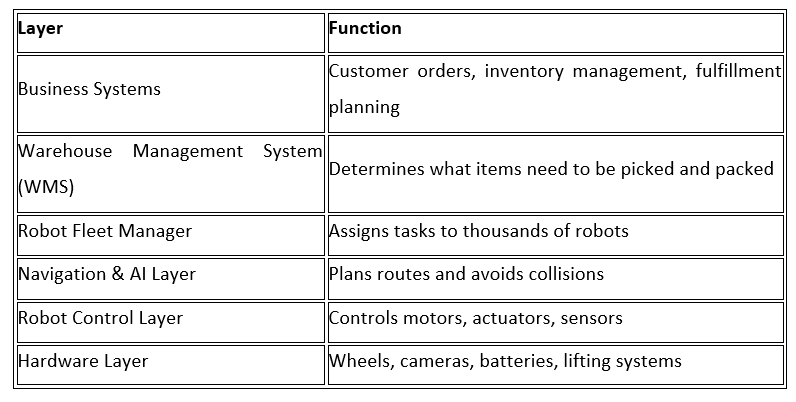
The robots continuously receive tasks from warehouse software rather than being manually driven.
2. Robot Fleet Control System
A fulfillment center typically has thousands of robots moving simultaneously. A centralized fleet management software is used to route and sequence the robots so that they do not collide with each other and with human staff.
 The fleet management software performs the following tasks: Tracks robot locations, Monitors battery levels, assigns work, optimizes travel paths, and prevents traffic congestion.
Inputs: It takes inputs of robot status, inventory location, order priority, battery levels, and traffic conditions.
Outputs: Typical outputs from the fleet management software are: command to move Shelf A → Station 12; Recharge Robot 45; Avoid Zone C; Wait for Traffic Clearance
The fleet manager continuously recalculates assignments every few seconds.
3. Navigation and Localization
Robots must know their exact location within the warehouse. The previous generation of Kiva robots used QR codes on floors, read barcode markers, and relied on optical sensors. These systems were slow and had high errors.
The modern AI-based localization robots use: Computer vision, LiDAR, IMU sensors, wheel encoders with SLAM algorithms.
SLAM – Simultaneous Localization and Mapping is used by Robots to estimate the current position, velocity, orientation, and identify nearby obstacles. It operates at rates exceeding 20–100 updates per second.
4. Path Planning Algorithms
Amazon robots must find optimal routes through warehouses. Specialized part planning algorithms are used. Some of the algorithms are:
A*: This A*is a common warehouse routing algorithm. It calculates the shortest path, at the lowest cost, and estimates traffic constraints.
Dijkstra: The Dijkstra algorithm is used for route optimization when multiple options exist.
Multi-Agent Path Planning: The Multi-Agent Path Planning is a specialized algorithm to coordinate thousands of robots simultaneously. The objectives: no collisions, minimal congestion, and provide the maximum throughput.
Example:
Robot A → Shelf 101
Robot B → Shelf 205
Robot C → Charging Station
AI calculates all routes together.
5. Computer Vision Systems
Given the thousands of identical-looking parcels, robots use cameras and AI models for perception. Computer vision systems for its AI robots help in autonomous navigation, safe human-robot collaboration, and precise item handling at a very large scale. By using cameras and spatial AI, these robots can interpret dynamic warehouse environments in real-time, drastically reducing fulfillment times and improving workplace safety.
The vision pipeline has: Camera > Image Processing > Neural Network > Object Detection > Decision Engine.
Objects detected by the computer vision systems are: shelves, packages, workers, forklifts, and obstacles.
Common AI models used in the computer vision systems are: CNNs, Vision Transformers (ViTs), YOLO-style detectors, and Object tracking networks.
 6. AI-Based Picking Systems
Robotic arms must identify and grasp products. This is a complex procedure since the objects are in different sizes, such as cartons and small parcels.
The Perception System is used for the picking system. It has sensors such as RGB Cameras, Depth Cameras, Force Sensors, and Tactile Sensors.
The AI determines the object shape, weight, orientation, and grasp points.
Grasp Planning is critical to prevent damage to the parcels. A deep learning model is used to calculate finger placement, suction point location, and to determine the optimum grip force.
Challenges are seen for transparent objects, reflective surfaces, soft packaging, and irregular shapes.
7. Motion Planning
The motion planning is about defining how the robot moves to pick and place the objects. After selecting a grasp point, several Motion Planning Algorithms are used.
Motion Planning Algorithms used are RRT, RRT*, PRM, and Trajectory Optimization.
Typical process is: Determine Current Arm Position > Generate Candidate Paths > Collision Checking > Choose Best Path > Execute Motion.
The execution is done at 100–1000 Hz control frequencies.
8. Reinforcement Learning
Amazon increasingly applies reinforcement learning for optimization. RL helps robots to navigate complex, changing environments through trial-and-error, self-correction, and rewards. RL allows robots to achieve goals without the need for pre-programmed code for every single scenario or a massive labeled training dataset.
The RL Frameworks used to find the state for: Robot Position, Shelf Location, Traffic Density, Battery Level.
- RL frameworks for actions are: Move, Wait, Charge, and Lift Shelf.
- The rewards are: Fast Delivery, Low Energy Use, and No Collisions.
- The system learns policies that maximize warehouse throughput.
9. Warehouse Digital Twin
The Amazon warehouse digital twin is a dynamic virtual replica of a physical warehouse. It mirrors facility layouts, equipment, inventory, and workflows. Merging real-time data from sensors and software with artificial intelligence allows managers to visualize, analyze, and optimize operations virtually before changing the physical floor. Amazon frequently tests robot behaviour in simulations before deployment.
✦ Digital Twin Components: These include Virtual Warehouse, Virtual Robots, Virtual Inventory, and Virtual Traffic
✦ The benefits are: faster testing, safety validation, and performance optimization.
✦ Millions of simulated robot-hours can be executed before real deployment.
10. Edge and Cloud Computing
Robot intelligence is split between local and centralized systems. Amazon Web Services (AWS) uses cloud computing, which provides massive, centralized data processing and storage in global data centres.
Edge Computing extends this cloud capability physically closer to end-users and devices, enabling ultra-fast, local data processing and real-time decision-making. They enable automated fulfilment, instant inventory tracking, and predictive operations.
✦ Edge Computing: It uses On-robot processors for sensor processing, obstacle avoidance, and motor control.
✦ The latency is 1–10 ms.
Cloud and Data Center Processing: These use larger systems that perform fleet optimization, AI model training, Analytics, and Simulation
The platforms often use services from Amazon Web Services.
11. Safety Systems
Safety is critical because robots operate near people. There are dangers of human-robot collisions that can result in death and amputations.
✦ Multiple Safety Layers: The system has several safety layers. These include hardware safety with emergency stop buttons, safety relays, and redundant sensors.
✦ Software Safety: It is maintained by speed limits, geofencing, and collision prediction
✦ AI Safety: Is maintained by vision systems to detect human presence, unexpected obstacles, and restricted zones. If risk exceeds a threshold, the processes are stopped immediately.
12. Communication Infrastructure
Thousands of robots communicate continuously through a unified communication and stack. A typical network stack has: Robot > Industrial Wi-Fi > Edge Gateway > Fleet Controller >
Warehouse Management System
Communication latency is typically measured in milliseconds.
13. Software Technologies Commonly Used
The following domains and technologies are used:
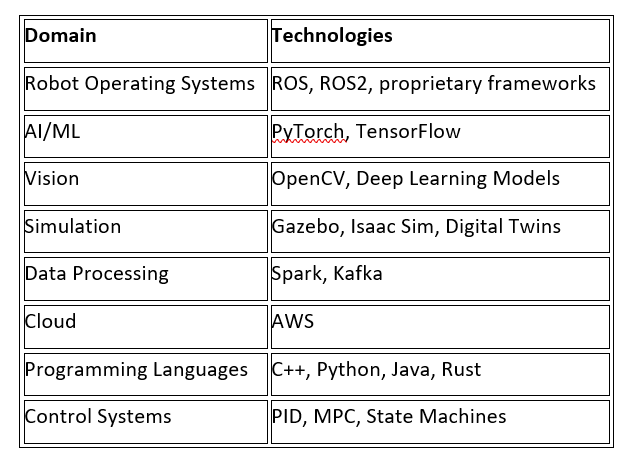
An example: End-to-End Workflow:
A customer orders a product: Order Received > Warehouse Management System > Shelf Identified > Fleet Manager Selects Robot > Robot Navigates to Shelf > Shelf Delivered to Picking Station > Robotic Arm Picks Item > Package Prepared > Shipment Dispatched.
Throughout this process, AI systems continuously optimize navigation, picking, traffic management, energy consumption, and inventory movement. In large Amazon fulfilment centers, thousands of robots can coordinate simultaneously, making the system one of the most sophisticated real-time autonomous robotics deployments in the world.
Tangible benefits and gains for Amazon from AI Robots
Amazon AI robots and automation have provided tangible financial and operational gains. Specific gains for Amazon are:
✦ Operating Cost Savings: Projections indicate that robotic rollouts in next-generation facilities reduce fulfilment costs by $0.60 to $1.20 per unit.
✦ Annual Savings: Analysts at Morgan Stanley indicate that robotic integrations will generate $2 billion to $4 billion in annual savings, with potential estimates scaling up to $10 billion as deployment accelerates.
✦ Corporate Cuts: Corporate AI initiatives, such as terminating over 30,000 corporate and middle-management roles over recent years, have yielded an estimated $3.6 billion in annual savings.
✦ Labor Cost Optimization: New initiatives like Full Facility Load Balancing, which uses AI to automatically move human staff across zones based on package volume, will save $193 million annually.
✦ Package Throughput: Productivity per employee has improved. The number of packages handled annually per employee increased from 175 to 3,870.
✦ Reduced Hiring Needs: Amazon aims to automate around 75% of operations. This will avoid hiring up to 600,000 U.S. workers by 2033.
✦ Shift from General Labor to Tech: Rather than firing staff, Amazon is shifting its workforce composition. More than 300,000 employees have been upskilled for technical roles, focusing on machine maintenance and supervisory oversight.
✦ Processing Times: Voice-enabled Proteus robot and Blue Jay systems have driven down fulfilment processing times by up to 25 percent.
✦ Increased Efficiency: AI algorithms allow robots to plan better picking routes. Robot travel time has reduced by 10% and further increasing the number of packages moved daily.
Conclusions
The article presented a deep technical dive into Amazon AI robot systems. Amazon has implemented more than a million of these robots across its warehouses and fulfilment centers.
These AI robots never tire and only require recharging every few hours. They do not get tired, do not ask for wage hikes, or complain about unsafe work. They are faster, more efficient, and more responsive than human robots.
Will AI robots eliminate the human workforce? Not yet. In any case, the traditional human jobs of picker, loader, and mover are now done by AI robots. A few humans are still needed for supervision.
About the author :
 Mr. Shashi Kadapa
Based in Pune, India, Mr. Shashi Kadapa is an engineer, MBA and has worked with leading IT and manufacturing firms. A multi-hyphenate, he has roles as a technical writer, and SEO content writer with a focus on IT and tech topics.
Creative fiction is his passion, and he serves as the managing editor of ActiveMuse, a journal of literature. His stories across multiple genres are published in more than 45 US and UK anthologies.
Mr. Shashi Kadapa can be contacted at :
E-mail | LinkedIn | Blog | Mobile : +91 7387492371
Also read Mr. Shashi Kadapa earlier article: