
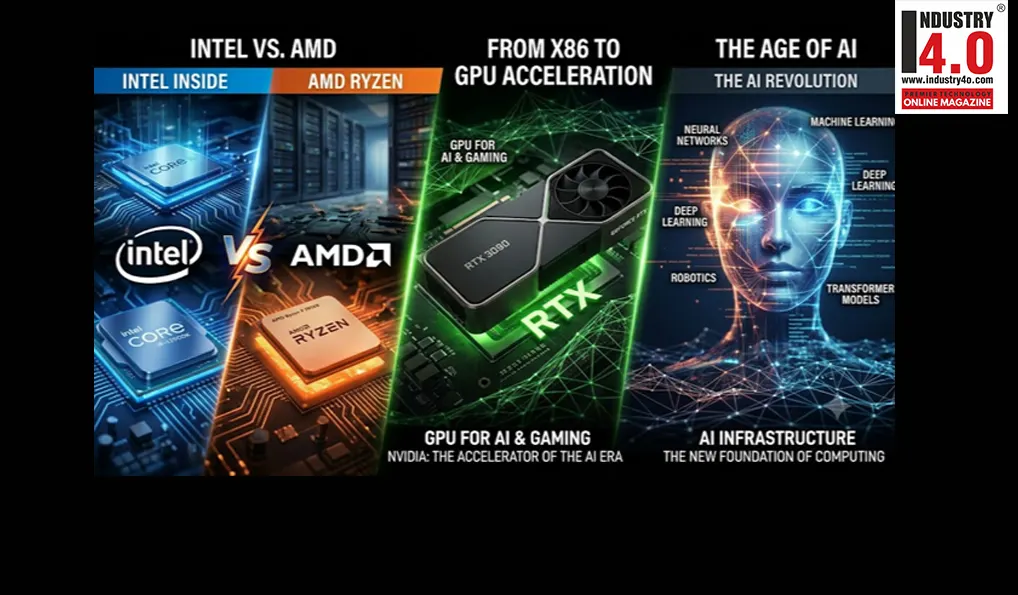
From Intel vs AMD to the Age of AI : The Incredible Journey of CPUs, GPUs, and the Future of Computing
A Personal Journey Through Four Decades of Computing
Being an 80s kid, I have had the privilege of witnessing one of the greatest technological revolutions in human history.
I still remember the days when buying a computer was not as simple as it is today. There was no YouTube, no AI assistant, no comparison websites, and very limited information available online.
The biggest question every buyer asked was:
“Should I buy Intel or AMD?”
I remember spending countless hours visiting computer stores, talking to salespeople, reading computer magazines, and seeking advice from friends before buying my first laptop.
After weeks of research, I finally chose an AMD-based laptop because it offered better graphics performance and value for money. As a passionate PC gamer, graphics mattered more to me than anything else.

Little did I know that this simple buying decision would become part of a much larger story—one that would eventually lead humanity into the age of Artificial Intelligence.
Today, the battle is no longer just Intel vs AMD.
It is now:
CPU vs GPU vs AI Accelerators
And the stakes have never been higher.
The CPU Era: The Brain of Every Computer
For more than 40 years, the CPU (Central Processing Unit) ruled the computing world.
The CPU was the king.
Everything happened through the CPU:
- Running Windows
- Opening applications
- Calculating spreadsheets
- Browsing the internet
- Playing games
- Running enterprise software
Companies such as:
- Intel Corporation
- Advanced Micro Devices
became household names.
The CPU was designed to perform a few complex tasks extremely fast.
 Think of the CPU as a highly skilled manager who can solve difficult problems one at a time with incredible efficiency.
For decades, this model worked perfectly.
The Great Intel vs AMD War
For many years Intel dominated the market.
Intel’s Strengths
- Market leadership
- Strong enterprise adoption
- Better software compatibility
- Superior manufacturing capabilities
- Trusted brand
Intel’s Weaknesses
- Higher pricing
- Slower innovation in some periods
- Less attractive integrated graphics
AMD’s Strengths
- Better price-performance ratio
- Strong gaming performance
- Competitive graphics technology
- Aggressive innovation cycles
AMD’s Weaknesses
- Smaller ecosystem
- Lower enterprise penetration
- Historically weaker marketing power
For decades Intel remained the giant while AMD played the challenger.
But the story was about to change dramatically.
The Rise of Graphics Cards
Gamers unknowingly became the pioneers of the AI revolution.
In the late 1990s and early 2000s, gaming graphics became increasingly demanding.
Companies such as:
- NVIDIA Corporation
- Advanced Micro Devices
began building powerful Graphics Processing Units (GPUs).
Initially GPUs had only one job:
Make games look amazing.
 They rendered:
- 3D environments
- Explosions
- Shadows
- Realistic characters
- Physics simulations
Nobody imagined these gaming chips would one day power Artificial Intelligence.
The GPU Revolution
Unlike CPUs, GPUs are designed differently.
Imagine:
A CPU is like a Formula 1 car.
A GPU is like a thousand motorcycles working together.
A CPU excels at handling one complex task.
A GPU excels at handling thousands of smaller tasks simultaneously.
This ability is called:
Massive Parallel Processing
And it changed everything.
How AI Changed the Entire Industry
Training Artificial Intelligence requires processing enormous amounts of data simultaneously.
This is exactly what GPUs are built for.
Suddenly, gaming hardware became AI hardware.
The same technology used to render game graphics could now:
- Train AI models
- Process billions of parameters
- Run machine learning algorithms
- Power autonomous vehicles
- Generate videos and images
- Create intelligent digital assistants
The world entered the AI age.
And GPUs became more valuable than oil.

The New Kings of Computing
Today the semiconductor battlefield looks very different.
Intel
Still a global giant with strong enterprise relationships and manufacturing ambitions.
Focus Areas
- AI PCs
- Data Centers
- Advanced Packaging
- Semiconductor Manufacturing
AMD
The comeback story of the decade.
Focus Areas
- Ryzen CPUs
- EPYC Data Center Processors
- AI Accelerators
- Gaming Platforms
NVIDIA
The biggest winner of the AI revolution.
Focus Areas
- AI Training
- AI Inference
- Data Centers
- Robotics
- Autonomous Systems
New Challengers
- Apple Inc.
- Qualcomm Incorporated
- Arm Holdings
- Google LLC
- Amazon Web Services
Everyone wants a piece of the AI chip market.
What Comes Next?
The next 20 years will be unlike anything humanity has experienced before.
Future computers may contain:
AI Processing Units (APUs)
Dedicated AI chips inside every device.
Neural Processors
Hardware designed to mimic the human brain.
Quantum Co-Processors
Machines capable of solving problems impossible for today’s computers.
Photonic Computing
Using light instead of electricity for calculations.
Biological Computing
Computers built using DNA and biological structures.
What sounds like science fiction today is already under development in research laboratories.
The Future of Personal Computers
The PC is not dying.
It is evolving.
Future computers may:
- Understand natural language
- Think contextually
- Predict user needs
- Create content automatically
- Act as personal assistants
- Run entirely through voice interaction
The keyboard and mouse may eventually become optional.
Your future PC may know what you want before you ask.
Looking 50 to 100 Years Ahead
Imagine a computer in the year 2125.
It may:
- Fit inside a contact lens
- Be powered by quantum processors
- Operate using brain signals
- Translate every language instantly
- Generate entire movies from thoughts
- Act as a digital companion
- Learn continuously like a human
The distinction between human intelligence and machine intelligence may become increasingly blurred.
The computer of the future may no longer be a machine sitting on a desk.
It may become an extension of ourselves.
Final Thoughts
When I bought my first AMD laptop many years ago, I was simply looking for a machine that could run games smoothly.
Today, those same technologies are powering Artificial Intelligence, autonomous systems, robotics, medical research, and innovations that are reshaping civilization.
We have traveled from floppy disks to cloud computing.
From dial-up internet to AI assistants.
From CPU dominance to GPU supremacy.
And perhaps we are only at the beginning.
The next chapter of computing will not be written by CPUs or GPUs alone.
It will be written by human imagination.
And if the last forty years have taught us anything, it is this:
The future always arrives faster than we expect.
About the Author :

Mr. Umesh K
Founder & Director,
Kstars Technology LLP

After spending more than 20 years in enterprise technology, ERP, and business consulting, Mr. Umesh K learned one simple truth : ” Technology alone doesn’t transform businesses.The right business outcomes do”.
Mr. Umesh K throughout his career, have worked across AI, ERP, CRM, Analytics, Cloud, and Digital Transformation, partnering with organizations to solve complex operational and growth challenges.
Those experiences has taught Mr. Umesh K that businesses don’t need more software—they need practical, scalable solutions that create measurable impact.
That’s what led Mr. Umesh K to build Kstars Technology.
Today, Mr. Umesh K is passionate about helping founders and business leaders understand how AI and automation can move beyond the hype and become practical tools for growth, efficiency, and innovation.
Mr. Umesh K enjoys connecting with business owners, CXOs, and technology leaders who believe the future belongs to organizations that combine human expertise with intelligent technology.
Mr. Umesh K is Bestowed with the following Licenses & Certifications :
https://www.linkedin.com/in/um
Mr. Umesh K can be contacted at :
About Kstars Technology LLP :
Kstars Technology LLP is a full-service enterprise technology and digital solutions firm, enabling businesses to design, scale, and operate with intelligence and clarity.
Kstars Technology LLP delivers integrated, end-to-end services across Digital Marketing, AI & Application Development, and IT Infrastructure & Cloud Services ensuring that technology directly supports business growth, efficiency, and measurable ROI.
With 10+ years of industry experience, Kstars Technology LLP work as a long-term technology partner not just a service vendor-combining strategic thinking, deep execution capability, and practical outcome-driven solutions.
Kstars Technology LLP can be contacted at :