
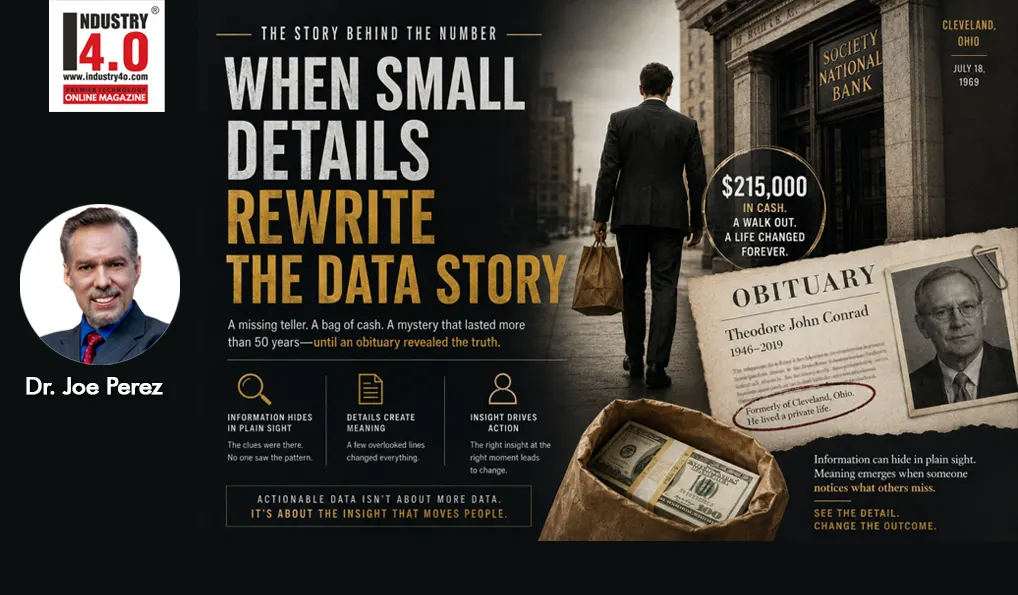
When Small Details Rewrite the Data Story
On a warm Friday afternoon in July of 1969, a young bank teller named Theodore John Conrad finished his shift at Society National Bank in Cleveland, picked up a plain paper bag, and walked out as if he were heading home like any other day. Inside that bag sat $215,000 in cash, the kind of money that would make most people hesitate before taking a single step. Conrad didn’t rush. He didn’t look over his shoulder. He simply blended into the ordinary movement of the city and kept going, leaving behind a puzzle that would stretch across more than fifty years.

What keeps his story alive is the quiet way he carried it out. Conrad had no criminal background and no dramatic explanation waiting in a notebook somewhere. People who knew him described a calm young man who never hinted at anything unusual. Investigators tried to follow the few clues they had, but the trail cooled almost immediately. Every lead seemed to dissolve into another dead end, and the case slowly turned into something closer to folklore than an active search.
When the truth finally surfaced, long after Conrad had built a new life under a different name, it arrived through something as ordinary as an obituary. A few small details, the kind that most readers would skim past without a second thought, were enough to unravel the secret he had carried for decades. It is strange how a life can hinge on something so small.
His story offers a surprisingly useful way to think about the idea of actionable data in data storytelling. Conrad’s escape shows how information can hide in plain sight, how scattered clues can sit untouched for years, and how meaning often depends on someone noticing the right detail at the right moment. Actionable data works in a similar way. It is less about the volume of information and more about the insight that actually prompts someone to move. Conrad’s story gives us a vivid backdrop for exploring that idea.
1. The Unseen Insights
When investigators first tried to understand how Conrad slipped away so easily, they kept circling back to the same problem. The clues they needed were sitting in front of them, yet none of those clues pointed anywhere useful. The bank’s security procedures were loose, and the daily routines were predictable. Conrad had studied those routines for months. He knew which details mattered and which ones everyone else ignored. That quiet awareness gave him an advantage that no one recognized until it was too late.
 Actionable data works in a similar way. Organizations often collect enormous amounts of information, but the pieces that truly matter are rarely the loudest ones. They tend to be the small patterns that hide inside the noise. A sudden shift in customer behavior, a subtle change in how people navigate a website, or a quiet trend in operational delays can reveal more than a hundred charts filled with surface‑level metrics. The challenge is learning to notice what others overlook. Conrad’s story reminds us that the most valuable insights are often the ones that sit quietly in the background.
There is also something to be said about the patience required to find meaning in those quieter signals. Conrad didn’t rush his plan. He watched, waited, and learned how the system around him behaved. Data storytellers face a similar task. The first glance at a dataset rarely tells the whole story. It takes time to understand what the information is trying to say. When you slow down enough to see the patterns that hide beneath the obvious ones, the insights become far more powerful. They become the kind of insights that change decisions rather than decorate presentations.
2. The Two‑Day Head Start
One of the most striking parts of Conrad’s escape was the timing. He chose a Friday afternoon, knowing the bank would not reconcile its cash until Monday morning. That gave him nearly two full days before anyone realized the money was gone. By the time the alarm was raised, he was already far beyond the reach of the first wave of investigators. Timing didn’t just help him. It shaped the entire outcome.
In data storytelling, timing plays a similar role. An insight that arrives too late loses its value. A trend that goes unnoticed for a week can turn into a missed opportunity. A risk that sits unaddressed for a month can grow into a crisis. The speed at which organizations act on their data often determines whether they stay ahead of a problem or chase it from behind. Conrad’s head start illustrates how quickly the window for meaningful action can close.
There is also a lesson here about the rhythm of decision‑making. Some organizations treat data as something to review only at scheduled intervals. They wait for the end of the quarter or the next leadership meeting. By then, the moment has already passed. Actionable data requires a different mindset. It calls for a willingness to respond when the signal appears, even if the timing is inconvenient. Conrad understood the power of timing instinctively. Data storytellers can learn from that instinct by recognizing that the right insight delivered at the right moment can change the entire trajectory of a decision.
 3. The Elusive Trail
When investigators searched for Conrad, they kept running into the same problem. There was almost nothing to work with. He had never been fingerprinted. He left behind no dramatic note or confession. There were no security cameras to review. The absence of information became its own kind of obstacle. Every time they tried to follow the trail, they found another empty space where a clue should have been.
In the world of data, those empty spaces matter. Missing information can reveal just as much as the data that is present. A sudden gap in customer activity might signal frustration. A missing field in a form might point to confusion. A drop in engagement might reflect a change in expectations. Data storytellers often focus on what they can measure, but the things they cannot measure sometimes carry the most meaning. Conrad’s trail teaches us that silence can be a signal of its own.
There is also a deeper challenge here. When information is incomplete, it becomes tempting to fill the gaps with assumptions. Investigators did this repeatedly. They guessed where Conrad might have gone. They imagined what he might have done. Those guesses led them in circles for years. Data storytellers face the same temptation. When the data is thin, it is easy to lean on intuition instead of evidence. The better approach is to acknowledge the gaps openly and explore what those gaps might imply. Sometimes the absence of data is the very thing that points toward the truth.
4. The Obituary Clue
The detail that finally revealed Conrad’s identity came from an unexpected place. His obituary mentioned a few small facts that matched the old case file. Those details were ordinary on their own, but together they formed a pattern that someone finally recognized. After decades of searching, the answer arrived through a source no one had considered important.
This is a familiar experience for anyone who works with data. Insights often come from places that seem unrelated at first glance. A customer support transcript might explain a sudden drop in sales. A maintenance log might reveal the cause of a recurring delay. A forgotten spreadsheet might hold the key to understanding a trend that has puzzled analysts for months. Actionable data rarely comes from a single source. It emerges when different pieces of information are brought together in a way that reveals something new.
There is also a lesson here about curiosity. The investigator who solved the case did so because he noticed something that others had overlooked. He allowed himself to follow a thread that seemed small. Data storytellers thrive when they approach information with that same sense of curiosity. The most meaningful insights often begin with a simple question. Why did this happen? Why does this number look different from last month? Why does this pattern appear only in certain situations? When you follow those questions with patience, the story inside the data begins to reveal itself.

Conclusion
Theodore John Conrad’s escape lasted more than fifty years, yet the heart of his story comes down to a handful of small details. A quiet observation about how the bank operated. A choice about timing. A trail defined as much by what was missing as by what was present. A final clue tucked inside an obituary. None of these pieces seemed dramatic on their own, but together they shaped one of the most unusual manhunts in American history.
Actionable data works the same way. It rarely announces itself with fanfare. It hides inside ordinary patterns, scattered clues, and overlooked signals. The value comes from noticing what others miss and understanding how those pieces fit together. When data storytellers approach information with that mindset, the insights they uncover become far more powerful. They become the kind of insights that guide decisions, reveal opportunities, and change outcomes.
Conrad’s story is a reminder that information has a life of its own. It moves quietly. It waits to be noticed. It rewards the people who pay attention. In a world overflowing with data, the real advantage belongs to those who can find the meaning inside the noise and turn it into something that moves people to act.
“Bringing Data to Life and Life to Data”
 About the Author:

Dr. Joe Perez,
Team Lead / Senior Systems Specialist,
NC Department of Health and Human Services

Dr. Joe Perez ( Dr.Joe ) is also the Chief Technology Officer – CogniMind
To book Dr. Joe Perez for your speaking engagement please click here

Dr. Joe Perez was selected as the 2023 Gartner Peer Community Ambassador of the Year.
Dr. Joe Perez is a truly exceptional professional who has left an indelible mark on the IT, health and human services, and higher education sectors. Dr. Joe Perez journey began in the field of education, where he laid the foundation for his career. With advanced degrees in education and a doctorate that included a double minor in computers and theology, Dr. Joe Perez embarked on a path that ultimately led him to the dynamic world of data-driven Information Technology.
In the early 1990s, Dr. Joe Perez transitioned into IT, starting as a Computer Consultant at NC State University. Over the years, Dr. Joe Perez’s dedication and expertise led to a series of well- deserved promotions, culminating in his role as Business Intelligence Specialist that capped his 25 successful years at NC State. Not one to rest on his laurels, Dr. Joe Perez embarked on a new challenge in the fall of 2017, when he was recruited to take on the role of Senior Business Analyst at the NC Department of Health, Human Services (NCDHHS). His impressive journey continued with promotions to Senior Systems Specialist and Team Leader, showcasing his versatility and leadership capabilities.
In addition to his full-time responsibilities at NCDHHS, Dr. Joe Perez assumed the role of
fractional Chief Technology Officer at a North Carolina firm in October 2020. An Amazon best-selling author with over 21,000 followers on LinkedIn and numerous professional certifications, he is a highly sought-after international keynote speaker and recognized expert in data analytics and visualization.
Dr. Joe Perez’s contributions have not gone unnoticed. Dr. Joe Perez is a recipient of the IOT Industry Insights 2021 Thought Leader of the Year award, the 2023 Gartner Peer Community Ambassador of the Year award, and Top Ten Global Thought Leader for several categories at Thinkers360 in four consecutive years (2023-2026). Dr. Joe Perez holds memberships in several prestigious Thought Leader communities, and was recently inducted into the United Nations Global Network of Data Officers and Statisticians. Dr. Joe Perez’s reach extends to more than twenty countries worldwide, where he impacts thousands through his speaking engagements, articles, and status as a Distinguished Fellow in the Public Sector Network’s Future Government Institute.
 Beyond his professional achievements, Dr. Joe Perez’s passion for teaching remains
undiminished. Whether as a speaker, workshop facilitator, podcast guest, conference emcee, or team leader, he continually inspires individuals to strive for excellence. He treasures his time with his family and is a gifted musician, singer, pianist, and composer. Joe also dedicates his skills through involvement in his church’s Hispanic ministry. Dr. Joe Perez manages the publication of a widely recognized monthly military newsletter, The Patriot News, and is deeply committed to his community.
To maintain a balanced life, Dr. Joe Perez is a regular at the gym, and he finds relaxation in watching Star Trek reruns. He lives by the philosophy that innovation is the key to progress, and he approaches each day with boundless energy and an unwavering commitment to excellence. Dr. Joe Perez’s journey is a testament to the remarkable achievements of a truly exceptional individual, and more importantly, to the amazing grace of God.
Dr. Joe Perez is Accorded with the following Honors & Awards :
https://www.linkedin.com/in/jw
Dr. Joe Perez is Bestowed with the following Licences, Certifications & Badge:
https://www.linkedin.com/in/jw
https://www.thinkers360.com/tl
Dr.Joe Perez is Voluentering in the following International Industry Associations & Institutions :
https://www.linkedin.com/in/jw
Dr.Joe Perez can be contacted at :
E-mail | LinkedIn | Web | Sessionize | FaceBook | Twitter | YouTube
Also read Dr.Joe Perez‘s earlier articles: