
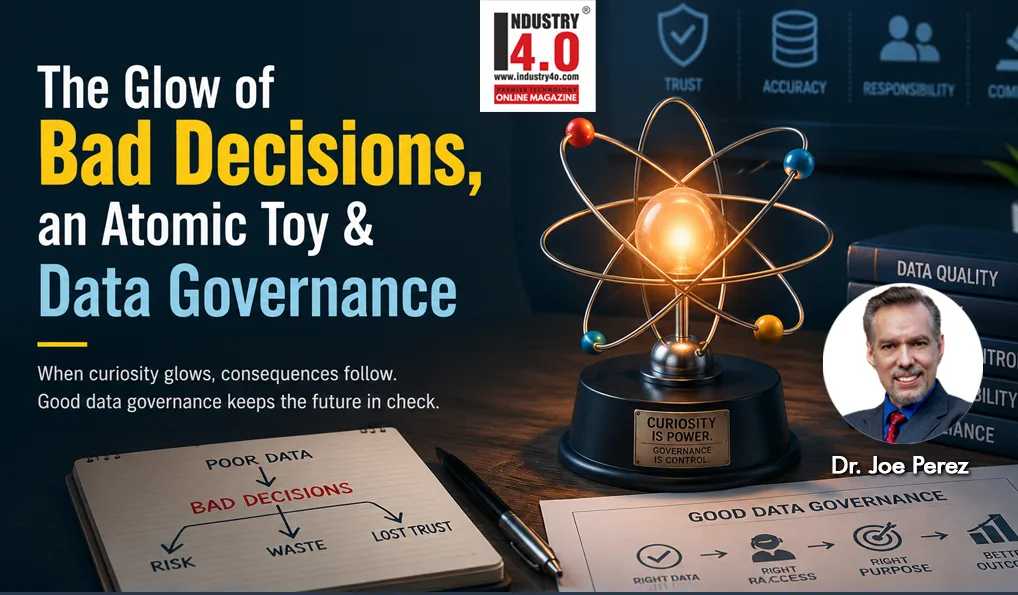
The Glow of Bad Decisions, an Atomic Toy, and Data Governance
After more than three decades in data and analytics, I have seen my share of curious objects. Most of them were digital, some were conceptual, and a few were the kind that made me rethink my own career choices. Yet none of them rival the odd creation that a breakfast cereal company once mailed directly to children for pocket change. The year was 1947, and one of the hottest toys on the market arrived in a small box alongside crunchy corn puffs. Inside the package sat a shiny ring decorated with stylized explosions and a miniature metallic “warhead” perched on top like a crown jewel.

Kids everywhere felt like secret agents while wearing it. Parents thought it was inventive. Scientists probably needed a moment to sit down once they learned what it contained. Hidden under a tiny red cover was a chamber that held a spinthariscope, a little device that revealed faint flashes of light when struck by alpha particles. Those particles came from a speck of a material that, today, would cause an emergency response team to appear faster than you could fold the cereal box flap back down. A pinch of Polonium‑210 had been used to create this “atomic spectacle” for children, and nobody worried about it at that time because the 1940s viewed atomic energy the same way people today view smart home devices. If it blinked or sparked or hummed, someone was already designing a toy out of it.
The story seems amusing at first, almost surreal. But it becomes less charming once you remember that ingesting or inhaling the radioactive substance inside that toy could have created quite a health crisis. The ring did not intend any harm. It simply reflected a cultural moment in which excitement overshadowed risk assessment. People focused on novelty instead of governance, thrill instead of oversight. The decisions behind that ring mirror what I see in data programs across industries. The technology sparkles, executives get excited, and somewhere beneath the surface sits a substance that everyone assumes is perfectly safe because it looks impressive on the surface.
In my career, I have learned that every data ecosystem carries its own version of that hidden chamber. It might not contain anything as dramatic as Polonium‑210, yet it carries the same risks: unseen dangers that stay invisible until you point the right lens at them. The cereal‑box story, odd as it is, offers four surprisingly useful parallels to modern data governance, each represented with a keyword. Put the keywords together and they spell BOMB, which feels appropriate considering the original artifact.
 The first parallel is Barrier. In the 1940s, people believed alpha particles could not pass through skin, so the ring must have been harmless. They misunderstood where the real danger lived. It was not in touching the object. The threat arose when the radioactive material escaped the chamber where it belonged. In the data world, organizations make the same mistake. They assume they are safe because the system appears sealed off. They trust that a firewall, a password, a biometric lock, or a vendor’s privacy statement creates an impenetrable shell. They forget that data leaks rarely occur through Hollywood‑style hacks. The biggest risks come from permissions granted too broadly, files shared casually, employees who copy information onto personal devices without thinking, or routine habits that bypass safeguards entirely. The barrier that organizations believe they have is often nothing more than a conceptual comfort blanket. Real safety depends on how well you control internal movement, not external touch.
 The second parallel is Oversight. The cereal company that distributed the ring was not malicious. It was enthusiastic. The people behind the promotion probably thought they were giving children a peek into the wonders of atomic science. They saw sparkles of light inside a tiny viewport and imagined themselves as creators of educational magic. What they lacked was structured review. Nobody asked the simple questions. Does this belong in a child’s toy? Does anyone fully understand the long‑term risk? Data programs go off course when they follow that same pattern. Teams fall in love with dashboards, cloud migrations, or predictive models. The glow of possibility distracts from due diligence. Oversight is not the enemy of innovation. Oversight is the insurance policy that ensures an exciting idea does not evolve into a lawsuit. Whenever I see a project launched without governance in place, I picture a 1940s marketing manager proudly mailing tiny atomic samples to children. Enthusiasm without review is a dangerous combination.
The third parallel is Maintenance. The original rings still exist today as collectors’ items. Many of them sit in display cases or museum drawers. The radioactive material inside them is far less potent than it used to be because the isotope decays over time. The object changes whether anyone pays attention or not. Data behaves the same way. It ages. It spoils. It drifts out of alignment. It becomes stale, incomplete, inconsistent, and misleading. Any dataset left unattended gathers a kind of informational rust. Organizations often underestimate this process. They believe data from ten years ago still tells the truth. They do not realize that old records produce strategic decisions with the accuracy of a foggy crystal ball. Maintenance is not optional. It is the difference between insight and illusion. The spinthariscope inside that ring once revealed bright specks of light. Decades later, the glow has faded. Data value follows the same trajectory without continuous care.
 The fourth parallel is Belonging. In the story of the atomic ring, the radioactive material never belonged inside a cereal‑box toy. It was a scientific tool disguised as entertainment. Its placement was inappropriate from the start. Likewise, not all data belongs everywhere. Customer information does not belong in personal email accounts. Sensitive records do not belong in unsecured cloud storage. Development teams often believe that data should be accessible to everyone so innovation can flourish; so collaboration appears effortless. That belief overlooks a critical truth. Information has a natural place where it fits and a natural place where it does not. When you respect where data belongs, you reduce exposure, limit misuse, and prevent disasters long before they occur.
Put the four keywords together. Barrier. Oversight. Maintenance. Belonging. BOMB. The word takes us right back to the tiny promotional ring that inspired this entire reflection. The ring dazzled children with a miniature display of atomic sparkle. The modern data landscape tries to dazzle executives with dashboards, machine learning models, and digital transformation slogans. Both contain something powerful hidden beneath the surface. Both require care, respect, and knowledge. Both can create harm when treated as toys.
Let me take the connection one step further. Imagine a modern data project that begins with excitement. Someone dreams up a plan to capture every customer interaction. The team races ahead without asking whether the data is clean, whether the storage practices follow regulations, or whether the intended use aligns with the company’s values. A platform is purchased. Dashboards are built. Reports appear in inboxes. Executives marvel at the sparkle. Nobody notices that the data contains unmasked personal identifiers. Nobody tracks access logs. Nobody sets retention rules. What begins as a harmless gadget becomes a hidden hazard. It sits quietly, generating risk that will one day announce itself with the subtlety of a siren.

This same pattern played out in the 1940s without anyone realizing it. The cereal company meant well. They believed they were promoting wonder and science. They did not consider the possibility that a child might pry open the tiny compartment, breathe in the glowing material, and face exposure to something far more dangerous than expected. In hindsight, the promotional ring looks like an artifact from a time when optimism towered over caution. In the data world, we still live in that tension. We celebrate rapid progress. We praise innovation. We chase whatever sparkles, whatever flashes, whatever glows, whatever entertains. We forget that excitement does not neutralize risk.
The unexpected twist is simple. People often treat data as harmless. They see rows in spreadsheets and think of them as numbers, not as the digital equivalent of radioactive particles. They forget that each piece of information carries weight, toxicity, and potential depending on how it is handled. Poor governance does not announce its danger in bright lights. It behaves more like the faint sparks inside that old ring. You must look carefully to see what is happening. Once you notice it, you realize how much energy sits in a space so small.
At this point, after three decades of watching organizations struggle with data chaos, my perspective is clear. Data governance is not a bureaucratic burden. It is a form of stewardship. It protects people. It protects reputation. It protects the organization from becoming the modern equivalent of that toy, admired at first glance and quietly hazardous once someone examines the hidden chamber. The cereal company thought it was creating wonder, but it created a collector’s item that now serves as a cautionary tale. Organizations today have the chance to learn from that mistake before their own glow produces consequences they never intended.
And so the story ends where it began. A child in 1947 peers into a tiny viewport and watches microscopic flashes dance across a zinc sulfide screen. The magic feels harmless. The ring becomes a treasured accessory. Decades later, adults handle surviving specimens with gloves and radiation counters. Perspective changed. Knowledge grew. What once felt like a novelty revealed its true nature over time.
Data behaves the same way. You must understand what you are holding. You must know how to contain it. You must decide who should see it and who should never open the chamber where it resides. Because somewhere, in an office not far from your own, someone might be wearing a metaphorical version of that ring. They marvel at the sparkle. They admire the novelty. They fawn over the clever engineering. They tap the little red base without realizing what sits inside. Governance is the difference between a harmless toy and a ticking problem. Without it, every dataset has the potential to become the next unexpected artifact that future generations examine and ask, with a mix of fascination and disbelief, “Why did they ever think this was a good idea?”
“Bringing Data to Life and Life to Data”
 About the Author:

Dr. Joe Perez,
Team Lead / Senior Systems Specialist,
NC Department of Health and Human Services

Dr. Joe Perez ( Dr.Joe ) is also the Chief Technology Officer – CogniMind
To book Dr. Joe Perez for your speaking engagement please click here

Dr. Joe Perez was selected as the 2023 Gartner Peer Community Ambassador of the Year.
Dr. Joe Perez is a truly exceptional professional who has left an indelible mark on the IT, health and human services, and higher education sectors. Dr. Joe Perez journey began in the field of education, where he laid the foundation for his career. With advanced degrees in education and a doctorate that included a double minor in computers and theology, Dr. Joe Perez embarked on a path that ultimately led him to the dynamic world of data-driven Information Technology.
In the early 1990s, Dr. Joe Perez transitioned into IT, starting as a Computer Consultant at NC State University. Over the years, Dr. Joe Perez’s dedication and expertise led to a series of well- deserved promotions, culminating in his role as Business Intelligence Specialist that capped his 25 successful years at NC State. Not one to rest on his laurels, Dr. Joe Perez embarked on a new challenge in the fall of 2017, when he was recruited to take on the role of Senior Business Analyst at the NC Department of Health & Human Services (NCDHHS). His impressive journey continued with promotions to Senior Systems Specialist and Team Leader, showcasing his versatility and leadership capabilities.
In addition to his full-time responsibilities at NCDHHS, Dr. Joe Perez assumed the role of
fractional Chief Technology Officer at a North Carolina firm in October 2020. An Amazon best-selling author with over 21,000 followers on LinkedIn and numerous professional certifications, he is a highly sought-after international keynote speaker and recognized expert in data analytics and visualization.
Dr. Joe Perez’s contributions have not gone unnoticed. Dr. Joe Perez is a recipient of the IOT Industry Insights 2021 Thought Leader of the Year award, the 2023 Gartner Peer Community Ambassador of the Year award, and Top Ten Global Thought Leader for several categories at Thinkers360 in four consecutive years (2023-2026). Dr. Joe Perez holds memberships in several prestigious Thought Leader communities, and was recently inducted into the United Nations Global Network of Data Officers and Statisticians. Dr. Joe Perez’s reach extends to more than twenty countries worldwide, where he impacts thousands through his speaking engagements, articles, and status as a Distinguished Fellow in the Public Sector Network’s Future Government Institute.
 Beyond his professional achievements, Dr. Joe Perez’s passion for teaching remains
undiminished. Whether as a speaker, workshop facilitator, podcast guest, conference emcee, or team leader, he continually inspires individuals to strive for excellence. He treasures his time with his family and is a gifted musician, singer, pianist, and composer. Joe also dedicates his skills through involvement in his church’s Hispanic ministry. Dr. Joe Perez manages the publication of a widely recognized monthly military newsletter, The Patriot News, and is deeply committed to his community.
To maintain a balanced life, Dr. Joe Perez is a regular at the gym, and he finds relaxation in watching Star Trek reruns. He lives by the philosophy that innovation is the key to progress, and he approaches each day with boundless energy and an unwavering commitment to excellence. Dr. Joe Perez’s journey is a testament to the remarkable achievements of a truly exceptional individual, and more importantly, to the amazing grace of God.
Dr. Joe Perez is Accorded with the following Honors & Awards :
https://www.linkedin.com/in/jw
Dr. Joe Perez is Bestowed with the following Licences, Certifications & Badge:
https://www.linkedin.com/in/jw
https://www.thinkers360.com/tl
Dr.Joe Perez is Voluentering in the following International Industry Associations & Institutions :
https://www.linkedin.com/in/jw
Dr.Joe Perez can be contacted at :
E-mail | LinkedIn | Web | Sessionize | FaceBook | Twitter | YouTube
Also read Dr.Joe Perez‘s earlier articles: