
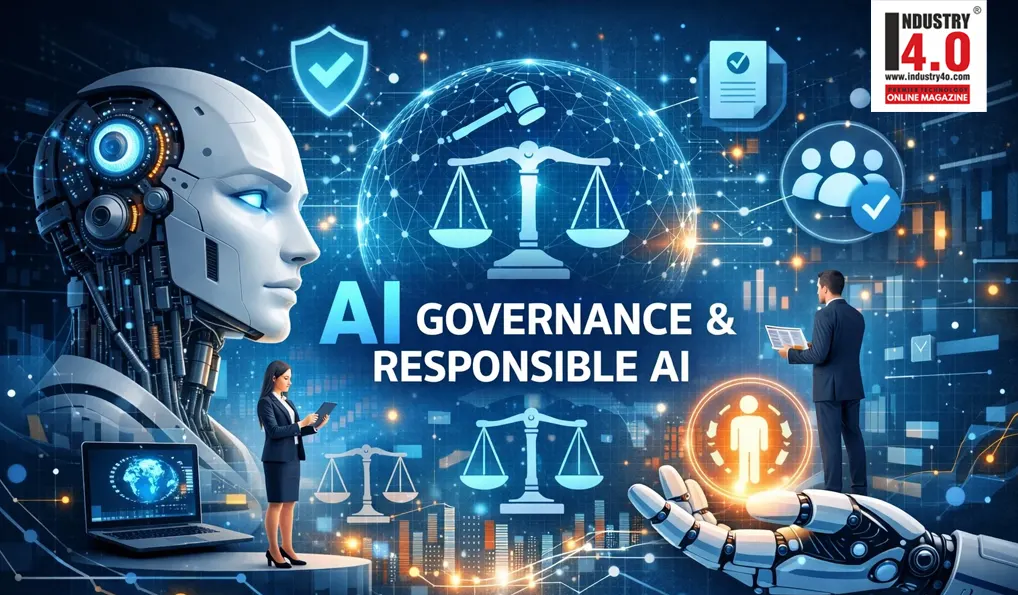
AI Governance : Initiatives, Opportunities & Challenges
“AI will be the best or worst thing ever for humanity” – Elon Musk, Techpreneur
The above-mentioned quotable quote pretty much sums up the state of affairs that we are in. AI adoption has intensified in all walks of life. 2023 will perhaps go down as the year of ChatGPT. Generative AI (Gen_AI) models led by ChatGPT and including Microsoft Co-pilot, Google Gemini, Llama, Whisper, and Claude, using Large Language Models (LLM), not only became pervasive but also impacted all sectors and endeavors of humankind. Over the last couple of years, we also realized that with growing AI adoption, stronger governance is vital to balance innovation with safeguards on accuracy, accountability, autonomy, bias, ethics, fairness, integrity, morality, privacy, safety, transparency, trust, and sustainability

Various challenges and misuse of AI that we encountered included bias, deep fakes, election interference using AI, copyright infringements, job losses, carbon emissions, misinformation, cyber-attacks, monopolistic practices, and low-quality content. Biases could be algorithmic, gender, language, and political in nature. AI regulatory frameworks have come to the fore with all governments engaging in said efforts. Governance of AI technologies has become essential for governments across the world. Over the last decade, 40+ countries have enacted 200+ AI and related legislations while over 90 countries have developed AI governance frameworks, which will eventually translate to legislation. This is a far cry from just one AI legislation in 2016. These governmental efforts are complemented by supranational agencies such as the International Telecommunication Union (ITU) agency of the United Nations (UN) & Organization for Economic Cooperation & Development (OECD). High-technology giants such as Google, OpenAI, Microsoft, Nvidia, Amazon, Meta, and Apple are also shaping the discourse in terms of AI technologies and its impact.
As we stand today, AI governance, regulation, and policy are, at best, a work-in-progress worldwide. Due to the rapid pace of evolution of the technology, a well-defined, comprehensive, and end-to-end AI policy framework remains a challenge. The wish list is that this AI governance framework should offer clarity and direction to all stakeholders, while remaining adaptable to the rapid evolution of technology. This investigation explores the various intergovernmental and supranational initiatives like GPAI, AI for Good, UNESCO AI, AI Impact summit, AI safety summit, and Bletchley declaration towards AI governance and regulation.
Global Partnership on Artificial Intelligence (GPAI)
 Global Partnership on Artificial Intelligence (GPAI) was launched in June 2020 by OECD subsuming earlier discussions on the topic by various nations as early as 2017. India was a founder member of this partnership along with EU and US. This is a global coordination platform that brings together governments, academia, industry, and civil society to ensure AI is developed in a way that is human-centric, ethical, and trustworthy. Various working groups have been formed centered along various themes such as Responsible AI, Data Governance, Future of Work, and Innovation & Commercialization. These efforts have been complemented by UNESCO as well as G20 & G7, who have factored the GPAI inputs and deliberated on AI in their respective summits and working group discussions. The focus is on ethics, policy, and responsible AI and not legislation and there are multiple layers of meetings all year around in addition to a global GPAI summit. These policy recommendations are generally non-binding and feed into major summit agendas including recently-held AI impact summit in India.
AI for Good
AI for Good is a similar initiative of International Telecommunication Union (ITU) in partnership with 40 UN sister agencies towards AI for society. This global- platform aims to identify practical applications of AI to advance the UN SDG and scale these solutions for global impact. These include AI applications in healthcare, education, disaster management, climate change and smart cities. An AI for Good global summit is conducted annually to add to the narrative to:
- Apply AI to real-world global problems
- Accelerate progress toward SDGs
- Promote ethical and inclusive AI
- Foster global collaboration
UNESCO AI framework
The UNESCO AI framework is another important global effort to guide ethical and human-centric AI development. From 2018, this has been in the works as an extension to UNESCO’s mandate to advance ethics of science and digital transformation. Adopted in November 2021 by 190+ countries, this framework sets standards for how AI should be designed, developed, and used responsibly. This is the first truly global AI ethics agreement focusing on the following areas:
- AI Governance & Regulation
- Data Governance
- Education & Skills
- Gender Equality
- Environmental Impact
- Ethical Impact Assessment
This serves as a reference and ethical guideline for national AI laws and policies and is complementary to GPAI and AI for Good, which focus on policy collaboration and application areas respectively. However, all of them are non-binding and part of a shared universe with multi-stakeholders such as government, UN agencies, Tech giants, civil society, and academia. Simultaneously, various countries are also working on their own sets of AI governance frameworks and policy. Some of them like US have been following a market-driven Ai regulatory approach. On expected lines, China has a state-driven approach whereas the EU follows a rights-driven approach.
 AI safety summit
The AI safety summit hosted by the United Kingdom for the first time in 2023 was a landmark event with respect to regulation of AI. The main objective of the summit was to address the risks and safe development of advanced AI systems, especially frontier models like generative AI in the larger context of AI governance. The policy recommendation and deliberations of complementary initiatives such as GPAI, AI for Good and UNESCO AI were feeders to this major global summit. At this summit, most advanced nations such as US, UK, China, India, and the EU more or less agreed towards a road map, which is defined in Bletchley Declaration, a global agreement by national governments towards regulation and human oversight of AI. Signed by 28 nations, this Bletchley Declaration affirms that AI should be designed, developed, deployed, and used in a manner that is safe, human-centric, trustworthy and responsible. A subsequent AI safety summit in Seoul in May 2024 and AI action summit in Paris in February 2025 reaffirmed these concerns. The Seoul summit advocated the establishment of multi-stakeholder safety institutes and testing frameworks to address concerns with respect to AI governance. The Paris summit saw 100 countries participate and sign the declaration on promotion of inclusive and sustainable AI. This summit focused on global coordination, policy alignment, inclusive governance, and balancing innovation with regulation.
Some of the guiding commitments of the Bletchley declaration are as follows:
- Shared understanding of AI risks including General-purpose AImodels also called Frontier of AI especially in areas such as biotechnology, cyber security applications and misinformation.
- International cooperation on AI safety research, standards and policies
- Risk mitigation and safety frameworks
- Scientific and evidence-based policies across countries to ensure safety while recognizing that approaches may differ based on national circumstances and applicable legal frameworks.
AI Impact Summit 2026
 The AI Impact Summit refers to a set of international forums focused on the real-world impact of AI, especially its economic, societal, and developmental consequences. How AI affects economies, jobs, governance, and society, and how to maximize benefits while minimizing risks……
The first AI Impact Summit 2026 hosted by India, marked a significant milestone in global AI dialogue, especially as one of the first large-scale AI summits held in the global south. This summit saw participation from 100+ countries and 20+ international organizations as well as the major tech giants in the AI space. This included foundation model companies (OpenAI, Anthropic, DeepMind), big tech platforms (Google, Microsoft, Amazon, Meta), infrastructure leaders (NVIDIA) and emerging ecosystem players (Indian startups working on sovereign AI and home-grown LLMs). At the AI Impact Summit 2026, the “7 Chakras framework” was used as a conceptual model to organize discussions and actionable policy directions around AI. These chakras represent key pillars of AI development and impact as follows:
- Human capital
- Inclusion
- Innovation
- Governance
- Safety & Trust
- Economic development
- Sustainability
While realizing that AI is a growth engine for economic transformation, this framework and summit provided a structured roadmap for countries to develop AI ecosystems while balancing innovation, inclusion, and safety. Other outcomes included a strong push for inclusive AI with enhanced access for developing nations in the global south, focus on digital infrastructure for public good, enhanced global and multistakeholder collaboration and workforce transformation.

India’s Approach in AI Governance
India is no doubt emerging as a global leader in AI governance and regulation. India’s approach has been pragmatic and non-aggressive as also veering towards combining innovation, inclusion, and ethical oversight without the risk of overregulation. It is a middle path akin to our non-alignment approach in geopolitics. Distinctly stakeholder-centric as opposed to state-focused approach of China or strict rights approach like Europe or market-focused like USA. India has been an active participant of various intergovernmental and supranational forums engaged in AI regulation and governance from their inception. India chaired the GPAI in 2024 and hosted the 2023 edition of the GPAI summit at New Delhi.
The successful conduct of the AI Impact Summit 2026 reaffirms India arriving at the high table of AI governance and regulation. Of course, there remains a lot to be done. An overarching, binding and comprehensive AI act under the ambit of the Digital India act is needed which subsumes multiple laws such as Digital Personal Data Protection Act, 2023; IT Rules, 2021 (platform accountability), sectoral frameworks, and AI governance guidelines.
About the Author:

Dr. Prashant R.Nair
Associate Director – Internal Quality Assurance Cell (IQAC)
President – Institution’s Innovation Council (IIC)
Professor – School of Engineering,
Amrita Vishwa Vidyapeetham (Deemed-to-be-University)

Dr. Prashant R. Nair, Associate Director, Internal Quality Assurance Cell (IQAC) & Professor of Computer Science & Engineering (CSE), Amrita Vishwa Vidyapeetham, Coimbatore, has twenty-six years of academic and administrative experience. Dr. Prashant R. Nair has taught in academic programs in the USA and Europe at University of California, San Diego; Sofia University, Bulgaria and University of Trento, Italy as an Erasmus fellow. Dr. Prashant R. Nair has written 6 books, 2 edited books, 1 book chapter and 75 publications in reputed journals, books and conferences.
Dr. Prashant R. Nair is active as a science writer & columnist. A very sought after speaker, by conservative estimates has addressed 150,000 students and trained 15,000+ faculty on technology, innovation, professional bodies and quality aspects of higher education in India, USA, Thailand, Russia, Italy, Bulgaria, Hong Kong, Singapore, Nepal, Bhutan etc. Awards & recognitions won include PK Das Best Faculty award in computer science & engineering, Padmavibhushan Dr. Murali Manohar Joshi Teacher award, multiple CSI best faculty and academic excellence awards, IEEE Education Society global chapter achievement award, IEEE Presidential coin, IETE & IE fellowships, Fulbright program reviewer, etc.
Dr. Prashant R. Nair is Bestowed with the following Licenses & Certifications
https://www.linkedin.com/in/pr
Dr. Prashant R. Nair can be contacted Contact Details :
E-mail | E-mail (2) | LinkedIn | FaceBook | Webpage | Blog (1) | Blog (2) | Google Scholar | Silicon India | YouTube | Mobile: +91-9943984483
Also read Dr. Prashant R. Nair‘s earlier article :