
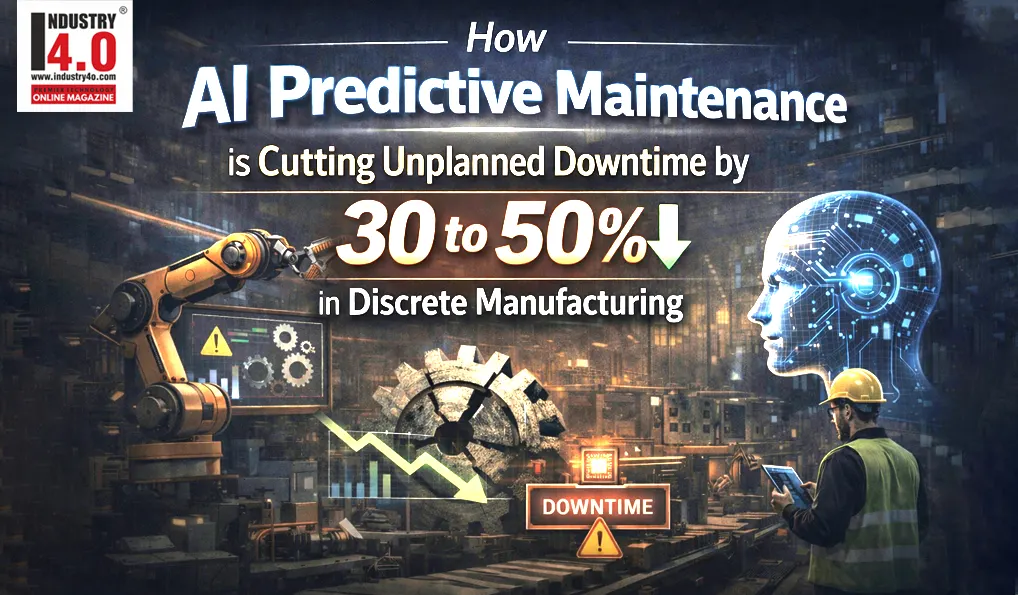
How AI Predictive Maintenance Is Cutting Unplanned Downtime by 30–50% in Discrete Manufacturing
📍 Unplanned Downtime Isn’t a Maintenance Issue ; It’s a Margin Crisis
The Core Shift: From Run-to-Failure → Predict-and-Prevent
In discrete manufacturing (automotive, electronics, aerospace, industrial equipment),
unplanned downtime is one of the largest and least visible profit leaks.

Industry Reality:
Large manufacturing plants lose ~$532,000 per hour due to unplanned downtime
( Forbes / Siemens )
So What?
➡ Plants are losing millions not because machines fail, but because failures are not
predicted in time.
📌 AI Unlocks the “Golden 48 Hours” Humans Can’t See
Why Traditional Maintenance Always Reacts Too Late
Conventional systems rely on fixed thresholds and alarms, they trigger only after
damage is already underway.
Capability Reactive / Preventive AI-Driven Predictive Detection Threshold-based
(late) Pattern-based (early) Accuracy High false positives 80-90% ML accuracy Intervention Window Minutes 24-48 hours Downtime Impact Fully unplanned 30 – 50% reduction
What AI Sees Differently
• Micro-anomalies across vibration, current, thermal, acoustic signals
• Degradation patterns invisible to operators and rules
• Early failure signatures days or weeks before breakdown
Evidence:
 AI models (Random Forest, LSTM) can predict failure cycles with ~80% accuracy,
providing 24–48 hours of lead time
(Journal of Industrial Engineering; McKinsey)
So What?
➡ Predicting failure early creates a 30–50% efficiency buffer operations never had
before.
📌 Cutting Downtime Requires Architecture, Not Just Algorithms
Why AI PdM Succeeds Only with a Structured Data-to-Decision Pipeline
Plants achieving consistent 30–50% downtime reduction follow a disciplined,
repeatable architecture.
The 5-Step PdM Operating Model
1. Sense
IIoT sensors capture vibration, thermal, acoustic, electrical data on bottleneck
assets
2. Ingest
Secure edge-to-cloud ingestion via OPC-UA / MQTT into a unified data layer
3. Model
Machine learning learns historical “failure signatures” and normal behavior
4. Predict
Models estimate Remaining Useful Life (RUL) and failure probability
5. Prescribe
Automated CMMS work orders triggered before failure thresholds are reached
What Leaders Do Differently
• Focus on the top 10–20% of assets causing 80% of downtime
• Embed PdM insights into daily maintenance and operations workflows
So What?
➡ AI PdM becomes a new reliability operating model, not a dashboard experiment.
📌 30–50% Downtime Reduction Is Now an Industry Benchmark
Why the ROI Is Proven Across Discrete Manufacturing
AI Predictive Maintenance is no longer experimental, it is repeatable at scale.
 Real-World Evidence
• Automotive (GM):
Monitored 7,000+ robots, predicted 70% of failures ≥ 24 hours in advance (ThinkAI / GM)
• Semiconductor Fab:
• Heavy Machinery:
18–25% maintenance cost reduction and ~20% asset life extension (Deloitte  Manufacturing Report 2025)
Beyond Downtime
• 5–10% energy reduction
• 14% safety improvement by preventing catastrophic failures
So What?
➡ AI PdM has moved from best practice to competitive baseline.
📌 The Competitive Window Is Closing Fast
Why AI PdM Is a Margin Play Today, and Survival Tomorrow
The gap between AI-enabled plants and legacy maintenance models is widening.
Market Signals
• 85%+ of manufacturers using AI PdM report significant downtime reduction
( Techstack / ResearchGate)

Risk of Inaction
• Structural cost disadvantage
• Higher emergency maintenance exposure
• Lower asset availability & OEE
• Weaker ESG & safety performance
Final Recommendation : Where to Start
Run a 4-week Critical Asset Audit to identify the top 3 machines where a 30%
downtime reduction delivers immediate ROI.
Closing Thought:
AI doesn’t eliminate maintenance work, it eliminates surprises.
And in discrete manufacturing, surprises are the most expensive failures of all.
 About the Author :
 Mr. Gulshan Kumar Saini
Senior Director
Samsung Electronics

Mr. Gulshan Kumar Saini is a global manufacturing, operations excellence, and smart factory transformation leader with over 30 years of leadership experience at Samsung Electronics, spanning senior roles across India, Vietnam, Korea, Russia, and the United States.
Mr. Gulshan Kumar Saini currently serves as Senior Director – Smart Factory at Samsung Electronics India, where Mr. Gulshan Kumar Saini spearheads enterprise-wide digital transformation initiatives across advanced manufacturing lines for consumer electronics and durables.
Mr. Gulshan Kumar Saini leads the deployment of AI-driven manufacturing systems, industrial robotics, IIoT platforms, machine vision, advanced analytics, and Digital Twin technologies to drive next-generation factory performance.
Mr. Gulshan Kumar Saini is widely recognized for delivering large-scale automation, step- change productivity improvements, and sustainable cost, quality, and efficiency gains in high-volume, high-complexity manufacturing environments. Across his career, Mr. Gulshan Kumar Saini has successfully led global NPI programs, greenfield and brownfield plant setups, capacity expansions, lean transformations, and multi-country manufacturing excellence programs.
Mr. Gulshan Kumar Saini is a PMP-certified professional and Six Sigma Black Belt, Mr. Gulshan Kumar Saini also holds an MBA in FinTech from BITS Pilani, combining strong digital, financial, and operational acumen to translate technology into measurable business outcomes.
Mr. Gulshan Kumar Saini is Bestowed with the following Licenses & Certifications:
https://www.linkedin.com/in/gulshan-kumar-saini/details/certifications/
Mr. Gulshan Kumar Saini is Accorded with the following Honors & Awards:
https://www.linkedin.com/in/gulshan-kumar-saini/details/honors/
Mr. Gulshan Kumar Saini can be contacted at:
Linked In | E-mail (1) | E-mail (2)
Also read Mr. Gulshan Kumar Saini‘s earlier article: