
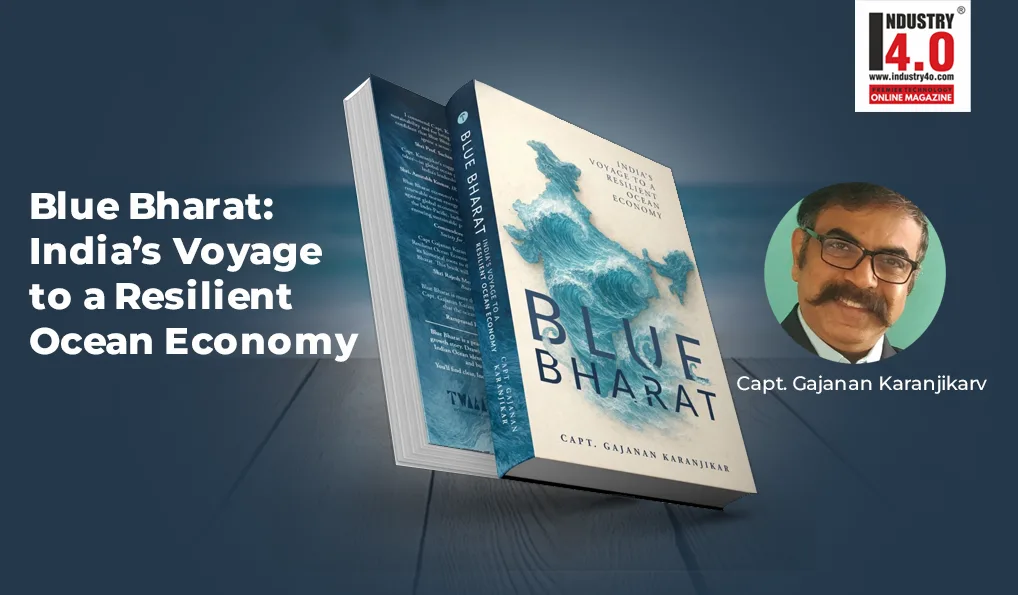
BLUE BHARAT – India’s Voyage to Resilient Ocean Economy “
Overview
India’s oceans are not just geographical frontiers they are engines of growth, resilience, and identity. With a 7,500 km coastline, 2.37 million sq. km EEZ, and 14% of its population living in coastal districts, India’s future is deeply tied to the health and prosperity of its seas.
Blue Bharat brings together insights from over 100 published essays and decades of maritime practice to frame a vision where economy, ecology, and equity sail together. The book explores how India can transform into a resilient ocean democracy by 2047, leading the Global South in sustainable maritime development.

Key Themes
1. Maritime Heritage & Identity
• From Lothal’s dockyards to Sagarmala, India’s history shows a continuous link with the sea.
• Maritime culture and trade networks remain central to India’s soft power.
2. Engines of Growth
• Fisheries & aquaculture employ 16 million people; India is the world’s 2nd largest fish producer.
 • Shipping & ports handle 95% of India’s trade by volume.
Offshore energy and marine biotechnology represent untapped opportunities.
3. Safeguarding Oceans
• Coastal erosion affects over 30% of India’s shoreline.
• 12 of India’s major cities are climate-vulnerable, facing sea-level rise and extreme weather.
• Plastic pollution and untreated wastewater threaten ecosystems and livelihoods.
4. Governance & Justice
• Ocean governance in India remains fragmented across ministries and states.
• Fisher rights, gender inclusion, and community equity are often overlooked.
• Blue Justice emerges as a guiding principle ensuring that growth is inclusive.
5. Technology & Finance
• India is investing in Digital Oceans (INCOIS, NIOT, ISRO satellites).
• Blue bonds, PPPs, and carbon credits could unlock billions in sustainable financing.
• Al, big data, and robotics will redefine shipping, fisheries, and marine monitoring.
6. Diplomacy & Global Leadership
• SAGAR (Security and Growth for All in the Region) anchors India’s Indian Ocean strategy.
• India holds leadership potential in IORA, ISA, IMO, and the new BBNJ treaty.
• Blue Carbon diplomacy can position India as a climate leader in COP forums.
7. Vision 2047: Blue Bharat as Ocean Democracy
• Oceans to contribute 10-12% of India’s GDP.
• India as global hub for Digital Ocean platforms and blue finance.
• Full coastal ecosystem restoration (mangroves, reefs, seagrass).
• Empowered coastal communities and women-led enterprises.
• India as rule-shaper (not rule-taker) in global ocean governance.
Structure of the Book
• Part I – Setting Sail: Heritage, identity, and the strategic importance of oceans.
• Part II – Engines of Growth: Fisheries, shipping, energy, and marine biotech.
• Part III – Safeguarding Blue Bharat: Pollution, climate resilience, governance, and community justice.
• Part IV – Driving Blue Bharat Forward: Innovation, finance, diplomacy, and India’s 2047 vision.
 Why This Book Matters
• Policy Relevance: Aligns with India’s Maritime Vision 2047, Sagarmala, and Blue Economy Draft Policy.
• Global Importance: Connects India’s vision with UNCLOS, BBNJ, IMO, and climate diplomacy.
• People-Centered: Highlights the voices of fishers, seafarers, women, and coastal communities.
• Practical Roadmaps: Data-rich tables, case studies, and visual roadmaps for action.
Closing Thought
As India approaches its centenary of independence, Blue Bharat argues that oceans are not merely frontiers to defend, but futures to define. The book is a call for India to embrace its maritime destiny – becoming a resilient ocean nation that balances prosperity, ecology, and equity for generations to come.
Preface by Author:
Preface
The oceans have always been central to India’s destiny. From the ancient docks of Lothal and the spice routes of Kerala to the bustling container terminals of Mundra and JNPT, the sea has shaped our culture, commerce, and civilization. Today, as the world speaks of the “Blue Economy,” India is rediscovering an eternal truth: our prosperity and resilience are inextricably linked to the health of our oceans.
This book, Blue Bharat: India’s Voyage to a Resilient Ocean Economy, is the culmination of a journey that began with a series of reflections in Sagar Sandesh. Over time, these reflections evolved into more than one hundred essays that explored various facets of the Blue Economy, including fisheries, ports, offshore energy, marine biodiversity, coastal resilience, finance, diplomacy, and community livelihoods. Each article sought to ask a simple but profound question: how can India harness the potential of its seas without compromising their sanctity?
The idea of “Blue Bharat” is not just about economics. It is about weaving sustainability into our national narrative, ensuring that development uplifts coastal communities, protects marine ecosystems, and secures India’s rightful place in the emerging ocean order. It is about recognizing that the Indian Ocean is not merely a maritime highway, but a living, breathing space of opportunity, responsibility, and shared heritage.
This book is the culmination of a decade of sustained study and fieldwork on the Blue Economy-its concepts, policy frameworks, and on-the-ground projects across the globe.
Drawing on research, advisory engagements, and dialogues with practitioners, it brings together a diverse set of case studies from countries that are pioneering ocean-centric development. The aim is to distill what works, where the gaps remain, and how these lessons can guide scalable, resilient, and inclusive blue initiatives for the decade ahead.
As India marches towards its centenary of independence in 2047, the Blue Economy will be a cornerstone of Viksit Bharat. The policies we craft today, the investments we make, and the cultural values we embed in our ocean governance will determine not only our maritime future but also the well-being of future generations.
For thirty centuries, India stood at the very heart of global maritime commerce. From Lothal’s dockyards to the Cholas’ overseas expeditions, from the shipyards of Bombay that built warships for the Royal Navy to the fishermen of today who form the backbone of our coastal economy, the ocean has always been India’s destiny.
However, we often forget this. Colonization, industrial disruption, and policy neglect obscured our maritime legacy. The Blue Economy is not just an emerging global idea; it is a rediscovery of India’s own heritage, reimagined for sustainability and equity. This book, Blue Bharat, is my attempt to weave that past with the present, and to envision an ocean future where India leads not by exploitation, but by stewardship.
This book brings together ideas, policies, case studies, and experiences that I have written, witnessed, and lived. It is both a call to action and a reflection of hope. A call for India to embrace innovation, inclusivity, and international cooperation in shaping its Blue Economy, and a hope that Blue Bharat will stand as a model of balance, where prosperity and sustainability sail hand in hand.
When I began writing Blue Bharat, I wanted a precise map, not just a manifesto. Recent work, led by the MoES (Ministry of Environment and Science) and partners, provides a map of policy anchors, MSP pilots, investment frontiers, and replicable models from Odisha to the Andaman Islands. If we now match this architecture with disciplined delivery, coordinated institutions, investable pipelines, and community ownership, India can lead a just, innovative ocean economy well before 2047. This book is my small contribution to that shared voyage.
As I listened to the Prime Minister’s call of “Samudra se Samriddhi,” I heard more than a slogan -I heard a framework for Blue Bharat. His emphasis on port-led development, deeper harbours, and more innovative last-mile logistics directly reinforces this book’s central thesis: India’s resilience and growth will ride on ocean arteries. The message is clear -coastal shipping, inland-waterway linkages, shipbuilding, and maritime services must work as a unified system, lowering logistics costs, accelerating exports, and creating dignified livelihoods from boatyards to backwaters. That vision extends beyond complex infrastructure to climate-ready ports, cleaner fuels, digital maritime corridors, and a skilled coastal workforce, precisely the building blocks of a resilient voyage for India.

Blue Bharat takes that cue and turns it into a practitioner’s playbook. If “sea to prosperity” is our compass, then our course is to align policy with projects: coastal freight corridors that decongest highways, green bunkering and hydrogen pilots at major ports, safer fisheries with cold-chain value addition, ocean-energy demonstrators, and biotech-led blue ventures that respect marine ecology. The Prime Minister’s speech, read in this light, is not a distant promise but an operating manual, urging us to stitch together river-sea synergies, insure against climate shocks, and convert maritime geography into national competitiveness. This preface, therefore, is both acknowledgement and intent: Blue Bharat will help translate that call into actionable cases, resilient institutions, and measurable gains for India’s ocean economy.
I dedicate this work to the seafarers, fishers, scientists, policymakers, and communities who live by the sea, work with the sea, and protect the sea. Their voices, struggles, and resilience are the actual anchors of India’s ocean story.
I believe that this voyage of Blue Bharat is just beginning. The tides are with us, and if we navigate wisely, India’s oceans will not only secure our national growth but also make a meaningful contribution to global sustainability.
“Yearning is all you need in order to realize God” – Shri Ramakrishna
 About the Author :

Senior Consultant ( Accident / Incident Investigation )
FMC International

Capt. Gajanan Karanjikar is a master mariner, maritime consultant, and thought leader whose career spans over three decades, both at sea and ashore. With command experience on large bulk carriers and VLCCs, as well as senior management roles overseeing fleets, ports, and marine operations in India, Singapore, the Middle East, and the United States, he has lived the ocean from the bridge, the boardroom, and the policy table.
Capt. Gajanan Karanjikar currently serves as President of the All-India Maritime Pilots’ Association (AIMPA) and as Senior Consultant at FMC International LLC, USA, advising on vessel operations, safety, and maritime governance in the Gulf Coast and Mississippi River region. He is also Managing Director of Cordelia Marine Services, leading initiatives in India and the UAE to strengthen pilotage safety, port development, and maritime training.
Capt. Karanjikar‘s leadership has been recognized widely. Capt. Gajanan Karanjikar was honored as the “Maritime Icon of India 2024” for his contributions to pilot safety and maritime reforms. Capt. Gajanan Karanjikar is a Fellow of the Company of Master Mariners of India (CMMI), a certified marine surveyor, and a flag-state inspector, frequently called upon as an expert witness in international maritime arbitration cases.
A passionate advocate of sustainability, he is an alumnus of the Cambridge Institute for Sustainability Leadership and an active voice in promoting India’s Blue Economy Vision. Capt. Gajanan Karanjikar‘s research and writings bridge the realms of policy, practice, and people, encompassing topics such as accident investigation and human factors, as well as blue carbon finance and river-based development.
Beyond professional achievements,Capt. Karanjikar is an active writer and storyteller. He has authored over 100 essays on India’s Blue Economy in Sagar Sandesh, contributed to anthologies such as The Sea Within, and is currently developing book projects on marine investigations, Riveronomics, and human factors in shipping.
In Blue Bharat: India’s Voyage to a Resilient Ocean Economy, he brings together his lived experiences, policy insights, and scholarly reflections to chart India’s maritime future. The book reflects his conviction that India’s path to prosperity and resilience lies in becoming a true Ocean Nation, balancing its economy, ecology, and equity.
Capt. Gajanan Karanjikar can be contacted at :
LinkedIn | E-mail | Website (1) | Website (2)
India: +91 75064 13035 (Only WhatsApp) | US : +1 504 314 6843 | +1 504 982 1117