
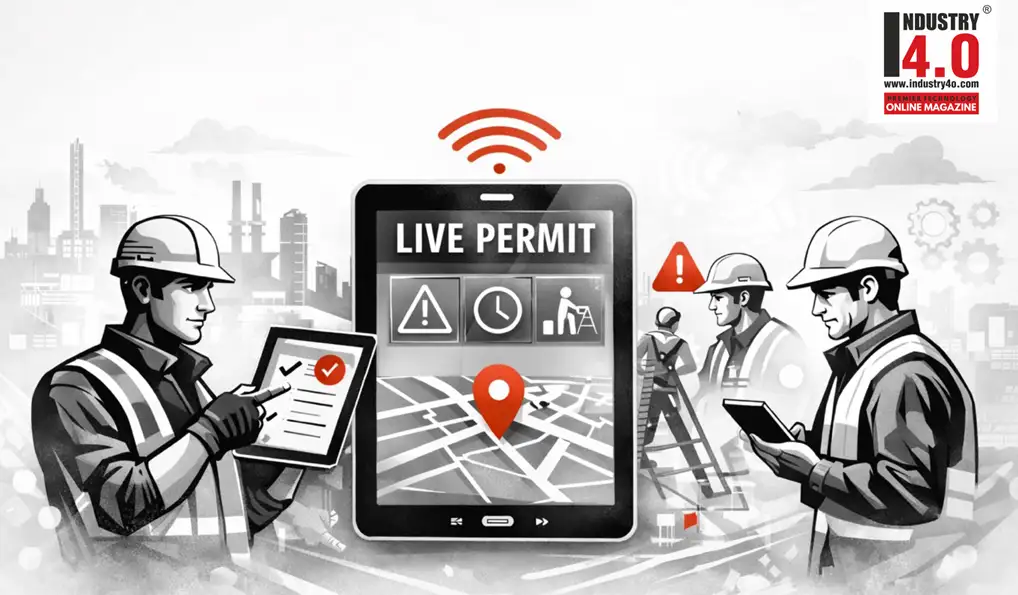
Live Permits: real-time Permit-to-Work (PTW) based on
location – from bureaucracy to collaboration between OHS and Maintenance
How do digital Live Permits transform “work orders” into a process that keeps pace with reality?
In many industrial plants, work permits still act as a “handbrake” for organizations: paper, signature circulation, scattered information, lack of up-to-date information, and limited visibility of what is actually happening on site. The problem is not just about convenience – it’s about safety, accountability, and the ability to respond quickly to changing working conditions.
Meanwhile, dangerous and critical work (e.g., hot work, work at height, work in hazardous areas, servicing during plant operation) does not happen according to an “ideal plan” — it happens in a dynamic, changing environment. This is why classic work orders often lose out to reality: they are not updated, they are not consistent with who is actually where, and they do not create a single version of the truth for health and safety, maintenance, and external companies.

Live Permits is an approach in which a work permit is not a document “for the archives,” but a living operational process — updated in real time, linked to the location and status of activities on site. This is how we build the system at InnerWeb®.
The challenge: safety vs. speed vs. complexity of operations
Before we move on to technology, it is worth identifying the sources of friction that almost always arise in work permit processes:
• Multi-layered responsibility: health and safety, UR, production, security, fire protection, supervision – each has its own piece of the risk and its own “minimum
necessary.”
• Changing conditions: weather, availability of utilities, parallel work, schedule, changes, vehicle traffic, presence of subcontractors.
• Outdated data: paper does not “know” that the team has changed location, work
has been delayed, or a new hazard has appeared in the area.
• Dispersion of information: training, authorizations, risk assessments, instructions,
lockouts/LOTO, approvals – often in different systems or outside the system
altogether.
• Cost of bureaucracy: signatures and document circulation take time that should be spent on planning, supervision, and real prevention.
As a result, the organization chooses between two bad options: either the process is “tight” but slow and cumbersome, or fast but risky. Live Permits are designed to resolve this conflict — through automation, consistency, and timeliness, not by “letting go” of safety.
 Where do Live Permits provide an operational advantage?
Below are the key areas where the “live” approach really changes the quality of the
process.
1. Digital permits as a common “point of truth”
The work permit becomes the central object of the process, rather than a form.
• A single process record: scope, risks, requirements, decisions, attachments, confirmations.
• Versioning and change history – who, when, what was approved or changed. Mobile access for field teams and approvers.
Example: instead of a piece of paper circulating, all parties see the same permit – with the current status and conditions for starting/continuing work.
2) Real-time updates – a process that keeps pace with change
The biggest difference between an “e-permit” and Live Permit is that the permit is not static.
• Dynamic statuses: preparation → ready to start → in progress → suspended →
completed → closed.
• Stop-work mechanisms when conditions change or requirements are violated.
• Communication and notifications to the appropriate roles (health and safety/UR/supervision/security/contractor).
Example: if a new risk arises in the zone (e.g., parallel work, leak, parameter exceedance), the permit can be automatically switched to “suspended” mode until corrective actions are confirmed.
3) Location as a safety context (geofencing, zones, plan compliance)
At the heart of the InnerWeb® approach is the linking of work permits to the
actual workplace.
• Assigning a permit to a zone/area/workstation (virtual map of the plant).
• Geofencing: checking “whether work is happening where it is supposed to
happen.”
• Situational view: where work is active, where teams are, where risk zones are.
Implementation example: in one of the EU-funded pilot projects at the MAN Trucks
plant in Niepołomice, the process included monitoring work permits, training
requirements for external companies and visitors, along with familiarization with the
current risks when entering the plant, alongside the location of trucks and drivers
moving around the facility – using the dense infrastructure of InnerWeb® Industrial
Radio Beacons (over 200 BLE transmitters on the plant’s internal roads). This shows
that work permits can operate in the same “data language” as logistics and traffic
safety at the plant.
4) Competencies and authorizations – “who can” is verified automatically
Live Permits is not just a form – it is compliance logic.
• Verification of training, qualifications, and job requirements before admission to
work.
• Start-up checklists (PPE, tools, safety measures, zones, instructions).
• Register of persons authorized to work under a specific permit.
Example : if current training and specific qualifications are required for hot work, the
system can block the start of work without meeting the conditions.
5) Particularly hazardous work : standards, LOTO, and condition control
For high-risk areas, repeatability and clarity of standards are important.
• Permit templates (e.g., hot work, work at height, work in confined spaces).
• Integration of procedures: risk assessment, instructions, fire safety requirements,
locks/LOTO, measurements.
• Enforcement of critical step confirmations (e.g., energy isolation, zone security, fire
safety readiness).
Example : Activating a permit to work in a confined space may require confirmation
of atmospheric measurements and a rescue plan – without this, the “in progress”
status is not possible.
6) Cooperation with security and gate –admission and verification at the entrance
In practice, many problems begin at the entrance to the facility: incomplete
documents, lack of confirmations, unclear scope.
• Quick verification: who is entering, why, to which zone, and under what conditions.
• Linking entry with an active permit and a list of authorized persons.
• Solving problems “on the spot” instead of sending the team away and generating
downtime.
Example : security can see whether a person has active access to a specific job and
zone, instead of relying on paper or declarations.

Additional features that complete the picture of the plant’s “operating system”
Live Permits work most effectively when they are part of a broader ecosystem: safety, maintenance, and logistics.
• Work and risk map – a view of “what is being done where” and what work is
being done in parallel.
• Alerts and escalations – including overtime, unauthorized entry into a zone, work
conflicts.
• Reports and audits – a complete audit trail for inspections, audits, and event
analysis.
• Operational analytics – bottlenecks in approval, typical causes of delays,
supervision workload.
• Mobile mode and field work – focused on the contractor and foreman, not just
the office.
• Resource location – people, vehicles, selected tools and equipment (where it
makes sense for the process).
Key success factors for Live Permits implementation
a) Data consistency and integrations
The less manual rewriting, the greater the timeliness and the lower the risk of error.
In practice, integrations with HR/training, contractor registration, maintenance, and,
where appropriate, security and access control areas are important.
b) Process design, not “paper digitization”
The most common mistake is to transfer paper 1:1 to the application. Live Permits
require the design of roles, decisions, checkpoints, and conditions for suspension / unblocking.
c) Common definition of risk (health and safety + UR)
The greatest value is achieved when UR and OHS stop “competing” with the
process and start running it together – with a clear division of responsibilities and
shared situational awareness.
d) Information security and compliance
Data on work, people, and location must be protected. At the same time, access
policies, retention, roles, and responsibilities must be planned.
Risks and issues to consider
• Privacy and GDPR: location and access to data must be purposeful,proportionate, and well described in terms of process.
• Operational trust: the system must operate stably, and suspension rules must not
generate false alarms.
• Location quality: it is worth clearly defining in which cases location is “critical”
and where it is “supportive.”
• Change management: without training on roles and field practices, even the best
system will become just another tool “on the side.”
What’s next: from “LIVE” permits to predictive prevention
The next step is to use data from the process (statuses, holds, conflicts, events,
locations, schedules) to predict risks and eliminate them in advance:
• Identification of typical scenarios in which work is suspended,
• Recommendations for start conditions based on history and context,
• Automatic detection of conflicts between parallel works,
• “Digital situational awareness” for supervision and security services.
Live Permits is the foundation: if an organization has a single version of the truth about field work, it can realistically move from reaction to prevention.
Conclusions
Live Permits is a practical response to a problem that is commonplace in many plants today: safety requires tightness, and operations require speed. Digital work orders with real-time updates — linked to location and compliance requirements – allow these goals to be reconciled without compromising safety.
At InnerWeb®, we build solutions for industrial environments where it is not only “compliance on paper” that counts, but also real control of working conditions, transparency for stakeholders, and the ability to respond quickly. Our implementations and pilot projects show that this model works when it covers the entire ecosystem: health and safety, maintenance, contractors, security, and logistics on site.
 About the Author :
 Mr. Marcin Worecki,
CEO & Founder
InnerWeb Sp. z o.o.

Mr. Marcin Worecki, CEO of InnerWeb®, is a visionary engineer with over 20 years of technical and industrial experience.
Together with his team, Mr. Marcin Worecki creates unique legal technology for modern industrial plants based on his own experience, customer requirements, and a deep understanding of the global problem of work permits in industrial plants.
As a result, the InnerWeb® System covers the entire process of managing external technical personnel, from training upon entering the plant, through written instructions for work and particularly dangerous work, as well as audits, acceptance, and permit renewals. InnerWeb® combine electronics, physics, algorithms, artificial intelligence, augmented reality, blockchain, web and mobile applications.
InnerWeb® has based their legal technology on a real-time location system, which also allows InnerWeb® to supervise the work being carried out, improve safety and alert in case of danger, which InnerWeb® protect with a patent in 23 countries (EU and US).
New technological solutions are InnerWeb®‘s passion, allowing InnerWeb® to fully realize their potential. InnerWeb® is open to cooperation and focused on completing the tasks assigned to them. InnerWeb® deliver extremely difficult projects and objectives, making the impossible possible. InnerWeb® operate quickly, dynamically, effectively, and proactively.
Mr. Marcin Worecki can be contacted at:
About InnerWeb® :

InnerWeb® provides technologies for industrial environments, focusing on safety, maintenance, and organizational efficiency.
InnerWeb® combine software and infrastructure (including BLE) to build location and process solutions, such as Live Permits (mobile work permits) and systems that support real-time risk control.
InnerWeb® carry out projects in the form of implementations and pilot programs, including co-financed projects, where, in addition to process digitization, verification of operational value in real plant conditions is key.
InnerWeb® can be contacted at :
InnerWeb®
ul. Michała Grażyńskiego 14
43-300 Bielsko-Biała, Polska
InnerWeb®’s Social Media Handles :
LinkedIn | Website | Youtube | Facebook
For InnerWeb® Technical Support : Email
Tel: +48 668 669 621
For InnerWeb® Commercials Service : Email
Tel: +48 668 669 328