
Intelligent AI Delegation : The Missing Layer for Scalable, Trustworthy AI Systems.
Artificial Intelligence is rapidly moving beyond simple chat interfaces into autonomous agents capable of executing complex workflows. But as organizations scale AI adoption, a critical question emerges:
👉 How do we safely and efficiently delegate tasks across AI agents and humans?
The concept of Intelligent AI Delegation provides a powerful framework to solve this challenge — enabling AI systems to decompose problems, assign responsibilities, monitor execution, and adapt dynamically.
This article explores the core ideas, practical implications, and why this paradigm will define the next generation of enterprise AI.
 🚀 What is Intelligent AI Delegation?
Intelligent delegation is defined as a structured decision process that includes:
• Task allocation
• Transfer of authority
• Accountability
• Clear roles and boundaries
• Trust mechanisms
It goes far beyond simple task splitting — it introduces governance, safety, and adaptabilityinto AI workflows.
In essence, it transforms AI from a tool into a coordinated workforce.
🧠 Why Traditional AI Orchestration Falls Short
 Most current multi-agent systems rely on static rules or heuristics. While useful for prototypes, they struggle in real-world environments because they:
❌ Cannot adapt to changing conditions
❌ Lack robust failure recovery
❌ Provide limited transparency
❌ Struggle with trust and accountability
The research highlights that real deployments require dynamic systems capable of continuous assessment and adjustment.
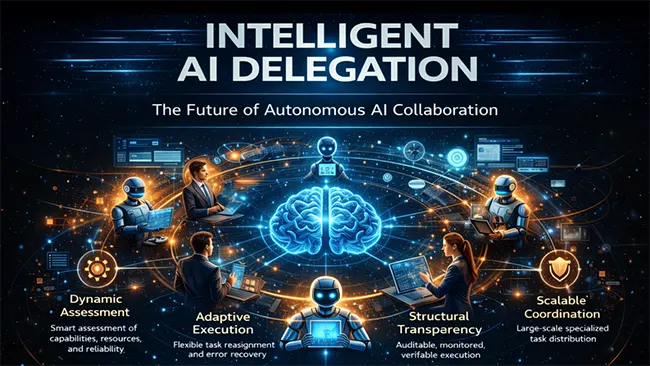
🏗️ Core Pillars of Intelligent Delegation
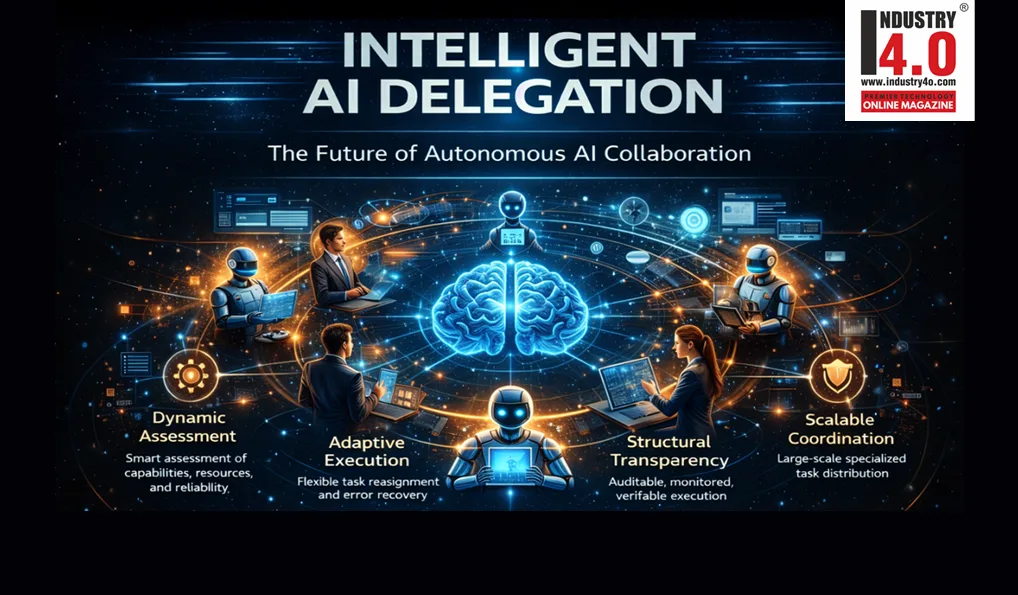
1️⃣ Dynamic Assessment
AI systems must continuously evaluate:
• Capabilities
• Resources
• Reliability
• Context
This ensures tasks are assigned to the most suitable agent at any moment.
2️⃣ Adaptive Execution
Delegation should not be static.
Systems must be able to:
✔ Reassign tasks mid-execution
✔ Respond to failures
✔ Adjust to resource changes
This creates resilience in complex environments.

3️⃣ Structural Transparency
Opacity is a major risk in AI workflows.
The framework emphasizes:
• Auditability
• Monitoring
• Verifiable execution
This ensures accountability across the delegation chain.
4️⃣ Scalable Coordination
 Future AI ecosystems will operate like markets where agents negotiate tasks.
This enables:
• Efficient resource allocation
• Specialized agent collaboration
• Large-scale coordination
5️⃣ Systemic Resilience
Without proper protocols, failures can cascade across systems.
Intelligent delegation introduces safeguards such as:
• Permission controls
• Security checks
• Redundancy
⚙️ How the Delegation Process Works
Step 1 — Task Decomposition
Complex goals are broken into smaller tasks optimized for efficiency and verification.
Step 2 — Task Assignment
Agents are matched based on capability, cost, and reliability.
Step 3 — Monitoring
Execution is tracked through outcome and process monitoring.
Step 4 — Optimization
Systems continuously balance trade-offs like cost, speed, and accuracy.
Step 5 — Adaptive Coordination
Tasks are reassigned if performance drops or conditions change.
These steps form a continuous feedback loop that improves reliability over time.
🤝 Human + AI Collaboration
One of the most powerful insights is that delegation isn’t just AI-to-AI.
It includes:
• Human → AI
• AI → AI
• AI → Human
This hybrid model leverages the strengths of both — computational speed and human judgment.
📊 Real-World Applications
Enterprise Automation
End-to-end workflow orchestration across departments
Autonomous Software Development
Agents planning, coding, testing, and deploying
Healthcare Decision Support
AI delegating tasks while keeping humans in the loop
Digital Economies
Agent marketplaces negotiating services
Robotics
Coordinated multi-robot task execution

⚠️ Key Challenges to Solve
Despite its promise, intelligent delegation introduces new risks:
• Trust calibration
• Alignment issues
• Monitoring overhead
• Privacy concerns
Addressing these will be crucial for safe adoption.
🔮 The Future: The Agentic Web
The research suggests we are moving toward an agentic web — a digital ecosystem where autonomous agents collaborate at scale.
In this world:
• AI will manage complex operations
• Markets of agents will emerge
• Trust and reputation systems will become critical
Organizations that understand delegation frameworks today will lead tomorrow.
💡 Key Takeaways
✅ Delegation is the foundation of scalable AI
✅ Trust and monitoring are non-negotiable
✅ Hybrid human-AI systems deliver the best outcomes
✅ Adaptive coordination enables resilience
✅ Governance will define successful AI adoption
🧩 Final Thoughts
Intelligent AI Delegation represents a shift from automation to orchestration.
As AI systems grow more autonomous, the ability to coordinate tasks safely and efficiently will become the defining capability of modern digital infrastructure.
For leaders, engineers, and AI strategists, understanding this framework is no longer optional — it’s essential.
Intelligent AI Delegation
Nenad Tomašev, Matija Franklin, Simon Osindero
Paper : https://arxiv.org/abs/2602.11865
 About the Author :
 Er. Shailesh Kumar Khanchandani
Project Manager – AI Product & Delivery
Vishleshan AI Solutions

Er. Shailesh Kumar Khanchandani is a results-oriented Project Management professional with over 12 years of diverse industry expertise, including 4+ years specializing in Enterprise AI, LLM Systems, and Digital Transformation.
Er. Shailesh Kumar Khanchandani career is defined by a unique blend of technical depth—anchored by an ME with Honors in Computer Science Engineering—and strategic leadership in driving high-scale ERP, EdTech, and AI/ML-based solutions.
Er. Shailesh Kumar Khanchandani currently is a Project Manager (AI Product & Delivery) at Vishleshan Software Solutions.
Er. Shailesh Kumar Khanchandani lead the implementation of enterprise-grade AI and workflow automation for industrial giants.
Er. Shailesh Kumar Khanchandani specialize in creating measurable operational efficiency through advanced technologies such as LLM fine-tuning, RAG pipelines, and intelligent assistant solutions.
Er. Shailesh Kumar Khanchandani Core Expertise’s are:
 AI & ML: RAG Pipelines | LangChain | Neural Networks | NLP |
Generative AI
Project Management: Agile/Scrum | SDLC | JIRA | TRELLO | Stakeholder
Engagement
Leadership at Scale: Managed cross-functional teams of 80+
individuals, overseeing complex lifecycles from ideation through UAT.
Enterprise ERP: Directed large-scale Education ERP implementations
(Admission, Exam, SRM modules).
Full-Stack & Design: Python (FastAPI) | React | Node.js | UI/UX (Adobe
XD, Figma)
Platforms: AWS | Docker | Salesforce | Zoho CRM
Beyond delivery, Er. Shailesh Kumar Khanchandani is a published researcher and contribute to the academic community as a Guest Faculty at MBM University, lecturing on AI and Computer Networks.
Er. Shailesh Kumar Khanchandani is passionate about building practical, impactful AI products that transform government processes, educational systems & large-scale enterprise environments.
Er. Shailesh Kumar Khanchandani is Bestowed with the following Licenses & Certifications:
https://www.linkedin.com/in/
Er. Shailesh Kumar Khanchandani can be contacted at:
Website | LinkedIn | Facebook | Instagram | Email | X
Mobile : +91-89468 64160