
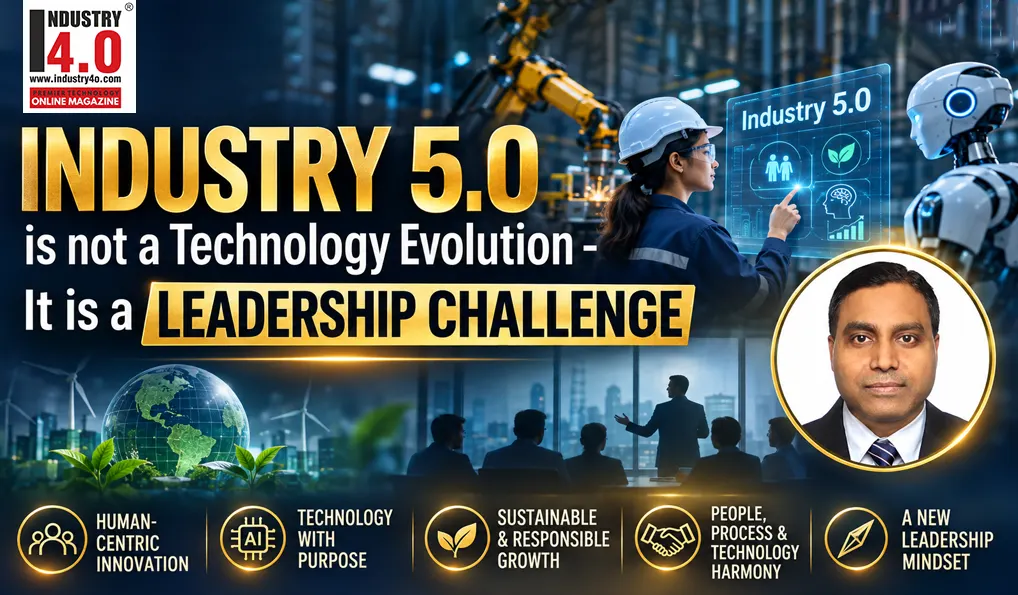
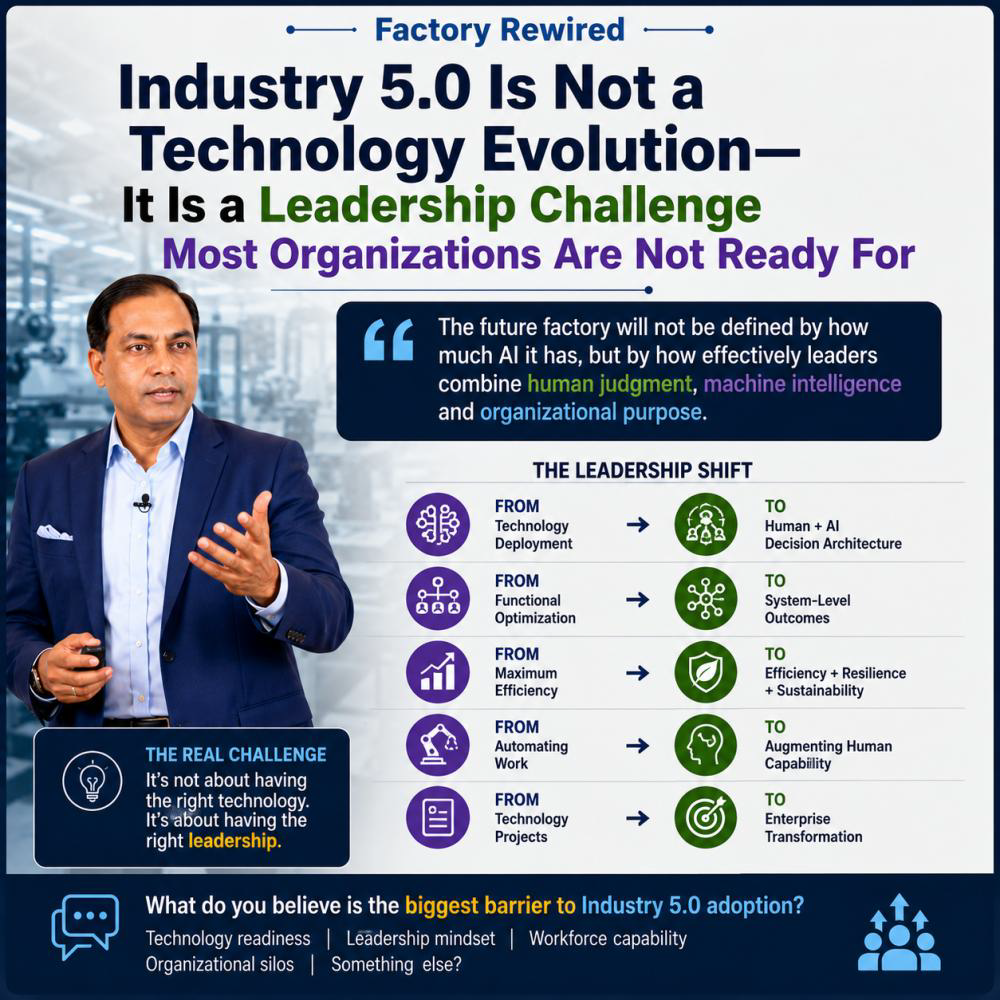
Industry 5.0 Is Not a Technology Evolution; It Is a Leadership Challenge Most Organizations Are Not Ready For
Industry 5.0 is often presented as the next technology revolution.
👉 But the real disruption is not the technology, it is the leadership challenge of deciding how humans, AI and intelligent systems will work together.
 For years, manufacturing transformation followed a familiar logic:
📍Invest in technology → digitize processes → automate operations → improve efficiency.
Industry 4.0 largely reinforced that model.
Connect the machines. Collect the data. Deploy AI. Automate decisions.
But Industry 5.0 introduces a more difficult question:
What should technology enable—and who should be responsible for deciding?
That is why Industry 5.0 is not simply the next stage of technology adoption.
🔖 It is a leadership challenge.
And that distinction matters.
Because a company can buy advanced technology much faster than it can build the leadership capability required to use that technology well.
1️⃣ The Technology Is Moving Faster Than the Organization
AI, robotics, digital twins, advanced analytics and autonomous systems are becoming increasingly capable.
But technology capability is only one side of transformation.
The harder side is organizational readiness.
✅ Consider the questions many manufacturing leaders are now facing:
- Which decisions should AI make autonomously?
- Which decisions must remain human-led?
- How do we redesign roles when automation changes the nature of work?
- How do we balance productivity with resilience?
- Who owns decisions that cut across operations, supply chain, engineering and IT?
- How do we measure success beyond cost and efficiency?
These are not software configuration questions.
🔖 They are leadership questions.
And many organizations are still structured for a world where technology supports existing processes, not one where technology fundamentally changes how decisions, responsibilities and value creation are organized.
2️⃣ The Real Shift: From Technology-Centric to Leadership-Centric Transformation
Industry 4.0 asked:
How can technology make the factory more efficient?
✅ Industry 5.0 asks:
How can technology, people and purpose work together to create better outcomes?
That sounds like a subtle shift.
It is not.
It changes the leadership agenda.
A technology-centric transformation can often be managed as a portfolio of projects:
- Implement MES
- Deploy IoT
- Automate inspection
- Introduce AI
- Build a digital twin
Each project has a budget, sponsor, implementation team and ROI.
🔖 Industry 5.0 is more complicated.
Its outcomes depend on how the entire organization operates together.
Human capability. Decision rights. Operating models. Work design. Resilience. Sustainability. Technology governance.
That cannot be solved by launching another digital project.
See content credentials
3️⃣ The Leadership Challenge #1: Deciding What Humans Should Continue to Do
✅ The wrong question is:
“What jobs can we automate?”
A better question is:
“Where does human judgment create the highest value?”
As AI becomes more capable, organizations face a critical design decision.
Some activities should be automated.
Others should be augmented.
And some decisions should remain firmly human-led.
For example:
AI can be exceptionally effective at: 
- Detecting patterns
- Processing large volumes of data
- Identifying anomalies
- Predicting potential outcomes
- Simulating scenarios
- Recommending optimal actions
Humans remain essential for:
- Contextual judgment
- Strategic trade-offs
- Ethical decisions
- Accountability
- Leadership
- Innovation
- Managing ambiguity
- Deciding what matters
🔖 The future factory does not need fewer humans.
It needs humans working at a higher level of decision-making.
But that requires leaders to redesign work—not simply automate existing tasks.
4️⃣ The Leadership Challenge #2: Moving From Efficiency to Resilience
✅ For decades, manufacturing leadership has been trained to remove:
- Waste
- Inventory
- Capacity buffers
- Cost
- Variability
Efficiency remains important.
But recent disruptions have exposed a weakness in an efficiency-only mindset.
A highly optimized system is not automatically a resilient system.
The cheapest supplier may create the highest supply risk.
The lowest inventory may create the greatest production vulnerability.
The most efficient production network may be the least adaptable.
Industry 5.0 requires leaders to manage trade-offs, not just optimize individual metrics.
The question becomes:
What level of efficiency are we willing to trade for greater resilience— and where?
🔖 That requires a different leadership capability.
Because resilience cannot be managed effectively when every function is optimizing only its own KPI.
- Procurement may optimize cost.
- Supply chain may optimize inventory.
- Operations may optimize utilization.
- Finance may optimize working capital.
But the business ultimately experiences the consequences as one system.
Industry 5.0 leadership requires system-level thinking.
5️⃣ The Leadership Challenge #3: Breaking the Functional Optimization Trap
✅ One of the biggest barriers to Industry 5.0 is organizational fragmentation.
Technology increasingly connects the factory.
But leadership structures often remain disconnected.
Consider a simple example.
An AI system identifies a potential supply disruption.
Who decides what happens next?
- Procurement?
- Supply chain?
- Manufacturing?
- Planning?
- Finance?
The answer cannot always be determined by an escalation matrix created years ago.
As systems become more intelligent and real-time, organizations need faster and clearer decision mechanisms.
 This means leadership must redesign:
Decision rights
Who has the authority to act?
Decision speed
How quickly can the organization respond?
Decision intelligence
What data and AI insights are available?
Decision accountability
Who owns the outcome?
🔖 The competitive advantage will increasingly come from organizations that can sense, interpret, decide and act faster across functional boundaries.
6️⃣ The Leadership Challenge #4: Creating Trust in AI-Augmented Decisions
Many organizations are investing heavily in AI.
But investment does not guarantee adoption.
✅ The hidden problem is trust.
If an AI system recommends changing a production plan, increasing safety stock or shifting capacity, the critical question is:
Will the people responsible for the outcome trust the recommendation enough to act?
If the answer is no, the AI becomes another dashboard.
Technology can generate recommendations.
Leadership must create the environment in which those recommendations can be:
- Understood
- Challenged
- Validated
- Governed
- Used responsibly
This requires more than AI training.
It requires a new management culture.
🔖 People need to understand:
When should I trust the system? When should I challenge it? When should I override it? And who is accountable when the decision is wrong?
Those questions are still unresolved in many organizations.
7️⃣ The Leadership Challenge #5: Measuring What Actually Matters
Perhaps the biggest leadership mistake is trying to measure Industry 5.0 with Industry 4.0 metrics alone.
✅ If every initiative must prove itself only through:
- Labor reduction
- Cost savings
- Productivity
- Utilization
- Headcount reduction
 then leaders may unintentionally optimize against the broader objectives of Industry 5.0.
The future manufacturing scorecard must become wider.
It should include:
Performance
Are we improving productivity and competitiveness?
Resilience
Can we absorb and recover from disruption?
Human capability
Are people becoming more capable and effective?
Sustainability
Are we reducing resource intensity and environmental impact?
Adaptability
How quickly can the organization respond to change?
🔖 The objective is not to replace efficiency.
It is to put efficiency into a larger definition of performance.
8️⃣ The Leadership Operating Model for Industry 5.0
The organizations most prepared for Industry 5.0 will build leadership capability around five areas:
- Purpose
Technology investments must connect to a clear business and operational purpose.
Not:
“Where can we use AI?”
But:
“What business problem, capability or outcome are we trying to improve?”
- People
Roles must evolve from task execution toward:
- Judgment
- Problem-solving
- Exception management
- Innovation
- Collaboration
The goal is not simply automation.
It is human capability amplification.
- Decision Architecture
Organizations need clarity on:
AI decides. AI recommends. Humans decide. Humans govern.
Without this architecture, AI creates confusion rather than speed.
- Cross-Functional Leadership
Industry 5.0 problems rarely fit neatly inside one department.
Leaders must increasingly manage across:
- Operations
- Engineering
- Supply chain
- IT
- Data and AI
- Finance
- Sustainability
The next generation of manufacturing leaders will need to think less like functional owners and more like system architects.
- Adaptive Governance
The operating environment is changing too quickly for static rules alone.
Organizations need governance that allows experimentation while maintaining:
- Accountability
- Risk management
- Human oversight
- Data integrity
- Responsible AI practices
The challenge is finding the balance between control and adaptability.
Too much control slows innovation.
Too little creates unmanaged risk.
The Biggest Mistake Leaders Can Make
9️⃣ The biggest mistake is treating Industry 5.0 as another technology roadmap.
It is not.
✅ You cannot simply move from:
IoT → AI → Robotics → Industry 5.0
Industry 5.0 is not a technology stack.
It is a shift in how leaders think about the relationship between:
People + Technology + Business + Society + Sustainability
The factories of the future will certainly be more automated.
They will also be more intelligent.
But intelligence alone will not create competitive advantage.
The differentiator will be leadership capability.
Two manufacturers can deploy similar AI platforms.
- They can use similar robotics.
- They can access similar technologies.
🔖 But one organization may create far more value because its leaders know:
- Where to apply technology
- Where humans must lead
- How to manage trade-offs
- How to redesign decisions
- How to build trust
- How to align the organization around shared outcomes
That is much harder to copy than technology.
🚨 The Question Manufacturing Leaders Should Be Asking Now
Instead of asking:
“What Industry 5.0 technologies should we implement?”
📍 Start asking:
“Is our leadership model ready for a factory where humans and intelligent systems increasingly make decisions together?”
That is the real readiness test.
👉 Because Industry 5.0 will not be won by the organization with the most technology.
It will be won by the organization with the clearest leadership, strongest decision-making capability and the ability to combine human intelligence with machine intelligence.
The next factory transformation is not only happening on the shop floor.
It is happening in the leadership room.
🎤 Your Turn
What do you see as the biggest barrier to Industry 5.0 adoption in manufacturing?
🔹Technology readiness? 🔹 Leadership mindset? 🔹 Skills and workforce capability? 🔹Organizational silos? 🔹Lack of a clear business case?
🗨️ Share your perspective. The most interesting Industry 5.0 discussion may not be about technology at all, it may be about whether leadership is ready to lead differently.
 About the Author :
 Mr. Gulshan Kumar (Saini)
Senior Director
Samsung Electronics

Mr. Gulshan Kumar Saini is a manufacturing transformation leader, experienced in scaling plants across India, Korea, USA/Mexico, Russia & Vietnam.
Mr. Gulshan Kumar Saini is a global manufacturing, operations excellence, and smart factory transformation leader with over 30 years of leadership experience at Samsung Electronics, spanning senior roles across India, Vietnam, Korea, Russia, and the United States.
Mr. Gulshan Kumar Saini currently serves as Senior Director – Smart Factory at Samsung Electronics India, where Mr. Gulshan Kumar Saini spearheads enterprise-wide digital transformation initiatives across advanced manufacturing lines for consumer electronics and durables.
Mr. Gulshan Kumar Saini leads the deployment of AI-driven manufacturing systems, industrial robotics, IIoT platforms, machine vision, advanced analytics, and Digital Twin technologies to drive next-generation factory performance.
Mr. Gulshan Kumar Saini is widely recognized for delivering large-scale automation, step- change productivity improvements, and sustainable cost, quality, and efficiency gains in high-volume, high-complexity manufacturing environments. Across his career, Mr. Gulshan Kumar Saini has successfully led global NPI programs, greenfield and brownfield plant setups, capacity expansions, lean transformations, and multi-country manufacturing excellence programs.
Mr. Gulshan Kumar Saini is a PMP-certified professional and Six Sigma Black Belt, Mr. Gulshan Kumar Saini also holds an MBA in FinTech from BITS Pilani, combining strong digital, financial, and operational acumen to translate technology into measurable business outcomes.
Mr. Gulshan Kumar Saini is Bestowed with the following Licenses & Certifications:
https://www.linkedin.com/in/gulshan-kumar-saini/details/certifications/
Mr. Gulshan Kumar Saini is Accorded with the following Honors & Awards:
https://www.linkedin.com/in/gulshan-kumar-saini/details/honors/
Mr. Gulshan Kumar Saini can be contacted at:
Linked In | E-mail (1) | E-mail (2)
Also read Mr. Gulshan Kumar Saini‘s earlier articles:
 |
 |
 |
 |
|
 |
 |