

Orchestrating Client Product Suitability with Agentic AI
Some are born great.. some have greatness thrust upon them
When it comes to customer onboarding, the adage ‘First impression is not only the last expression but also an everlasting one’ holds true in today’s context. Within the financial services industry, and particularly in wealth management, effective onboarding goes beyond a simple introduction. Private banks and wealth management firms are entering a new era where regulatory compliance, personalized advice, and artificial intelligence converge. It encompasses the holistic management of client profiling and subsequent investments, ensuring an end-to-end experience that integrates seamlessly with systems, supports the client lifecycle, and adheres to regulatory compliance.

All the world’s a stage, and all the men and women merely players
This article examines client onboarding and categorization through the lens of MiFID II’s Knowledge and Experience framework. It further explores the MiFID II Article 24 guidelines on the suitability and appropriateness of products. It encapsulates the aspects of distributing products to clients categorised under ESMA and other European regulatory frameworks, including Swiss FINMA regulations. Therefore, it is crucial for product and treasury teams to manufacture products clearly defining the boundaries, purposes and risk with a 360 view on market, customer need, government regulations and guidelines, distributor’s commission and own interest.
As he was valiant, I honour him
MiFID II mandates investment firms to assess a client’s knowledge & experience (K&E) to determine whether a financial product or service is suitable or appropriate for them. Investment firms must classify clients into different categories to ensure appropriate levels of investor protection and suitability of investments based on their knowledge, experience, and financial circumstances – Retail clients; Professional Clients and Eligible Counter parties (ECPs). Flexibility to migrate (opt-in or opt-out) is in the game, subject to eligibility.
All that glitters are not gold
To distinguish genuine opportunities from fool’s gold, product manufacturers require robust specifications and intelligent decision support to embark on a personalized client journey. Agentic AI elevates client prospecting by autonomously analyzing multiple structured and unstructured data sources to identify, prioritize, and engage prospective clients.
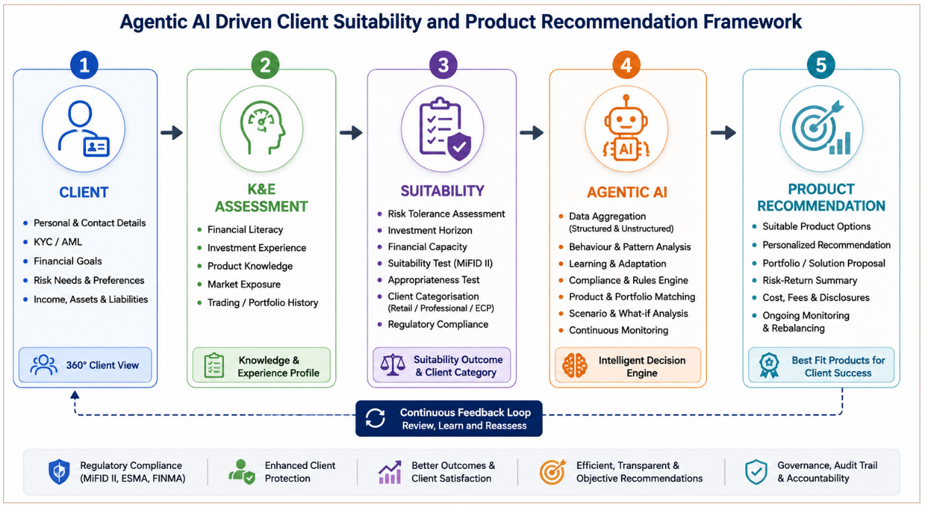
 The evolution of wealth management models from standardized offerings to highly adaptive advisory frameworks is further accelerated by Agentic AI. The emerging trend of Direct Indexing exemplifies this transformation, where AI agents continuously align portfolio construction with a client’s unique financial objectives, tax considerations, risk appetite, ESG preferences, and changing life events.
Fig 1: Agentic AI–Driven Framework for MiFID II Client Categorisation, K&E Assessment, and Product Suitability
 What Makes Agentic AI Different?
Agentic AI is central to these components, which must be continuously monitored, reviewed, and reassessed through a dynamic feedback loop of Review, Learn, Reassess, and Recalibrate.
Unlike traditional AI systems that generate insights on demand, Agentic AI operates through autonomous agents capable of planning, reasoning, acting, and continuously learning from outcomes. In financial management, these agents can independently monitor client suitability, interpret regulatory changes, trigger portfolio reviews, coordinate with advisory workflows, and recommend actions while maintaining human oversight.
All the world’s a stage, and all the men and women merely players
The treasury, product and investment advisor teams need to disclose their product offerings appropriately so that suitability assessments, appropriateness tests, best-execution requirements, inducement restrictions, and disclosure obligations remain fully aligned with regulatory directives. To guarantee investor protection, market transparency and fair treatment, front and middle office teams should clearly establish governance rule books around – Target Market, risk-reward pitfalls, Distribution Strategy Alignment, Ongoing Review and Monitoring and avoid Conflicts of Interest of issuer and distributor.
 What’s past is prologue
By combining human judgment with autonomous AI-driven intelligence, investment firms can better synchronize client goals with investment strategies, and proactively adapt portfolios.
The technology landscape presents several challenges that must be addressed to enable next- generation suitability frameworks powered by intelligent and autonomous decision-making, like:
• Customers expect “Netflix” experience characterized by personalization, immediacy, and seamless digital engagement.
• Managing complex financial instruments, including manufactured products, illiquid assets, and esoteric investment vehicles, requires sophisticated data models and decision frameworks.
• Fragmented workflows across product manufacturers, distributors, advisors, and technology platforms can impede information sharing, operational efficiency, and the effective delivery of suitable products to clients.
• Increasing client expectations and market volatility necessitate real-time access to information, insights, and decision support across channels and investment platforms.
Uneasy lies the head that wears a crown
The inclusion of agentic AI in MiFID client categorisation frameworks can revolutionize how firms assess and deliver product suitability and appropriateness. Unlike conventional AI systems, Agentic AI autonomously interacts with client data, continuously learning from financial behaviour, transaction history, and evolving investment goals.
For suitability tests, agentic AI can dynamically match retail clients in advisory and portfolio management services with products that align precisely to their risk tolerance, financial objectives, and knowledge levels. For appropriateness tests, particularly in execution-only services, agentic AI can evaluate whether clients truly understand the complexity and risks of products before proceeding, thereby safeguarding compliance. By bridging these two critical assessments, agentic AI empowers relationship managers to present offerings with greater precision and transparency, ensuring that every recommendation is both regulatory-compliant and client-centric.

Brevity is the soul of wit
The critical success factors for effective customer onboarding and product investment include
- Digitalisation of workflow and data handling
- Application of AI and Machine Learning on customer feedback and on-boarding satisfaction
- Seamless access across platforms
- Comprehensive data integrity and analytics-driven insights
- Personalized advice and tailored product offerings
The contest for competitive advantage in customer on-boarding is increasingly being fuelled by digitalisation accelerated by artificial intelligence (AI) and machine learning (ML). Technology is set to play an increasingly important role as firms look for ways to create hyper-personalized onboarding and future services tailored to investors’ unique financial goals, risk tolerance, and holistic wealth topography.
Along with KYC, Knowledge & Experience (K&E) is a critical element of conduct-of-business requirements under MiFID II. It ensures fair practices and suitability of product and service offering to client along with transparency.
All’s well that ends well
Agentic AI extends the principles embodied by platforms such as Aladdin by introducing autonomous decision orchestration. Instead of merely identifying portfolio risks, AI agents can continuously reassess client suitability, trigger portfolio reviews, and recommend corrective actions aligned with changing client objectives and market conditions. While current implementations focus on advisor augmentation, the next evolution is Agentic AI, where autonomous agents continuously monitor client profiles, market events, and suitability parameters to proactively identify investment opportunities while ensuring adherence to evolving regulatory and compliance obligations.
About the Authors :
 Mr. Sudeep Mukherjee
Senior Industry Consultant – Financial Market,
IBM

Mr. Sudeep Mukherjee is a senior consulting professional working in a renowned technology MNC. Mr. Sudeep Mukherjee has collaborated with global financial services sector firms worldwide. Mukherjee holds Financial Risk Manager (FRM) certification from Global Association of Risk Professional (GARP) and has Master’s degree in business management with specialisation in finance, complimented by Bachelor’s degree in computer science.
Mr. Sudeep Mukherjee has rich experience in digital transformation and strong client relationship leading to enhanced customer experience and value creation.
Mr. Sudeep Mukherjee has front-to-back project implementation experience in Investment & Private Banking, Wealth Management, Fixed Income (Interest Rate Derivatives) and OTC Derivatives, Regulatory and Trade Reporting Services, Credit & Liquidity risk, Data harmonization and Data Migration.
Mr. Sudeep Mukherjee is an evangelist for agile method and devops, thereby bringing changes to projects via continuous improvement and collaboration.
Mr. Sudeep Mukherjee can be contacted at:
Also Read Mr. Sudeep Mukherjee‘s earlier article:
 Ms. Swati Sharma
Senior Industry Consultant – Financial Market,
IBM
Ms. Swati Sharma is an experienced Business Analyst specializing in the financial markets sector, with a focus on market intelligence, risk analysis, and financial product strategy. With over 11+ years in the investment banking sector. Ms. Swati Sharma‘s background spans business analysis, solution development, and securities services. Ms. Swati Sharma is analysing and refining financial processes, products, services and systems.
Ms. Swati Sharma has lead the front-to-back digital transformation of investment banking, securities trading, clearing, settlement & portfolio management platforms.
Ms. Swati Sharma’s area of expertise is capital markets technology modernization.
Ms. Swati Sharma areas of expertise include risk frameworks, regulatory compliance, and using AI, cloud-native architectures, and advanced analytics to streamline processes and open up new revenue streams.
Ms. Swati Sharma is working with investment banks, asset managers, custodians, and fintech companies.
Ms. Swati Sharma assist businesses in future-proofing their business models by striking a balance between client expectations, regulatory requirements and new market opportunities.
Ms. Swati Sharma is Accorded with the following Honors & Awards :
https://www.linkedin.com/in/sw
Ms. Swati Sharma can be contacted at:
Also read Ms. Swati Sharma‘s earlier article: