


The Rise of the AI-Augmented Business Analyst in Banking
Business analysts (BAs) have long been an important but frequently unseen part of the banking industry. In highly regulated environments, we translate needs, manage change, and make sure nothing goes wrong by sitting between business, operations, compliance, and technology. Although many banking operations have been automated, the BA position has remained primarily manual, time-consuming, and document intensive.
That is now shifting.
Business analysts’ work is being subtly transformed by generative AI (GenAI), which enhances their effect, speed, and ability to think. GenAI is no longer an experiment in 2026. For BAs working in banking and financial services, it is turning into a useful co-pilot.

The Traditional BA Challenge in Banking: – A typical BA in banking handles:
- Complicated requirements for compliance and regulations
- A lot of documentation, including traceability matrices, process flows, FRDs, and BRDs
- Several stakeholders in the areas of operations, risk, law, and IT
- Tight delivery deadlines, data transfers, and legacy systems
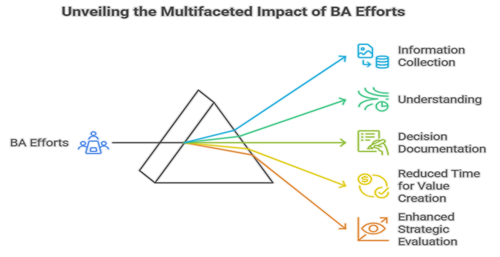
GenAI can help with this.
How the BA Role Is Being Enhanced by GenAI
Although GenAI cannot “understand banking” on its own, it can be a useful tool when directed by a BA’s subject-matter expertise.
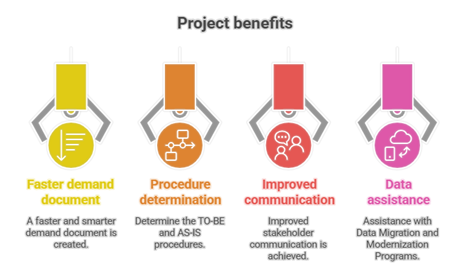
A faster, smarter demand document: – GenAI is capable of:
- Use the meeting notes to organize BRDs or user stories
- Create rough drafts of functional requirements
- Reword the standards so that they are more understandable and consistent with stakeholders
 As a result, business analysts can move more instantly from documentation to validation and decision-making.
1. Determine the TO-BE and AS-IS procedures: – GenAI can analyse inputs such as SOPs, process documentation, tickets, and past changes
- List the current protocols (AS-IS)
- Draw attention to gaps, redundancies, and manual handoffs
- Help build optimal TO-BE flows
GenAI accelerates analysis and discovery while the BA maintains control over the logic.
Improved stakeholder communication: – Misalignment in banking programs can be costly.
GenAI helps by
- Translating technical information into business-appropriate language
- Developing executive summaries for leadership
- Conducting impact evaluations for risk and compliance teams
This reduces rework and builds stakeholder trust.
2. Assistance with Data Migration and Modernization Programs: – GenAI can help BAs with core banking modernization, data migration, and cloud transformation.
- Assist with source-to-target mapping drafts
- Determine data quality rules and reconciliation scenarios
- Develop test case ideas based on requirements
This is particularly useful for mainframe-to-cloud or legacy platform conversions.
Switching to agent-based support from automation
Agentic AI, which enables GenAI-powered bots to carry out tasks independently while being supervised by humans, is the next stage.
This suggests for BAs:
- Agents oversee monitoring modifications to requirements and updating documentation
- Agents who are responsible for identifying consequences related to regulations or reliance
- Monitoring discrepancies between system performance and business objectives
- The BA becomes a decision orchestrator instead of a document manager
Why does human judgment still matter?
 GenAI has limitations despite its abilities, especially in the banking industry.
- To understand the purpose of the rule, advice is needed
- There is no accountability
- Has no risk tolerance or understanding of organizational politics
As a result, the BA job gains value rather than loses it.
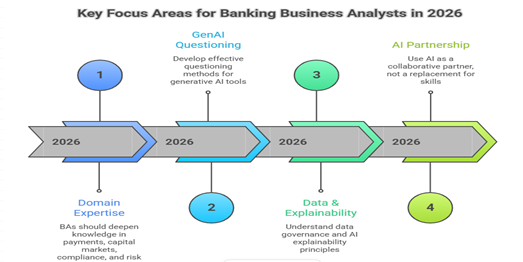
The future BA combines:
- Expertise in the domain
- Demonstrates analytical thinking
- Demonstrating ethical judgment
- AI-assisted productivity
Conclusion
 GenAI is not meant to replace Business Analysts in banking.
Its purpose is to remove friction, reduce repetition, and improve insight.
In a world of increasing regulation, complexity, and transformation, banks will need business analysts who can combine human judgment and AI intelligence. The future belongs to analysts who can think critically, communicate effectively, and use GenAI responsibly.

About the Author :
 Ms. Swati Sharma
Senior Industry Consultant – Financial Market,
IBM

Ms. Swati Sharma is an experienced Business Analyst specializing in the financial markets sector, with a focus on market intelligence, risk analysis, and financial product strategy. With over 11+ years in the investment banking sector. Ms. Swati Sharma‘s background spans business analysis, solution development, and securities services. Ms. Swati Sharma is analysing and refining financial processes, products, services and systems.
Ms. Swati Sharma has lead the front-to-back digital transformation of investment banking, securities trading, clearing, settlement & portfolio management platforms.
Ms. Swati Sharma’s area of expertise is capital markets technology modernization.
Ms. Swati Sharma areas of expertise include risk frameworks, regulatory compliance, and using AI, cloud-native architectures, and advanced analytics to streamline processes and open up new revenue streams.
Ms. Swati Sharma is working with investment banks, asset managers, custodians, and fintech companies.
Ms. Swati Sharma assist businesses in future-proofing their business models by striking a balance between client expectations, regulatory requirements and new market opportunities.
Ms. Swati Sharma is Accorded with the following Honors & Awards :
https://www.linkedin.com/in/sw
Ms. Swati Sharma can be contacted at:
Also read Ms. Swati Sharma‘s earlier article:








 have long been an important but frequently unseen part of the banking industry. In highly regulated environments, we translate needs)