
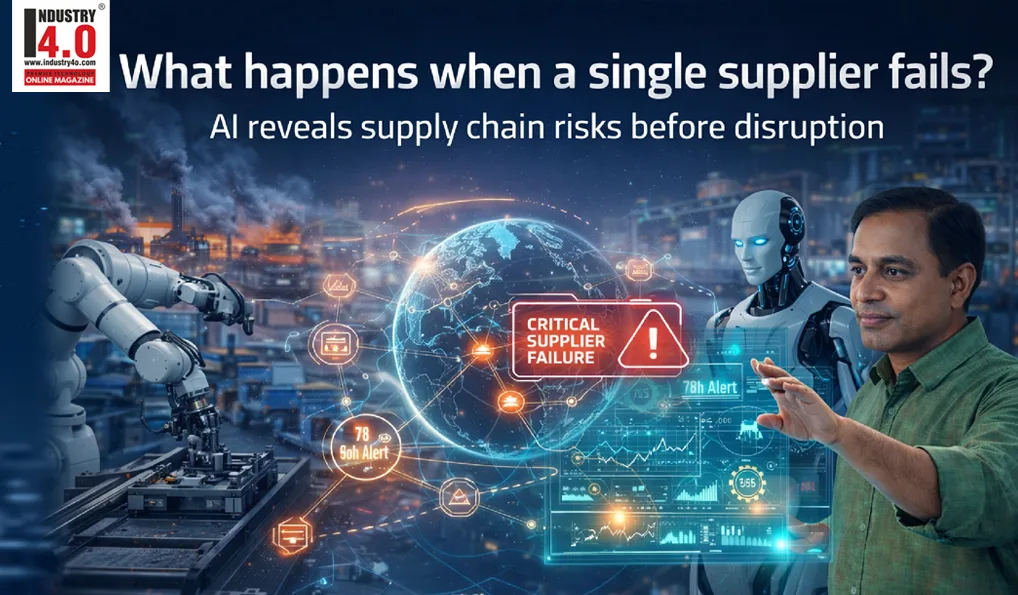
What Happens when a Single Supplier Fails ?
AI Reveals about Supply-Chain Risks before they Disrupt.
What AI reveals about supply-chain risks, before they disrupt your factory
🚩One Supplier Fails, Your Factory Stalls.
• The problem: Modern factories depend on tightly tuned supplier networks; a
single Tier-1 or Tier-2 supplier failure can cascade into major production
stoppages and margin loss.
• Why this matters now: Global systems remain fragile, many leaders still lack
deep multi-tier visibility and board-level focus on supplier risk.
• Immediate consequence: A single upstream disruption can force line
changeovers, emergency sourcing, lost revenue and reputational damage, often far larger than the cost of redundancy.
➡️ So what?
You don’t have an “issue”, you have an existential risk that must be seen early, not fixed after the alarm.

🚩AI Sees the Signals Humans Miss.
● What AI detects: Pattern-level anomalies across financial health, delivery cadence, quality trends, logistics delay signals, and 3rd-party events, days or weeks before an outage.
● How accurate: Proven models (ensemble ML, LSTM/time-series, graph analytics) provide high early-warning accuracy across heterogeneous supplier signals.
● Where it matters: Multi-signal sensing is especially powerful for single-source components (semiconductors, specialty chemicals, sub-assemblies) where substitutes are scarce.
➡️ So what?
AI gives you the Golden Window to act, to reroute, re-order, or execute contingency plans before the factory feels the pain.
🚩Five-Step Early-Warning Pipeline (Data → Decision → Action)
 1. Map: Build a prioritized supplier topology (Tier-1 → Tier-n) and identify single-supplier chokepoints.
2. Ingest: Pull structured (POs, lead times, quality scores) + unstructured data (news, social, port delays, sanctions) via APIs / streaming.
3. Enrich: Add third-party risk signals : financial distress, geopolitical alerts, weather, cyber incidents.
4. Model: Run ensemble ML + graph-based contagion models to estimate probability & lead-time of supplier failure.
5. Act: Auto-trigger graded responses (expedite, dual-source, order re-allocation, safety stock release, escalation to procurement/supply-chain war-room).
➡️ So what?
It’s not an IT project, it’s a decision pipeline that turns signal into a timed business action.
🚩Real evidence: AI catches disruptions before they cascade.
● Case patterns: Toyota’s experience after Tōhoku showed how single-source microcontroller failure cascaded across OEMs, multi-tier fragility is real.
● Research & pilots: Systematic reviews and pilot studies show AI early-warning systems materially improve lead time to intervention and reduce outage impact.
● Market trend: Manufacturers are investing in AI for supply-chain decisions to preserve just-in-time efficiency under volatility (recent industry coverage).
➡️ So what?
The ROI is practical ; fewer emergency buys, lower expedite fees, less downtime, and stronger customer delivery performance.
 🚩What leaders must do next (rapid checklist).
Immediate 90-day playbook
1. Identify 10 highest-impact single-supplier items (cost, criticality, lead time).
2. Deploy an AI pilot on 3 suppliers: combine on-time delivery, quality, financial health, and open-source event feeds.
3. Define graded responses (auto-alerts → procurement action → exec escalation).
4. Close the governance gap: elevate supplier risk to the board cadence; assign an owner for nth-party visibility.
5. Invest in resilience: selective dual-sourcing, strategic safety stock for true single-source items, and supplier development.
➡️ So what?
The firms that institutionalize AI-driven early warnings will shrink the window between supplier stress and factory impact , turning single-supplier risk from a panic into a managed event.

📌 Closing Takeaway
This isn’t about adding another dashboard. It’s about turning supply-chain risk into a managed decision window.
The next disruption won’t announce itself.
The winners will be the factories that see it coming, and act before production feels it.
🤞 If one of your critical suppliers went silent today, would you know early enough to protect your factory?
 About the Author :
 Mr. Gulshan Kumar Saini
Senior Director
Samsung Electronics

Mr. Gulshan Kumar Saini is a global manufacturing, operations excellence, and smart factory transformation leader with over 30 years of leadership experience at Samsung Electronics, spanning senior roles across India, Vietnam, Korea, Russia, and the United States.
Mr. Gulshan Kumar Saini currently serves as Senior Director – Smart Factory at Samsung Electronics India, where Mr. Gulshan Kumar Saini spearheads enterprise-wide digital transformation initiatives across advanced manufacturing lines for consumer electronics and durables.
Mr. Gulshan Kumar Saini leads the deployment of AI-driven manufacturing systems, industrial robotics, IIoT platforms, machine vision, advanced analytics, and Digital Twin technologies to drive next-generation factory performance.
Mr. Gulshan Kumar Saini is widely recognized for delivering large-scale automation, step- change productivity improvements, and sustainable cost, quality, and efficiency gains in high-volume, high-complexity manufacturing environments. Across his career, Mr. Gulshan Kumar Saini has successfully led global NPI programs, greenfield and brownfield plant setups, capacity expansions, lean transformations, and multi-country manufacturing excellence programs.
Mr. Gulshan Kumar Saini is a PMP-certified professional and Six Sigma Black Belt, Mr. Gulshan Kumar Saini also holds an MBA in FinTech from BITS Pilani, combining strong digital, financial, and operational acumen to translate technology into measurable business outcomes.
Mr. Gulshan Kumar Saini is Bestowed with the following Licenses & Certifications
https://www.linkedin.com/in/gulshan-kumar-saini/details/certifications/
Mr. Gulshan Kumar Saini is Accorded with the following Honors & Awards
https://www.linkedin.com/in/gulshan-kumar-saini/details/honors/
Mr. Gulshan Kumar Saini can be contacted at:
Linked In | E-mail (1) | E-mail (2)
#supplychainrisk #aiinsupplychain #smartmanufacturing #supplychainresilience #industrialai #supplierrisk #multitiersupplychain #manufacturingleadership #operationalrxcellence #futureofmanufacturing
Also read Mr. Gulshan Kumar Saini‘s earlier article: