
Decentralised Energy Intelligence: Integrating Agentic AI & Blockchain for Autonomous Demand Coordination
What if your appliances could haggle over the electricity bill so you don’t have to? Think of a following scenario: your EV needs a charge immediately, but the dishwasher you just loaded can easily run later tonight. Instead of both drawing heavy power at the same time and straining the system, the EV essentially tips the dishwasher a digital energy token to hold off for a few hours. It all happens in milliseconds, completely behind the scenes, without a central hub directing traffic and without any human intervention.

This is not an imaginary scenario. It is the core premise of a new energy management framework that combines Multi-Agent Reinforcement Learning (MARL) with a blockchain-enforced token economy to bring truly autonomous, fair, and privacy-preserving energy distribution to the smart home.
The Problem with the Existing Smart Home Solution
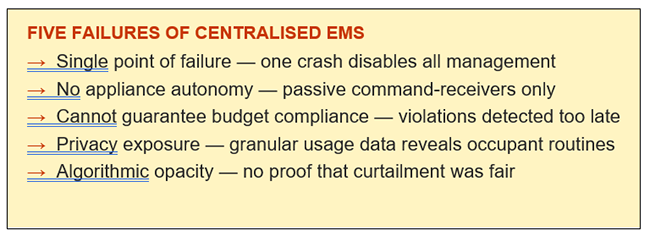
In today’s world, home energy systems are generally managed by a central controller. The central controller can be remote devices co-ordinating between different appliances through individual instructions. This kind of architecture has an inherent flaw – single point of failure e.g. with the absence of a remote, you may not be able to turn on a dishwasher remotely. Imagine central controller going offline during a heatwave or grid emergency. This can have catastrophic effect as the entire system will fail in the absence of a controller.
Also a centralised controller usually processes requests from dozens of appliances sequentially, introducing decision latency of 200–500 milliseconds per cycle. In a world where grid-frequency events demand sub-second responses, this is simply too slow. As appliances passively wait for commands, the system misses the flexible value they inherently hold e.g. an EV that could defer charging for thirty minutes or a water heater coasting on thermal mass has no mechanism to express that flexibility.

“Each appliance becomes an economic agent — not a passive switch, but an autonomous negotiator with its own wallet, its own urgency, and its own strategy.”
— MARL-PoN Framework Design Principles
Every Appliance Becomes an Agent
Instead of a central controller giving instructions to other devices , every device acts as its own independent agent, constantly reading the room—checking real-time electricity prices, grid frequency, and what else is running in the house. Based on that data, the appliance calculates how badly it needs power using a straightforward formula:

 A medical ventilator, with a safety priority of 10, always scores highest — it receives energy unconditionally. An EV with a depleted battery scores high on urgency. A dishwasher mid-cycle scores low on time sensitivity. These scores drive an encrypted auction, run every sixty seconds, in which appliances bid for energy tokens using zero-knowledge proofs — mathematical techniques that allow an appliance to prove its bid is valid without revealing the amount, preserving the occupant’s privacy completely.
This paradigm — known as Centralised Training, Decentralised Execution (CTDE) — means agents are trained on rich global data but execute their policies independently at runtime. No server, no cloud dependency, no single point of failure.
What the Published Evidence Shows
A growing body of peer-reviewed research supports the performance case for MARL-based energy management. A 2025 study spanning more than 1,200 buildings across three metropolitan areas found that MARL coordination reduced peak demand loads by approximately 23% and cut energy consumption costs by nearly 19% compared to traditional centralised control [C1]. On the standardised CityLearn benchmark — the field’s primary evaluation platform — the attention-based AAC-MADRL algorithm achieved energy cost reductions of up to 18% and improved self-sufficiency by up to 10.5% during periods of limited solar generation, while deploying 40% faster than decentralised deep RL alternatives [C2].
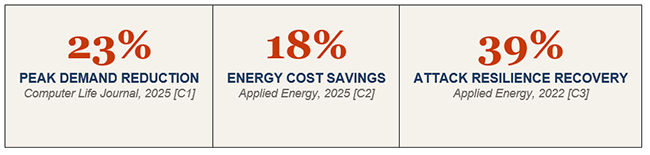
Adversarial robustness is equally critical for real-world deployment. A 2022 study found that the Robust Adversarial MARL framework (RAMARL-DR) recovered approximately 39% of grid-ramping performance degraded by cyber-attacks [C3] — a result directly relevant here. The Proof-of-Necessity consensus tolerates up to 33% Byzantine (malicious) nodes by slashing the staked tokens of any appliance found misrepresenting its priority, achieving equivalent resilience through economic incentive rather than trusted hardware.
Blockchain: Not Hype — Hard Mathematics
 The blockchain layer does something that very few software policy can. It can make budget violation mathematically impossible, not just unlikely. Every day, the household receives exactly B energy credit tokens from the utility company, where each token corresponds to a watt-hour . Appliances spend tokens to activate. Since the ledger enforces the constraint Σ(active allocations) ≤ B through distributed consensus, there is no race condition, no double-spending, and no way for a software bug to allow simultaneous overconsumption.
Tokens have a time decay property so that if a household or agent tries to hoard them, the value decays exponentially, which in turn ensures energy credits circulate like actual energy rather than being stockpiled by greedy agents. But what is more important is that this creates a cryptographic audit trail. Households participating in demand-response programmes can prove to utilities that they did indeed curtail demand by the promised amount. Thus unlocking incentive payments that soft-enforcement systems cannot access.
What This Means for Smart Homes
The broader significance reaches beyond the home. The same architecture can be scaled for neighbourhood microgrids. Households with rooftop solar can sell surplus tokens to neighbours, enabling peer-to-peer energy trading without an intermediary. As building electrification accelerates in terms of EVs, heat pumps, grid-connected batteries, etc., the number of negotiating agents grows, but so does the available flexibility. A 2020 study estimated that demand response programmes hold the potential to cut electricity peaks by around 20% in the building sector alone.
This opens new avenues of opportunity for different kinds of stakeholders. For appliance manufacturers, this can mean a new agent-enabled appliance that ships with a reinforcement learning policy, a cryptographic wallet, and a smart-contract execution environment built into its firmware.
When it comes to grid operators, it is a population of millions of autonomous demand-response participants who can react in under 100 milliseconds without a single manual override.

Last but not least, for the residents, it’s a home that optimises itself, proves its fairness, and never shares its data.
The self-negotiating home is not a distant vision. The mathematics are settled, the benchmarks are encouraging, and the architecture is ready for pilot deployment. The only remaining question is how quickly the industry is prepared to stop thinking of appliances as passive loads — and start treating them as agents.
About the Authors:

Ms. Madhusmita Patil is an IBM Distinguished Engineer, an IBM Master Inventor & an open group certified Distinguished IT Architect.
Ms. Madhusmita Patil as a Chief Technical officer of a few elite clients for IBM, leads their technology strategy & defines their technical architecture.
Ms. Madhusmita Patil is known as an innovative technical leader focused on client- centered solutions.
Ms. Madhusmita Patil is a member of IBM Open Innovation Community
Ms. Madhusmita Patil has more than twenty patents & thirty publications to her credit.
Ms. Madhusmita Patil is a Bronze recipient of ISG Digital Innovation Award 2025.
Ms. Madhusmita Patil is an eminent speaker.
Ms. Madhusmita Patil is associated with multiple Universities / Academics.
 Ms. Madhusmita Patil can be contacted at:
 Mr. Soumya Bhattacharya is a Senior Architect working in a leading Software Development/ Service Company with over two decades of rich experience with expertise in Banking domain.
Mr. Soumya Bhattacharya has led complex multi-year programs across multiple industries from vision to analysis, to implementation to application go-live, including accommodations for business and technical requirements and impact.
Mr. Soumya Bhattacharya can be contacted at :
 Mr. Raja Basu is a Senior Consulting professional in a leading MNC.
Mr. Raja Basu works as a business architect and helps global banking and financial markets clients to enable their digital transformation journey.
Mr. Raja Basu has special interest in responsible use of AI and sustainability.
Mr. Raja Basu is also pursuing his doctoral studies (PhD) from XLRI Jamshedpur.
Mr. Raja Basu is based out of Kolkata, India.
Mr. Raja Basu is an experienced leader in both technology and business, he has a proven track record of defining and implementing technology-driven transformations for clients in the global banking and financial markets.
Mr. Raja Basu focus lies in automation, particularly artificial intelligence (AI), and its impact on climate and sustainability (SCR).
Mr. Raja Basu possess a deep understanding of value-driven advisory practices, which have played a significant role in building strong client relationships. Throughout his career, he has actively contributed to numerous transformation programs involving complex applications for international clients across the United States, Canada, Europe, and Singapore.
Mr. Raja Basu is Bestowed with the following Licenses & Certifications :
https://www.linkedin.com/in/ba
Mr. Raja Basu is Volunteering in the following International Associations & Institutions :
https://www.linkedin.com/in/ba
Mr. Raja Basu is Accorded with the following Honors & Awards :
https://www.linkedin.com/in/ba
Mr. Raja Basu can be contacted at :
Also read Mr. Raja Basu’s earlier article :