
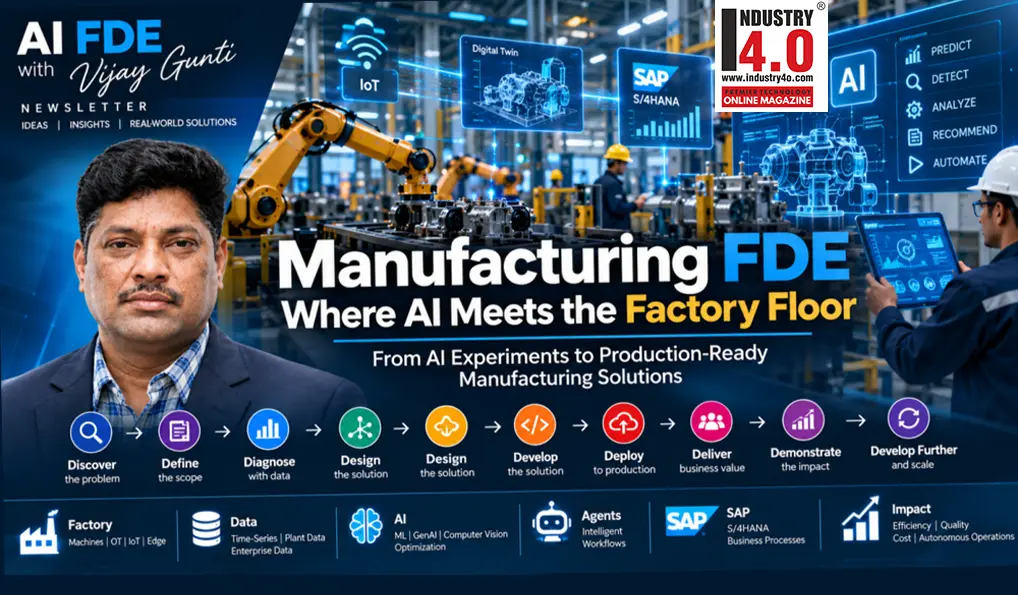
Manufacturing FDE: Where AI Meets the Factory Floor
From AI Experiments to Production-Ready Manufacturing Solutions
Manufacturing is entering a new phase of digital transformation.
The challenge is no longer simply “How do we use AI?”
The real question is:
 How do we take an AI idea from the factory floor and turn it into a measurable, production-ready business solution?
This is where Forward Deployed Engineering (FDE) becomes powerful.
What is Manufacturing FDE?
A Manufacturing FDE operates at the intersection of:
Business Problem + Manufacturing Domain + Data + AI + Engineering + Enterprise Systems
Unlike a traditional AI project that may focus primarily on developing a model, an FDE works across the complete journey:
Discover → Define → Diagnose → Decompose → Design → Develop → Deploy → Deliver → Demonstrate → Develop Further
The objective is not merely to build an AI model.
The objective is to solve a real manufacturing problem in production.
1. Start With the Factory Problem
Manufacturing organizations have hundreds of potential AI use cases:
• Predictive maintenance
• Visual quality inspection
• Supplier quality
• Production planning
• Downtime prediction
• Energy optimization
• Worker safety
• Inventory optimization
• Root-cause analysis
• Process optimization
• Demand forecasting
• Defect detection
• Intelligent SAP operations
But an FDE does not start with:
“Which AI model should we use?”
The FDE starts with:
“What business problem are we trying to solve?”
For example:
A production line is experiencing repeated unplanned downtime.
The FDE investigates the process, machines, sensors, maintenance history, production orders, operator inputs and enterprise systems before selecting the technology.
2. Connect the Factory Data
Manufacturing AI requires more than an LLM.
A typical Manufacturing FDE architecture may connect:
 Machines → PLC/SCADA → Edge → IoT Platform → Time-Series Data → Data Lake → AI/ML → Enterprise Applications → Users
For an SAP-centric manufacturing environment, the architecture can extend to:
Shop Floor → IoT → Data Platform → AI → SAP S/4HANA → SAP BTP → AI Agents → Business Users
This creates a bridge between operational technology and enterprise technology.
3. AI + SAP + Industrial Data
The future manufacturing architecture will increasingly combine:
OT
Machines, PLCs, SCADA, sensors and industrial systems
IoT
Telemetry, events, equipment signals and edge processing
Data
Historian, time-series, transactional and enterprise data
AI/ML
Prediction, classification, anomaly detection, optimization and computer vision
GenAI
Natural-language interaction, knowledge retrieval and reasoning
Agentic AI
AI agents that can investigate, recommend and execute defined workflows
SAP
Production orders, materials, maintenance, inventory, quality and finance processes
The FDE becomes the engineer who connects these layers.
4. From Dashboard to AI Agent
Traditional manufacturing analytics often follows:
Data → Dashboard → Human → Decision
An AI-enabled manufacturing environment can evolve toward:
Data → AI → Insight → Recommendation → Action → Feedback
For example:
Traditional
A maintenance manager opens a dashboard and discovers abnormal equipment behavior.
 AI FDE
An AI agent identifies the anomaly, retrieves historical maintenance information, correlates sensor patterns with previous failures, identifies possible root causes, recommends an action and prepares the relevant maintenance workflow.
Human approval can remain part of the process wherever required.
This is the transition from analytics to intelligent operations.
5. A Manufacturing FDE Use Case
Consider Supplier Quality & Incoming Material Release.
Business Problem
Incoming material inspection is slow and inconsistent.
FDE Solution
Combine:
• Supplier data
• Purchase orders
• Material information
• Inspection results
• Historical quality data
• Images
• OCR
• Computer vision
• SAP quality processes
• AI reasoning
The solution can detect potential quality issues, retrieve historical supplier patterns and support the quality engineer’s release decision.
The important point is that the FDE is not building “a computer vision model.”
The FDE is building a complete business solution.
 6. The Manufacturing FDE Skill Stack
A successful Manufacturing FDE needs a combination of capabilities.
Manufacturing Domain
Production, quality, maintenance, supply chain and plant operations.
Enterprise Systems
SAP S/4HANA, MES, ERP and business applications.
Data Engineering
SQL, APIs, event streams, data pipelines and data platforms.
AI Engineering
ML, GenAI, RAG, computer vision and model evaluation.
Agentic AI
Agents, tools, workflows, orchestration and enterprise integration.
Cloud & Edge
Azure, AWS, GCP, IoT platforms and edge computing.
Software Engineering
Frontend, backend, APIs, databases, security and deployment.
Consulting
Problem discovery, stakeholder management, requirements and value realization.
The FDE therefore needs breadth across the technology stack and depth around the customer’s problem.
7. The Manufacturing FDE Factory
I see the future Manufacturing FDE operating model as an AI FDE Factory.
Layer 1 — Business Problems
Identify high-value manufacturing problems.
Layer 2 — Process Discovery
Understand the current process and constraints.
Layer 3 — Data
Connect operational and enterprise data.
Layer 4 — AI
pply ML, GenAI, computer vision and optimization.
Layer 5 — Agents
Build AI agents for investigation and workflow execution.
Layer 6 — Integration
Connect SAP, MES, IoT and enterprise applications.
Layer 7 — Application
Deliver the solution through web, mobile, dashboards or copilots.
Layer 8 — Deployment
Move from prototype to production.
Layer 9 — Adoption
Train users and integrate the solution into daily operations.
Layer 10 — Measurement
Track business impact and continuously improve.
8. The FDE Mindset
The biggest shift is mindset.
A traditional approach asks:
“Can we build this?”
An FDE asks:
“Should we build this, how will it work in the customer’s environment, how will users adopt it, and how will we measure the outcome?”
That is the difference between an AI prototype and an AI product in production.
The Future
Manufacturing organizations will increasingly move from:
Digital Factory → Intelligent Factory → Autonomous Operations
And the Manufacturing FDE can become one of the key engineering roles enabling that transformation.
The FDE brings together:
Consulting + Engineering + AI + Manufacturing + Product Thinking
That combination is what turns AI from a technology experiment into an operational capability.
My Perspective
The next generation of Manufacturing transformation will not be driven only by data scientists, consultants, software engineers or AI engineers working independently.
It will require people who can walk into a factory, understand the problem, connect the data, engineer the AI solution, integrate enterprise systems, deploy it, measure the outcome and continuously improve it.
That is the opportunity for the Manufacturing AI FDE.
From Factory Problem → AI Solution → Production Impact.
That is where AI meets the factory floor.
 About the Author :

Mr. Vijay Gunti brings two decades of expertise in IT, Artificial Intelligence (AI), Machine Learning (ML), and Generative AI (GenAI), specializing in devising strategies and implementing solutions to drive efficiency, innovation, and growth.
With a strong passion for Generative AI Mr. Vijay Gunti is motivated by a desire to solve complex business challenges and help organizations harness the full potential of AI, ML, and GenAI.
Mr. Vijay Gunti also has extensive experience in developing, architecting, and deploying AI and GenAI solutions that have delivered significant commercial outcomes.
Mr. Vijay Gunti specializes in crafting generative AI strategies, go-to-market (GTM) plans, and implementing industry-specific AI agents that drive tangible results.
As an eloquent speaker, trainer, podcaster, and blogger, Mr. Vijay Gunti has actively contributed to multiple forums, tech talks, chapters, and conferences.
As an Author Mr. Vijay Gunti writings focus on Digital Transformation, Data, AI/GenAI approaches, and technological innovations in domains such as IoT, IIoT, Industry 4.0, Big Data, Machine Learning, Deep Learning, Artificial Intelligence, Cognitive Computing, Augmented Reality, Virtual Reality, 3D technologies, and Blockchain.
Whether you are a business professional, technology leader, startup founder, or enthusiast looking to expand your knowledge of Generative AI, enter the GenAI business space, or develop proofs of concept (POCs) and minimum viable products (MVPs) for various industries, Mr. Vijay Gunti welcomes you to connect and collaborate.
Mr. Vijay Gunti is Bestowed with the following Certifications:
https://www.linkedin.com/in/vijaygunti/details/certifications/
Mr. Vijay Gunti can be contacted at :
Also read Mr. Vijay Gunti’s earlier article :