
Instant Payments: The Psychology of Instant Gratification
Why Behavioural Economics is Reshaping Customer Experience in Payments
“People don’t just want better payments. They want payments that feel effortless, immediate, and certain.”
The Age of Immediacy
Today’s consumers live in an economy built around immediacy. They stream movies instantly, order groceries with a tap, hail rides within minutes, and receive real-time updates on everything from deliveries to investments. Digital leaders such as Amazon, Netflix, Uber, and WhatsApp have fundamentally changed consumer expectations by eliminating waiting and making convenience the default.

Financial services are no exception. Consumers no longer compare one bank transfer with another they compare the experience of making a payment with every seamless digital interaction they have throughout the day. In this new reality, speed is no longer viewed as a premium feature; it is an expected part of the customer experience.
As Amazon founder Jeff Bezos famously observed, “Customers are beautifully, wonderfully dissatisfied.” Customer expectations are constantly evolving, and today’s benchmark is no longer the banking industry, it’s the broader digital economy.
Behavioural Economics: Understanding Why Instant Payments matter so much
Traditional economics assumes that consumers make rational decisions based on price and utility. Behavioural economics tells a different story.
People are influenced by emotion, habit, convenience, perceived risk, and immediate rewards. Nobel Prize-winning research by Daniel Kahneman and Richard Thaler, along with decades of behavioural science, demonstrates that people frequently value how an experience feels as much as its functional outcome.
This is precisely why instant payments have become so powerful. Customers don’t simply value speed—they value:
- Certainty
- Simplicity
- Convenience
- Immediate gratification
Instant payments deliver all four simultaneously.
 Rather than merely moving money faster, they remove waiting, eliminate uncertainty, and provide immediate confirmation that a transaction has been completed successfully. The result is a payment experience that feels effortless and trustworthy.
Instant Gratification: A Fundamental Human Preference
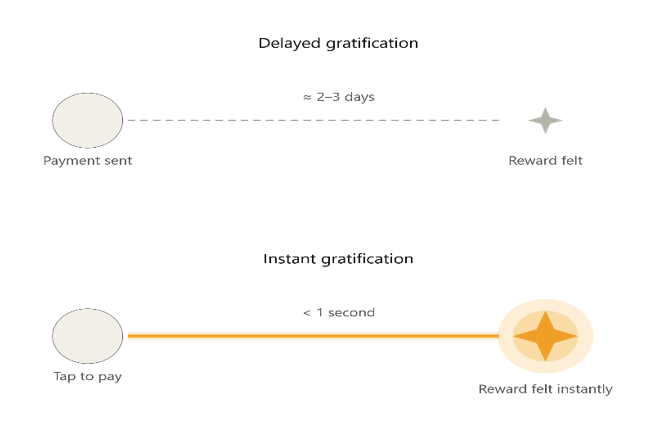
One of the best-known principles in behavioural economics is Present Bias, the tendency for people to place greater value on immediate rewards than future benefits. Consumers naturally prefer:
- instant confirmation over delayed settlement
- immediate access over waiting
- certainty over ambiguity
This explains why instant payments resonate so strongly. Receiving payment in seconds satisfies a deeply rooted psychological preference for immediate outcomes. Instead of wondering whether a transaction has been processed, customers receive instant confirmation, creating reassurance and reinforcing trust.
Speed therefore becomes much more than an operational metric—it becomes a driver of customer satisfaction.
 Payments Are Psychological, Not Just Financial
Research increasingly shows that payment methods influence consumer psychology. In The Psychology of Money, Morgan Housel argues that financial decisions are rarely driven by logic alone—they are shaped by psychology, emotions, habits, and personal experiences. People don’t simply seek financial efficiency; they seek experiences that make them feel confident, in control, and secure. This perspective provides a powerful lens through which to understand the rapid adoption of instant payments.
Instant payments succeed because they align with the way people naturally think about money. Consumers value certainty over uncertainty, convenience over complexity, and immediate outcomes over delayed gratification. Receiving confirmation that money has been sent or received within seconds creates reassurance, reduces anxiety, and reinforces trust. As Housel suggests, success with money is fundamentally about behaviour, and the same is true for payment systems. The most successful payment platforms are those designed around human behaviour rather than technology alone.
One emerging concept, “Spendception,” describes how digital payments reduce the psychological barriers associated with spending by making transactions less visible, more intuitive, and virtually effortless.
Unlike cash, which creates a tangible “pain of paying,” digital and instant payments minimize cognitive effort. Customers no longer need to think about payment mechanics, they simply complete the transaction and move on. For banks and payment providers, this represents a profound shift. The competitive advantage is no longer just faster processing, it feels easier.
Charlie Munger’s Mental Model: The Power of Immediate Rewards
Charlie Munger frequently argued that human beings are naturally wired to seek immediate rewards over delayed gratification. His famous observation captures the importance of behavioural incentives:

“Never, ever, think about something else when you should be thinking about the power of incentives.”
Instant payments are a perfect example.
- The incentive isn’t simply faster settlement.
- The incentive is immediate certainty.
- The incentive is eliminating anxiety.
- The incentive is removing friction.
Every successful digital payment ecosystem understands this principle
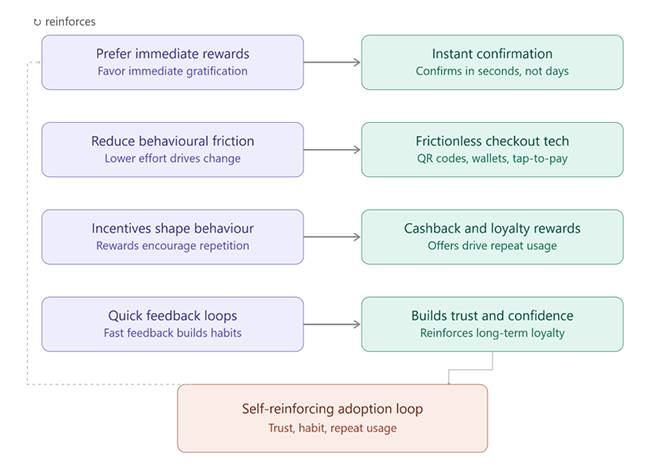
Each row pairs a Munger principle (purple) with its digital payments parallel (teal), flowing left to right. But the real insight is what happens at the bottom, all four dynamics feed into a single outcome (coral): a self-reinforcing adoption loop.
The Behavioural Economics of Instant Payments
Behavioural economics helps explain why instant payments have become a customer expectation rather than simply a technological innovation.
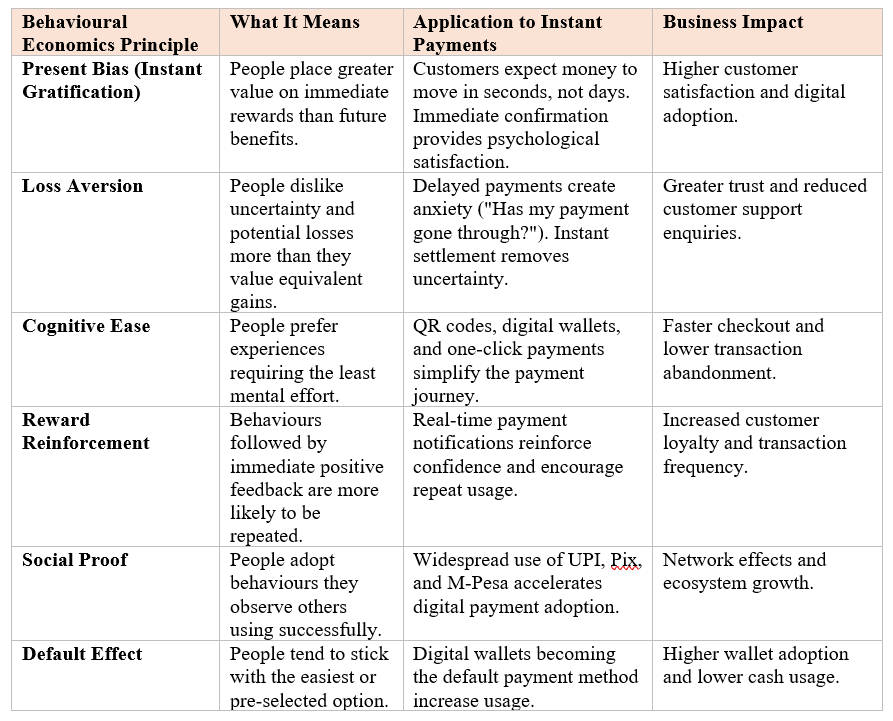
Today, customers don’t judge their bank’s payment experience against another bank anymore. They compare it with the apps they use every day—buying something on Amazon with one click, paying for an Uber without thinking about it, tapping their phone with Apple Pay, subscribing to Netflix in seconds, or sending a message on WhatsApp that gets delivered instantly. These experiences have changed what people expect. They want payments to be just as fast, simple, and effortless. That’s why instant payments are no longer a nice-to-have—they’ve become the standard customers expect.
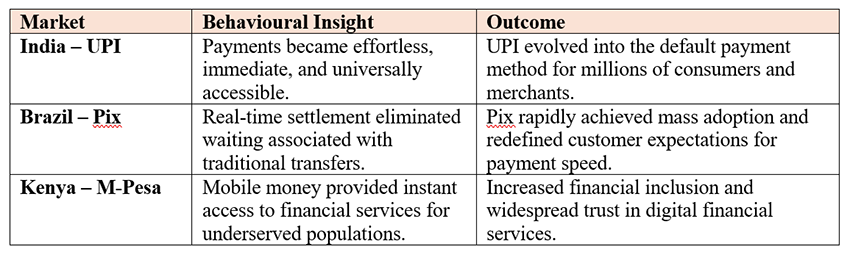
Global Examples of Behavioural Change
Around the world, successful payment systems demonstrate how reducing friction changes customer behaviour.
Conclusion
Instant payments represent far more than a technological advancement; they are a behavioural innovation. By aligning with fundamental principles of human psychology such as immediacy, certainty, and simplicity, they transform payments into a powerful driver of customer experience, trust, and digital adoption. As customer expectations continue to evolve, institutions that design payment experiences around human behaviour, rather than technology alone, will be best positioned to build lasting loyalty and competitive advantage.
About the Authors :

Ms. Sudha Rawat Talwar
Payments Advisor,
IBM Consulting

Ms. Sudha Rawat Talwar is passionate about driving value for Payments businesses, delivering agile program execution, go-to-market strategy, and innovative payment solutions across international markets.
With close to two decades of global experience, Ms. Sudha Rawat Talwar have led and contributed to large-scale payment transformation initiatives supporting multi-region deployments, enabling faster time-to-market, improved operational efficiency, inclusion and increased adoption of digital payment capabilities.
Ms. Sudha Rawat Talwar brings strong Go-to-market offering, and market-entry expertise to position products and services effectively, align solutions with customer and business needs, and drive multi-million revenue growth.
Previously at Oracle India Pvt Ltd, Ms. Sudha Rawat Talwar has built a strong foundation in enterprise technology, client-focused solutions, and global stakeholder engagement.
Passionate about driving collaboration and innovation, Ms. Sudha Rawat Talwar‘s focus on optimizing processes, scaling global solutions, and delivering measurable, market-ready outcomes in payment systems transformations.
Ms. Sudha Rawat Talwar can be contacted at :
 Mr. Raja Basu
Client Delivery & GTM – Financial Services,
IBM Consulting
Mr. Raja Basu is a Senior Consulting professional in a leading MNC.
Mr. Raja Basu works as a business architect and helps global banking and financial markets clients to enable their digital transformation journey.
Mr. Raja Basu has special interest in responsible use of AI and sustainability.
Mr. Raja Basu is also pursuing his doctoral studies (PhD) from XLRI Jamshedpur.
Mr. Raja Basu is based out of Kolkata, India.
Mr. Raja Basu is an experienced leader in both technology and business, he has a proven track record of defining and implementing technology-driven transformations for clients in the global banking and financial markets.
Mr. Raja Basu focus lies in automation, particularly artificial intelligence (AI), and its impact on climate and sustainability (SCR).
Mr. Raja Basu possess a deep understanding of value-driven advisory practices, which have played a significant role in building strong client relationships. Throughout his career, he has actively contributed to numerous transformation programs involving complex applications for international clients across the United States, Canada, Europe, and Singapore.
Mr. Raja Basu is Bestowed with the following Licenses & Certifications :
https://www.linkedin.com/in/ba
Mr. Raja Basu is Volunteering in the following International Associations & Institutions :
https://www.linkedin.com/in/ba
Mr. Raja Basu is Accorded with the following Honors & Awards :
https://www.linkedin.com/in/ba
Mr. Raja Basu can be contacted at :
Also read Mr. Raja Basu’s earlier article :