
“ELIYA” – Mastering Simplicity : A Synopsis
When simplicity becomes a strategy, not a compromise
The Premise
In an era where organizations are constantly chasing scale, speed, and sophistication, complexity often becomes an unintended byproduct. Processes multiply, hierarchies deepen, and decision-making slows under the weight of its own structure. Eliya – Mastering Simplicity enters this landscape with a provocative idea: what if the solution to complexity is not more control, but less?
Rather than presenting simplicity as an abstract ideal, the narrative anchors it within a relatable, human story—one that unfolds through the lived experiences of a young professional navigating the realities of modern work culture.

The Protagonist
At the center of the story is Pavithra, a freshly graduated mechanical engineer stepping into her first corporate role. Like many early-career professionals, she carries with her a sense of ambition, readiness, and the expectation that effort will naturally translate into impact.
However, her initial experiences reveal a different reality.
She finds herself in an environment defined by rigid structures, layered approvals, and communication barriers. Ideas struggle to move upward, decisions seem distant, and even simple tasks appear unnecessarily complicated. The enthusiasm she once carried begins to give way to hesitation, as she tries to reconcile her expectations with the system she now operates within. The Turning Point
Amidst this uncertainty, Pavithra turns to an unlikely source of clarity—her grandmother.
Far removed from corporate frameworks, the grandmother offers insights shaped by experience rather than formal expertise. Her perspectives are simple, often expressed through everyday observations and analogies. At first glance, these reflections appear disconnected from Pavithra’s professional challenges.
Yet, they linger.
Each conversation subtly challenges Pavithra’s assumptions, encouraging her to look beyond complexity and focus on the essence of problems. Instead of seeking elaborate solutions, she begins to question whether clarity itself might be the answer.

The Shift
What follows is not an immediate transformation, but a gradual shift in perspective.
Pavithra begins to experiment with simplicity in small, deliberate ways:
✦ Choosing clarity over jargon in communication
✦ Addressing issues through direct conversations rather than escalation
✦ Identifying the core purpose of tasks instead of blindly following processes
These changes, though seemingly minor, begin to create ripples within her work environment.
A recurring misunderstanding within her team is resolved through a straightforward exchange. A time-consuming process is streamlined by eliminating redundant steps. Decisions that once seemed complex become clearer when stripped to their fundamentals.
The Conflict
 However, simplicity does not go unquestioned.
Within a system accustomed to equating complexity with competence, Pavithra’s approach is met with skepticism. Colleagues perceive her methods as overly simplistic, even naive. The belief that “more complexity equals more value” creates resistance to change.
This tension becomes a defining element of the narrative.
Rather than positioning simplicity as an easy path, the story highlights the discipline it demands. It requires confidence to challenge established norms, patience to navigate resistance, and clarity to remain focused on what truly matters.
The Transformation
As the story progresses, Pavithra’s growth becomes increasingly evident.
She evolves from a hesitant newcomer into a professional who influences her environment—not through authority, but through clarity of thought. Her ability to simplify does not diminish the depth of her work; instead, it enhances it.
Gradually, her approach begins to resonate.
Teams communicate more effectively. Processes become more transparent. Decisions are made with greater confidence. What started as individual experimentation begins to shape collective behavior.
The Broader Lens
Beyond Pavithra’s personal journey, the narrative expands into a broader commentary on organizational culture.
It challenges a deeply ingrained assumption—that complexity is a sign of sophistication. Through its storytelling, it reveals how excessive layers, controls, and structures often obscure rather than enhance effectiveness.
In contrast, simplicity is presented as a strategic discipline:
✦ It demands clarity of purpose
✦ It prioritizes what truly matters
✦ It enables agility without chaos
The story subtly reinforces that simplicity is not about doing less, but about doing what matters—better.
The Underlying Philosophy
 At its core, Eliya – Mastering Simplicity is not just about workplace challenges or personal growth. It is about a way of thinking.
Through the intergenerational exchange between Pavithra and her grandmother, the narrative bridges traditional wisdom with contemporary realities. It suggests that meaningful insights are not always found in complexity, but often in the ability to observe, reflect, and distill.
Simplicity, in this context, becomes more than a technique—it becomes a mindset.

The Takeaway
As the story approaches its conclusion, it avoids dramatic resolutions or sweeping transformations. Instead, it offers a quiet yet powerful realization:
Simplicity, when applied with intent, has the potential to reshape not just individual approaches, but entire systems.
Pavithra’s journey stands as a testament to this idea—demonstrating that clarity can cut through confusion, that thoughtful action can replace unnecessary process, and that meaningful change often begins with small, deliberate shifts.
About Author:

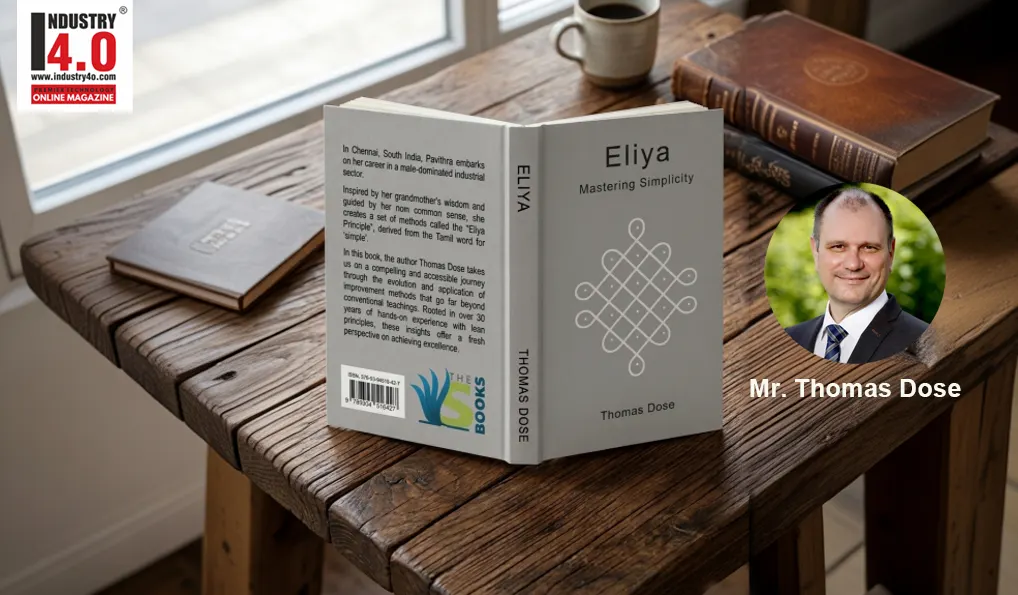
Mr. Thomas Dose
Managing Director
BMW India

Mr. Thomas Dose spent over 30 years in the industry as a consultant and in senior leadership positions, where Mr. Thomas Dose learned to align large organisations and successfully implement substantial change. One of Mr. Thomas Dose‘s key strengths is guiding people through transformation processes, thinking outside the box, and conveying his knowledge in a clear and easily understandable way.
For the past 15 years, Mr. Thomas Dose has lived and worked primarily in India. Mr. Thomas Dose is particularly fascinated by South Indian culture and have sought to capture this in this book.
Mr. Thomas Dose‘s initial intention was to write a nonfiction book about the Eliya Principle. However, India is so full of fascinating stories that it has now turned into a short novel. This marks the beginning of a series titled: “Eliya – the secret of success“