
From Data to Decisions: How AI Is Transforming Production Monitoring into Autonomous Manufacturing
Introduction: Manufacturing Has Enough Data – Now It Needs Intelligence
Modern manufacturing facilities generate enormous volumes of data every day. Machines report operational status, production systems capture cycle times and output, quality systems record defects, and Industrial Internet of Things (IIoT) sensors monitor parameters such as temperature, pressure, vibration, and energy consumption.
For years, the primary purpose of production monitoring was to improve shop floor visibility. Manufacturers could track machine status, production output, downtime, OEE, quality, and resource utilization in real time. However, as factories become increasingly connected, collecting and displaying more information alone is no longer enough.
The challenge has shifted from accessing data to extracting intelligence from it—and using that intelligence to make better operational decisions.
Recent research demonstrates the potential of smart manufacturing. Deloitte’s 2025 Smart Manufacturing and Operations Survey reported improvements of up to 20% in production output and employee productivity, along with up to 15% in unlocked capacity among surveyed organizations.

The next stage of Industry 4.0 is therefore about using industrial AI, machine learning, predictive analytics, and emerging AI agents to understand what is happening, anticipate what may happen next, determine the most appropriate response, and continuously improve decisions based on their outcomes.
This represents the evolution from production monitoring to intelligent manufacturing and, ultimately, autonomous manufacturing.
Why Traditional Dashboards Are No Longer Enough
Dashboards provide valuable visibility into machine availability, production output, cycle time, downtime, quality, and OEE. But they primarily answer one question:
What is happening?
A dashboard may show that a production line has missed its target, for example. But the production team still needs to determine:
- What caused the decline?
- Which machine or process contributed most?
- Is the issue recurring?
- What impact could it have on the production schedule?
- Which response should be prioritized?
These questions become more difficult as production performance is influenced by interconnected factors such as machine condition, materials, quality, maintenance, scheduling, WIP, and resource availability.
AI-powered manufacturing systems can analyze these relationships to identify patterns, detect anomalies, predict potential outcomes, and support operational decisions.
The objective is therefore not to replace dashboards, but to transform production data from information into actionable intelligence.
 From Monitoring to Autonomous Manufacturing
The evolution toward autonomous manufacturing can be understood as a continuous intelligence cycle rather than a simple sequence of monitoring and automation.
1. Monitor: What Is Happening?
Connected machines, sensors, and production systems provide real-time visibility into machine status, output, downtime, cycle time, WIP, quality, energy, and OEE.
2. Understand: Why Is It Happening?
AI and advanced analytics analyze relationships between production variables to identify potential causes behind changes in performance.
3. Predict: What Could Happen Next?
Predictive models identify potential equipment failures, quality deviations, bottlenecks, production delays, and abnormal energy consumption before they become major problems.
4. Decide: What Should Be Done?
This is where intelligence needs to move beyond insight.
A prediction or insight does not automatically determine the right operational response. The system must consider the wider manufacturing context—including production priorities, machine availability, WIP, material availability, quality requirements, maintenance resources, and potential business impact.
Decision intelligence brings these factors together to evaluate possible responses and determine which action is most appropriate.
Once a decision is made, the appropriate response can be carried out through people, automated workflows, or connected systems.
Depending on the risk and operational boundaries, this could involve notifying a maintenance team, creating a maintenance request, adjusting a production schedule, reallocating work, or triggering another predefined workflow.
6. Measure: What Was the Outcome?
Action should not mark the end of the intelligence process.
The system needs to evaluate what happened after the decision. Did production recover? Did downtime decrease? Did quality improve? Was the expected result achieved?
7. Learn: What Can Be Improved?
 The outcome becomes new operational knowledge. The system can compare the expected result with the actual result and identify which decisions produced better outcomes under specific conditions.
8. Optimize: How Can the Next Decision Be Better?
This accumulated learning can then be used to improve future recommendations, priorities, and operational strategies.
The complete progression becomes:
Monitor → Understand → Predict → Decide → Act → Measure → Learn → Optimize
This closed-loop approach is the foundation for increasingly intelligent and self-optimizing manufacturing.
From Insight to Decision: The Missing Intelligence Layer
Manufacturing intelligence creates value only when insights can be translated into meaningful decisions.
Consider a production line where AI identifies a machine anomaly and predicts a possible failure. The insight itself is valuable, but the next question is more important:
What should the manufacturer do about it?
Stopping the machine immediately may prevent a failure, but it may also interrupt a critical production order. Continuing production may protect the current schedule but increase the risk of equipment failure. Moving the workload to another machine may reduce the risk, but available capacity and material constraints may need to be considered.
A decision-support system can evaluate these competing factors rather than treating the machine anomaly in isolation.
The decision process can therefore be viewed as:
Insight → Context → Evaluate Options → Prioritize → Decide → Act
This allows AI to move beyond simply identifying problems and toward supporting decisions based on operational priorities.
For lower-risk and predefined situations, the response can be automated. For complex or high-impact decisions, the system can present the recommendation, supporting information, and expected impact to an operator, engineer, or manager for approval.
This human-guided approach provides a practical path toward greater autonomy without removing human judgment from critical manufacturing operations.
AI Agents and Autonomous Decision-Making on the Shop Floor
One of the emerging developments in industrial AI is agentic AI.
Traditional AI applications are generally designed for specific tasks such as anomaly detection, predictive maintenance, or quality analysis. AI agents can potentially go further by analyzing information, planning actions, and coordinating activities toward a defined operational objective.
For example, an AI agent could be given the objective:
“Identify why production output fell below today’s target and recommend the most effective corrective action.”
It could analyze information from production monitoring systems, MES, machine data, quality records, maintenance history, production schedules, and WIP information.
Instead of manually investigating multiple systems, production personnel could receive a consolidated analysis that connects the likely cause with potential responses.
The agent could then evaluate available options, consider operational priorities, and recommend a course of action.
The next level is execution. For predefined and approved scenarios, the system could initiate workflows such as creating maintenance requests, notifying responsible teams, adjusting schedules, or responding to defined operational conditions.
However, autonomy should be introduced gradually. Critical manufacturing decisions may require human approval, while lower-risk and predefined activities can increasingly be automated.
How IoT, MES, ERP and AI Work Together
AI is only as effective as the data supporting it. IoT and machine data provide real-time equipment information, MES provides production and WIP data, ERP provides planning and material information, while quality and maintenance systems provide additional operational context.
When these systems operate in isolation, manufacturers struggle to understand the relationships between machine conditions, materials, production schedules, quality, and maintenance.
Connecting these sources enables AI to analyze the complete operational context rather than individual metrics. This makes IT/OT integration and manufacturing data contextualization essential for industrial AI.

McKinsey’s 2025 research found that 46% of surveyed manufacturing COOs identified limitations in data or IT/OT systems as a barrier to AI implementation.
The foundation for autonomous manufacturing is therefore connected, reliable, and contextualized data—not AI alone.
AI in Manufacturing: The Industry by the Numbers
Recent research highlights both the progress of smart manufacturing and the opportunity that remains:
Up to 20% improvement in production output reported by surveyed smart manufacturing organizations
Up to 20% improvement in employee productivity
Up to 15% additional unlocked capacity
29% of respondents using AI/ML at facility or network level
24% deploying generative AI at the same scale
46% identifying data or IT/OT limitations as a challenge
Only 2% reporting AI as fully embedded across all operations
These figures show that AI adoption is increasing, but large-scale implementation remains a work in progress. Many manufacturers are still moving from individual pilots toward scalable industrial AI.
The opportunity now lies not simply in deploying AI models, but in connecting them with operational systems and creating repeatable decision and learning processes.
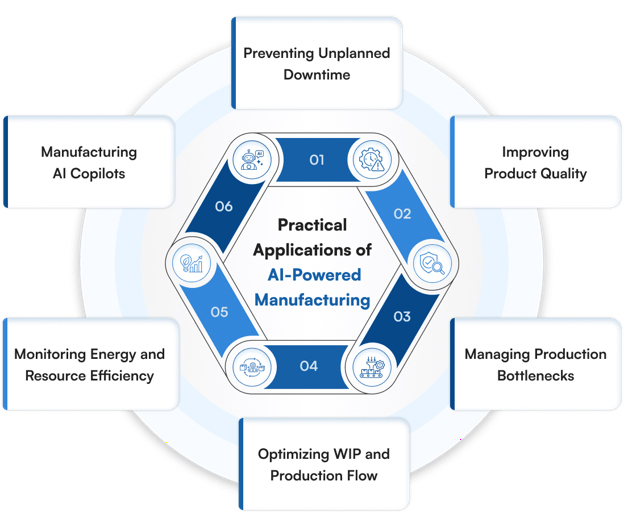
Practical Applications of AI-Powered Manufacturing
AI can support a broad range of manufacturing decisions beyond equipment maintenance.
1. Production Performance Optimization
AI can analyze production output, cycle times, machine availability, WIP, schedules, and process conditions to determine why production is falling behind target.
Rather than simply reporting a production loss, an intelligent system can evaluate potential responses—such as changing production sequences, reallocating work, or adjusting schedules—and help identify which option is most likely to improve throughput.
After the intervention, actual production performance can be compared with the expected outcome, providing feedback for future decisions.
Quality problems can result from multiple interacting factors, including machine settings, materials, process conditions, and equipment behavior.
AI can identify relationships between these variables and recurring defects. Instead of stopping at defect detection, the system can recommend process adjustments or corrective actions based on the conditions associated with previous quality outcomes.
The results of those actions can then become feedback for future quality decisions.
This creates a shift from detecting defects to continuously improving the conditions that influence quality.
3. Dynamic Bottleneck Management
Production bottlenecks can change as machine performance, WIP, material availability, quality, and schedules change.
AI can continuously evaluate these variables to identify emerging constraints and determine which intervention could have the greatest impact on overall production flow.
Once an action is taken, the system can measure its effect on throughput, WIP, and machine utilization.
This enables bottleneck management to become a continuous optimization process rather than a periodic investigation.
4. WIP and Production Flow Optimization
Excessive WIP can indicate downstream constraints, while insufficient WIP may cause production starvation.
AI can combine WIP information with machine availability, production priorities, schedules, and process dependencies to identify potential disruptions and recommend better production sequencing or allocation.
The resulting production performance can then be used to refine future flow decisions.
5. Energy and Resource Optimization
Energy consumption should not be treated as an isolated KPI.
AI can compare energy usage with production output, machine operating conditions, and process requirements to identify unusual consumption patterns and potential inefficiencies.
The system can then help determine how energy or other resources can be reduced without negatively affecting production targets or quality.
As with other applications, measuring the result of these changes allows future optimization decisions to become more informed.
6. Predictive and Prescriptive Maintenance
AI can analyze historical and real-time machine data to identify patterns associated with developing equipment problems.
Instead of waiting for failure, maintenance teams can investigate changes in vibration, temperature, pressure, cycle time, or other operating parameters.
The next step is prescriptive maintenance, where AI considers the predicted issue alongside production priorities, machine criticality, maintenance resources, and potential production impact to help determine which maintenance action should be prioritized.
This moves maintenance from predicting failure toward making better maintenance decisions.
Natural-language AI interfaces can make manufacturing information easier to access and interpret.
Instead of navigating multiple dashboards, users could ask:
- “Why did production fall below target?”
- “Which machine contributed most to today’s production loss?”
- “Which order is at risk of delay?”
- “What are the possible causes of today’s quality issue?”
- “What actions could reduce this bottleneck?”
- “Which response has the lowest production risk?”
The next generation of manufacturing copilots can therefore move beyond answering questions. They can help connect information, evaluate operational context, compare possible responses, and support faster decision-making while retaining human judgment.
The Human-in-the-Loop Approach
Autonomous manufacturing does not mean eliminating people from the factory.
Manufacturing decisions often require experience, engineering knowledge, safety awareness, and business context. AI can process large volumes of information quickly, but human expertise remains essential for complex and high-impact decisions.
A practical human-AI model allows AI to:
- Monitor production continuously
- Detect anomalies
- Identify relationships and patterns
- Predict potential outcomes
- Evaluate possible responses
- Recommend actions
- Automate predefined workflows
- Measure the results of those actions
- Learn from operational outcomes
Operators, engineers, and managers can review higher-risk recommendations and approve significant decisions.
This approach creates a balance between automation and human expertise. As confidence in AI systems increases and operational boundaries become better defined, more suitable decisions can gradually move toward automation.
The goal is therefore human-AI collaboration, where technology increases decision speed and capability rather than simply replacing human expertise.
Building the Data Foundation for AI
Scaling industrial AI requires a reliable operational foundation:
Reliable data: Machine and production data must be accurate, consistent, and available in real time.
Legacy connectivity: Existing equipment can often be connected through appropriate industrial gateways rather than replaced.
Data contextualization: Sensor data becomes more valuable when linked to machines, products, materials, orders, and processes.
System integration: AI needs access to relevant IoT, MES, ERP, quality, and maintenance data.
Outcome tracking: The results of decisions and actions must be captured so AI can learn from operational outcomes.
Security and governance: Data access, cybersecurity, AI usage, and operational boundaries must be clearly controlled.
These foundations enable manufacturers to move from isolated AI experiments toward scalable manufacturing intelligence and continuous optimization.
Challenges and Cybersecurity Considerations
The transition toward increasingly autonomous operations comes with several challenges.
Data quality is critical because unreliable information can lead to unreliable recommendations.
Legacy integration can be complex when factories contain a mixture of older and newer equipment.
AI explainability is important because operators need sufficient context to understand and trust recommendations.
Cybersecurity becomes increasingly important as more machines, systems, and AI applications become connected.
Manufacturers must also address the pilot-to-scale gap. A successful AI proof of concept does not automatically translate into an enterprise-wide solution. Organizations need reusable data architectures, governance, integration methods, and operational standards.
Most importantly, autonomous systems require clearly defined boundaries. Manufacturers need to determine which decisions AI can recommend, which actions it can execute, and which situations require human approval.
The Road Toward Self-Optimizing Factories
Autonomous manufacturing should be treated as a gradual journey:
Stage 1 – Connected Visibility
Establish real-time production monitoring and reliable data collection.
Stage 2 – Intelligent Understanding
Use analytics and AI to identify patterns, relationships, and potential causes.
Stage 3 – Predictive Operations
Identify potential failures, bottlenecks, quality issues, and delays before they escalate.
Stage 4 – Decision Intelligence
Evaluate operational context and recommend the most appropriate response.
Allow people to approve recommendations while systems execute selected workflows.
Stage 6 – Closed-Loop Learning
Measure the outcome of actions and use operational feedback to improve future recommendations.
Stage 7 – Autonomous Optimization
Allow intelligent systems to continuously optimize defined processes within approved operational, business, and safety boundaries.
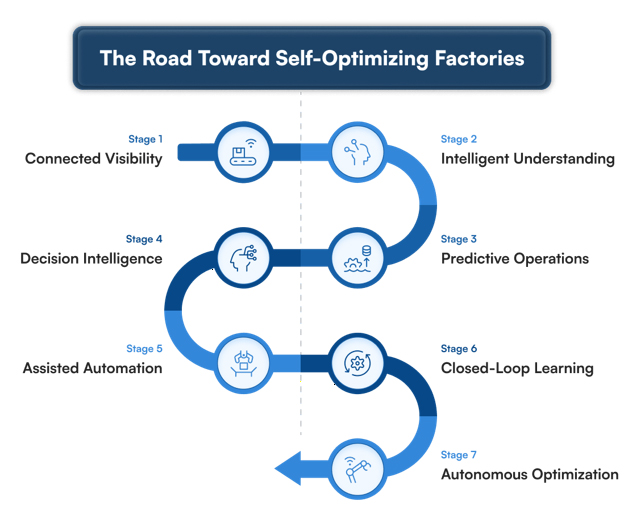
This progression is important because autonomy is not achieved simply by adding AI to existing monitoring systems. It emerges when connected data, intelligent decisions, automated actions, and continuous learning work together.
Manufacturers can begin with focused, high-value applications such as production optimization, quality analysis, predictive maintenance, energy management, or WIP optimization. Successful implementations can then provide the experience, data, and infrastructure required for broader autonomy.
Conclusion
Production monitoring made the modern factory more visible. AI is now making it more intelligent—and increasingly capable of learning from its decisions.
The competitive advantage of the next generation of manufacturing will not come simply from collecting more data or creating more dashboards. It will come from connecting information, understanding its context, predicting what may happen, deciding what should be done, and measuring whether that decision delivered the expected result.
By combining IIoT, real-time production monitoring, MES and ERP integration, predictive analytics, industrial AI, and emerging AI agents, manufacturers can move beyond knowing what happened to understanding why it happened, what may happen next, what should be done, and how the outcome can improve the next decision.
The path to autonomous manufacturing will require reliable data, connected systems, cybersecurity, scalable architecture, clearly defined operational boundaries, and skilled people who can work effectively with AI.
But the direction is clear:
The factory of the future will not simply collect data. It will learn from it, reason with it, act on it, measure the outcome, and continuously optimize how decisions are made.
That is the transformation from data to decisions—and from production monitoring to autonomous manufacturing.
Ready to transform your factory with intelligent automation?
Contact us to discover smart manufacturing solutions designed to improve visibility, efficiency, decision-making, and operational performance.
Let’s build a more connected, intelligent, and future-ready manufacturing operation together.
About the Author :

Mr. Ranjith Kumar Diraviyam
Founder & CEO
Bevywise Networks INC.

Ranjith Kumar Diraviyam is the Founder & CEO of Bevywise Networks, an IoT and Industry 4.0 solutions company that enables manufacturers and enterprises to drive digital transformation. With over two decades of experience in product development and technology leadership, Ranjith brings a unique blend of technical expertise and business vision.
Before founding Bevywise in 2016, Ranjith was spent 14 years at Zoho Corporation, where Ranjith was part of the core team that built Zoho Writer and later led multiple large-scale product initiatives, including a graph database-based authorization system. Ranjith’s deep background in building scalable frameworks and enterprise tools laid the foundation for Bevywise’s product suite.
At Bevywise, Ranjith has bootstrapped the company into a global player, delivering MQTT frameworks, IoT simulators, MES solutions, energy management systems, and smart factory platforms. The company today serves more than 100 customers worldwide, including Johnson & Johnson, Celiker Holding, IITs, and large manufacturing enterprises.
Ranjith is also passionate about education and mentorship, running an academy in Tirunelveli to train and recruit students in IoT and Industry 4.0 technologies. Ranjith‘s vision is to build solutions that connect devices, people, and processes—making data-driven decision-making accessible to businesses of all sizes.
Mr. Ranjith Kumar Diraviyam can be contacted at:
LinkedIn | Email |Mobile : +9198407 87678
About Bevywise Networks Inc.,
 Transforming Industries with IoT, AI, and Smart Solutions
At Bevywise Networks, we lead the charge in digital transformation, offering advanced MQTT-based IoT platforms, smart factory solutions, AI-driven manufacturing enhancements, and innovative educational tools. Our mission is to empower businesses and educational institutions to thrive in the connected era by providing tailored solutions that drive operational efficiency and academic excellence.
Our Expertise: MQTT-based IoT Platform: Enabling seamless, real-time communication across devices with scalable IoT connectivity, enhancing data exchange and system integration. Smart Factory Solutions: Revolutionizing manufacturing with intelligent solutions that optimize production, Traceability, Quality, Data Management, and operational performance.
AI Implementation for Manufacturing: Leveraging artificial intelligence to refine manufacturing processes, improve quality control, and provide plan annalysis and effective planning, driving smarter, more efficient operations.
Educational Tools: Developing state-of-the-art tools for colleges and institutions to enrich learning, streamline administration, and enhance educational outcomes.
Flexible Solutions: We offer both SaaS (Software-as-a-Service) and on-premise models to meet the unique needs of our clients, providing flexibility in deployment and management. Why Choose Bevywise Networks?
Expert Team: Our professionals bring extensive experience in IoT, AI, smart manufacturing, and educational technologies, delivering proven results across various industries.
Customized Approach: We craft bespoke solutions that align with your specific business or educational goals, ensuring optimal performance and impact. Commitment to Excellence: We uphold the highest standards of quality and integrity, continuously innovating to stay at the forefront of technological advancements. We are Open for Collaboration to enhance the world into much productive place.
Bevywise Networks Inc., can be contacted at:
X | FaceBook | YouTube | LinkedIn | E-mail
Also read Bevywise Networks Inc., earlier articles: