
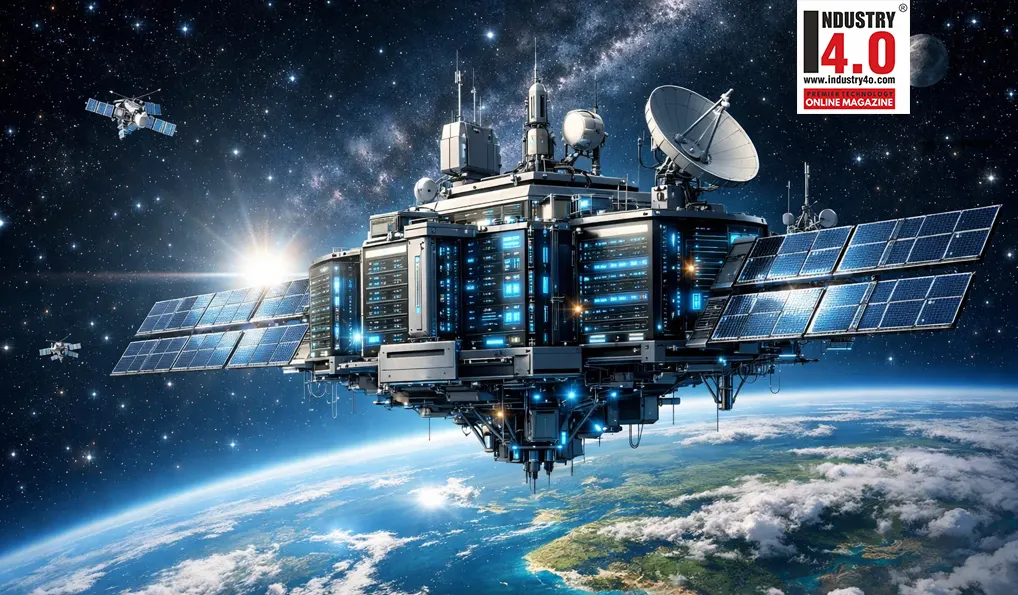
AI Data Centers in Space – The future?
Massive GW-capacity AI data centers are needed for defense and civilian use. People across the world resist them since they consume massive power and water. Setting up AI data centers in space is a solution under conceptual development. What is the tech, system architecture, costs, and efforts needed?
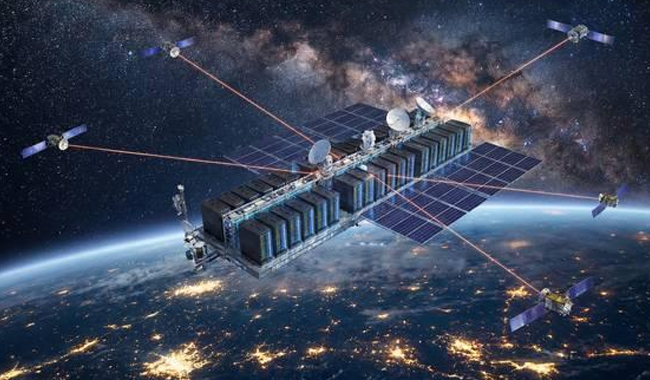
Figure 1. AI Space Data Center Representation (Shashi Kadapa with Gemini AI)
Data centers in space in near-Earth orbits are the staple in sci-fi movies such as Moon 2009, Ad Astra (2019), and even 2001: A Space Odyssey (1968), among others. Until recently, there was no need to host data centers in space.
There are about 1,180 hyperscale and about 8,820 smaller data centers in the world. Hyperscale data centers have at least 5000 servers, with a 10,000+ square feet area and use 100+ MW of power. They have advanced cooling systems since servers release massive heat.
 Such servers converge cloud servers; they are efficient, can scale quickly, and are automated. Organizations such as Amazon, IBM, Google, Microsoft, Meta, and Apple have such servers in multiple locations.
Local communities do not want these AI data centers. Some reasons are diverting power, consuming fresh water, and increased traffic. However, these massive AI data centers are essential to provide services.
Some organizations are considering installing these servers in near-Earth orbit in space. The locations promise uninterrupted solar power, cooling, and constraints on Earth become irrelevant.
However, setting up AI data centers in space has several challenges, such as infrastructure, costs, maintenance, and others. Some enterprises such as Starcloud, SpaceX, Blue Origin, Pixxel, and Sarvam are investing in this concept.
This presentation examines the technical aspects of AI data centers in space.
Challenges with large AI data centers
By 2035, the number of hyperscale, colocation, and neocloud configurations will increase to 3,200. The computing power of each will increase from the current 150+ MW of IT loads to the GW ranges. They will have extreme dense rack densities, multi-chip modules, thousands of special AI GPUs per cluster domain delivering exaflops of computing per row.
Several challenges are seen:
Power: A one GW campus will require about 9 TWh (Terra Watt Hours) annually, and this is the output of a medium-size nuclear plant. Global AI data centers will require 565 TWh. A large metro like Mumbai requires on one million requires 15- 18 TWh annually. This much power is not available in public networks.
 Water: Water consumed by a large hyperscale AI data center is about 5 million gallons. This is the water needed for a town with 50,000 residents. Traditional evaporation cooling will need about 2 billion gallons/ year. About 2.4 gallons of water is used per kilowatt-hour (kWh) of server energy.
This volume of water is not available in areas where AI data centers are planned. Closed-loop cooling with a mix of water and propylene glycol with cold plates attached to chips reduces fresh water consumption by 70 percent. However, fresh water requirement is a major challenge.
Infrastructure: It takes about 18 months to fully set up and commission a hyper AI data center. However, power and water connectivity take up 4-8 years. This inability to provide utilities is a major challenge since tech and requirements will change over such a long time.
Costs: Considering a cost of $20 million per MW in construction, the costs can increase to $44 to 170 billion / GW. The global expenditure on AI data centers by 2030 will be about $7 trillion. Organizations require assurance that the utilities and other setup are available before they invest.
Land: The land needed for hyperscale AI data centers is about 1000 acres. The campus will host server halls, heavy-duty liquid cooling setups, on-site electrical substations, and long-term land banking. Procuring so much land near major towns can be expensive.
Advantages of space-based AI data centers over terrestrial systems
Space-based AI data centers are important due to the rapid growth of AI. The demand requires massive electricity, cooling, land, and networking infrastructure. While terrestrial data centers will be the main platform for most workloads, orbital AI data centers offer several advantages for specific high-power, compute-intensive applications.
The following figure compares orbital data centers with terrestrial platforms.
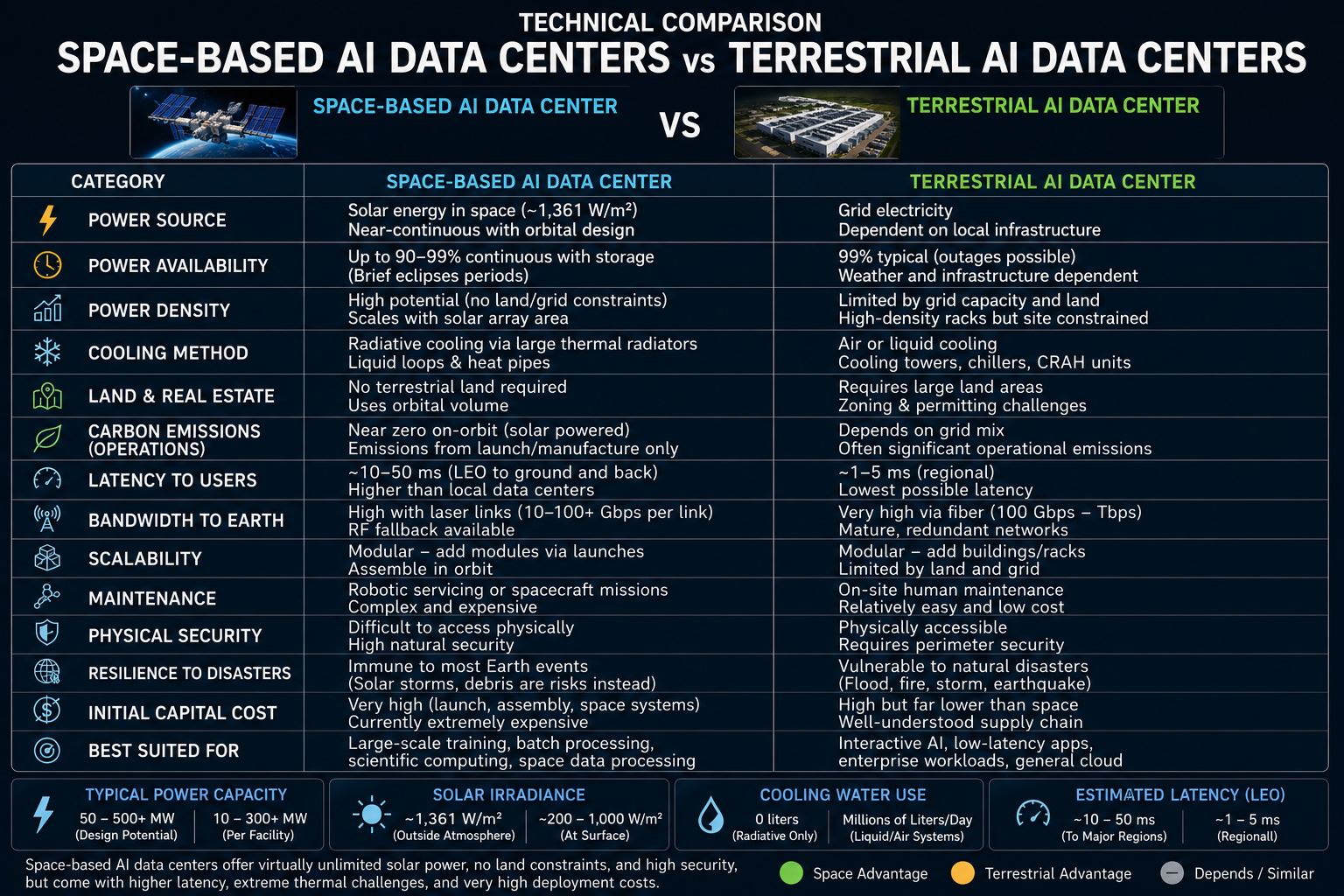 Figure 2. Comparison of Earth vs space based AI data centers (Shashi Kadapa with Gemini AI)
Technical details of AI data centers in space
 Space based AI data centers are placed in low earth orbits in dawn to dusk sun synchronous paths, used by satellites. The systems are in continuous sunlight and collect more than nine times the sunlight possible on Earth’s surface. There is no need for battery backups used on Earth.
Cooling is by radiative dissipation with space and vacuum serving as infinite heat sinks. Heat is removed through passive infrared radiator panels. Chips operate at high thermal tolerances that increase their radiative cooling efficiency to the fourth power with temperature.
Initial costs would be $170 billion/ GW, compared to $ 55 billion for terrestrial GW systems. Main costs are heavy launch payloads and solar power generation. As reusable rockets with liftoff become widespread, launch costs would fall to $100 per kilogram. the overall costs would reduce in the next decade, and be at par with terrestrial AI data centers.
The following figure presents the conceptual illustration of a super hyperscale AI data center in space.
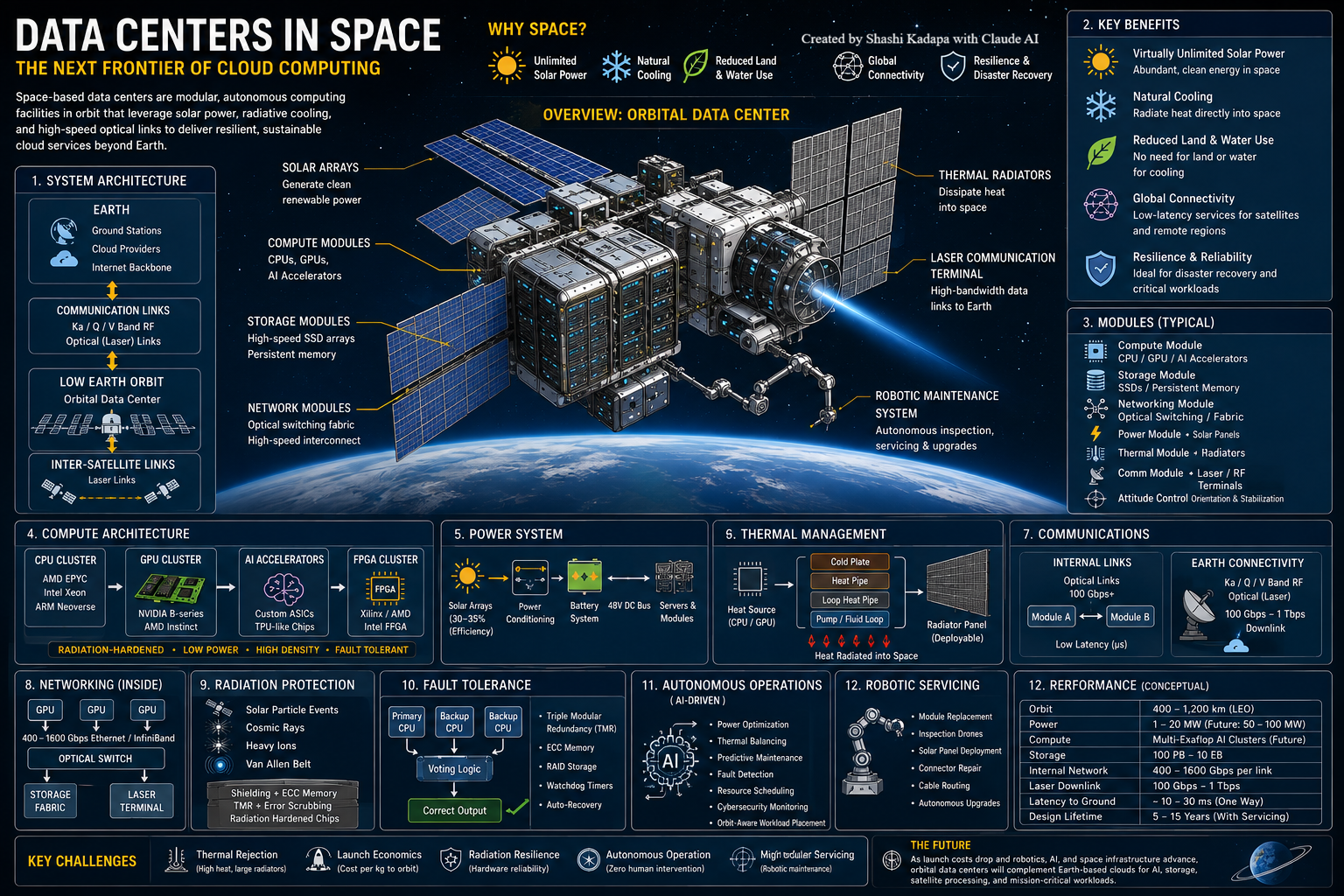
Figure 3. Tech details of Data centers in space (Shashi Kadapa with Claude AI)
The technical details are discussed as follows. Some of the technologies would need to be developed.
System Architecture
The system architecture would be similar to what is used on Earth, except for components and communications. The main components are user access, ground segment, space communication layer, orbital AI data center platform, compute module, storage module, AI network fabric, power generation and thermal management systems, communication modules, autonomous operations, and robotic maintenance.
Ground support: This is the gateway between Earth-bound users and the space AI data centers. Ground gate stations’ functions include tracking satellites, authenticating users, Encrypt/decrypt communications, routing AI workloads, receiving telemetry, and others. Equipment will include Ka-band antennas, Optical laser terminals, High-speed routers, a Network Operation Center, and Mission Control Systems.
User access layer: Users use AI to request tasks to be completed. Requests travel over the public internet or private enterprise networks to the cloud provider. Some examples of tasks are Chatbots and LLM inference, AI image generation, Scientific simulations, Drug discovery, financial modeling, Climate prediction, Military intelligence, Earth observation analytics, and others.
Performance Targets
Certain minimal performance requirements or targets expected from space AI data centers are:
| Metric | Units |
| AI Accelerators | 10,000–100,000+ |
| Compute | Multi-exaFLOP AI capability |
| Power | 50–500 MW |
| Storage | Multi-exabyte |
| Network | 400–1600 Gbps fabrics |
| Availability | 99.9%+ with redundancy |
| Design Life | 10–20 years |
Orbital Platform
The orbital platform will carry all the infrastructure. Multiple modules will be docked together to create a very large compute platform. Some details are:
- Orbit: Low Earth Orbit (400–1200 km)
- Velocity: 7.66 km/s
- Orbital Period: ~90 minutes
- Lifetime: 10–20 years
- Mass: 50–500 tons
- Modular Architecture: Yes
Compute Hardware
This aspect is core to the optimum functioning of the AI data space center. The hardware must be hardened to resist radiation, intense launch, extreme cold, vacuum, and solar winds. While the hardware modules will evolve, the initial configuration are:
CPU: ARM server processors, x86 server CPUs, Radiation-tolerant controllers. There will be 8–16 AI accelerators per node, 1–2 CPUs, 1–4 TB RAM, and NVMe SSD storage.
Space Networking
This aspect refers to the internal networking between different clusters and their components. It will resemble the networking used in terrestrial clusters. Inter-module links may use optical fiber internally and free-space optical links externally.
Technologies recommended are 400- 800 Gbps Ethernet, InfiniBand, Optical switching, and Silicon photonics.
Storage Architecture
A hierarchical approach would be used with at least three tiers.

Tier 0: This will have HBM memory with 3–5 TB/s bandwidth
Tier 1: Will have DDR5/LPDDR memory of several TB per node capacity
Tier 2: Will be NVMe SSDs with PCIe Gen5, and tens of TB per server
Tier 3: Will have distributed object storage made of S3-compatible object storage, and
Distributed file systems
Power Generation
This is a critical aspect of the system. One of the main advantages is continuous strong solar. On earth’s surface, the solar flux is about 340 W/m2. In space, it would be about 1400 W/m2 since there is no atmospheric filtering. A 100 MW AI platform requires 250,000–350,000 m² of solar panels depending on efficiency.
Deployable solar arrays will have multi-junction solar cells with an efficiency of 35%-40%. Solar panels will spread over several kilometers. Power will flow from solar arrays > MPPT controllers > HVDC bus, DC/ DC converters > Server power supplies.
Energy Storage
Since the platform passes through Earth’s shadow periodically, there will be a need to have energy storage systems. These will be bulky and heavy. Some power storage options for space AI data centers are Lithium-ion batteries, Solid-state batteries, Supercapacitors, and Fuel cells.
Cooling systems
Cooling systems present a major change since the heat emitted by space AI data centers is massive. Outer space temperatures can rise to 125 degrees centigrade. Standard convection methods are not possible since air is not present, and only radiation methods can be used.
Internal cooling methods are Liquid cooling, Cold plates, Heat pipes, and Two-phase cooling. External cooling is with large radiators that emit heat as infrared radiation. A 170 MW cluster generates enough heat to power 2000,000 homes.
AI cluster architecture
The software would include Kubernetes, Slurm, Ray, MPI, Distributed training frameworks, and AI model serving platforms.
Robotics
The system would be unmanned or with very minimal staff, and space robots will manage all functions. Robots will replace compute modules, Swap failed boards, deploy radiators, Clean optical terminals, inspect structures, and connect new modules.
Limitation and Engineering Challenges
Constructing, operating, and maintaining space AI data centers present some key challenges. In terms of power and other factors, it would be hundreds of times the size and complexity of the International Space Station (ISS). Some limitations are:
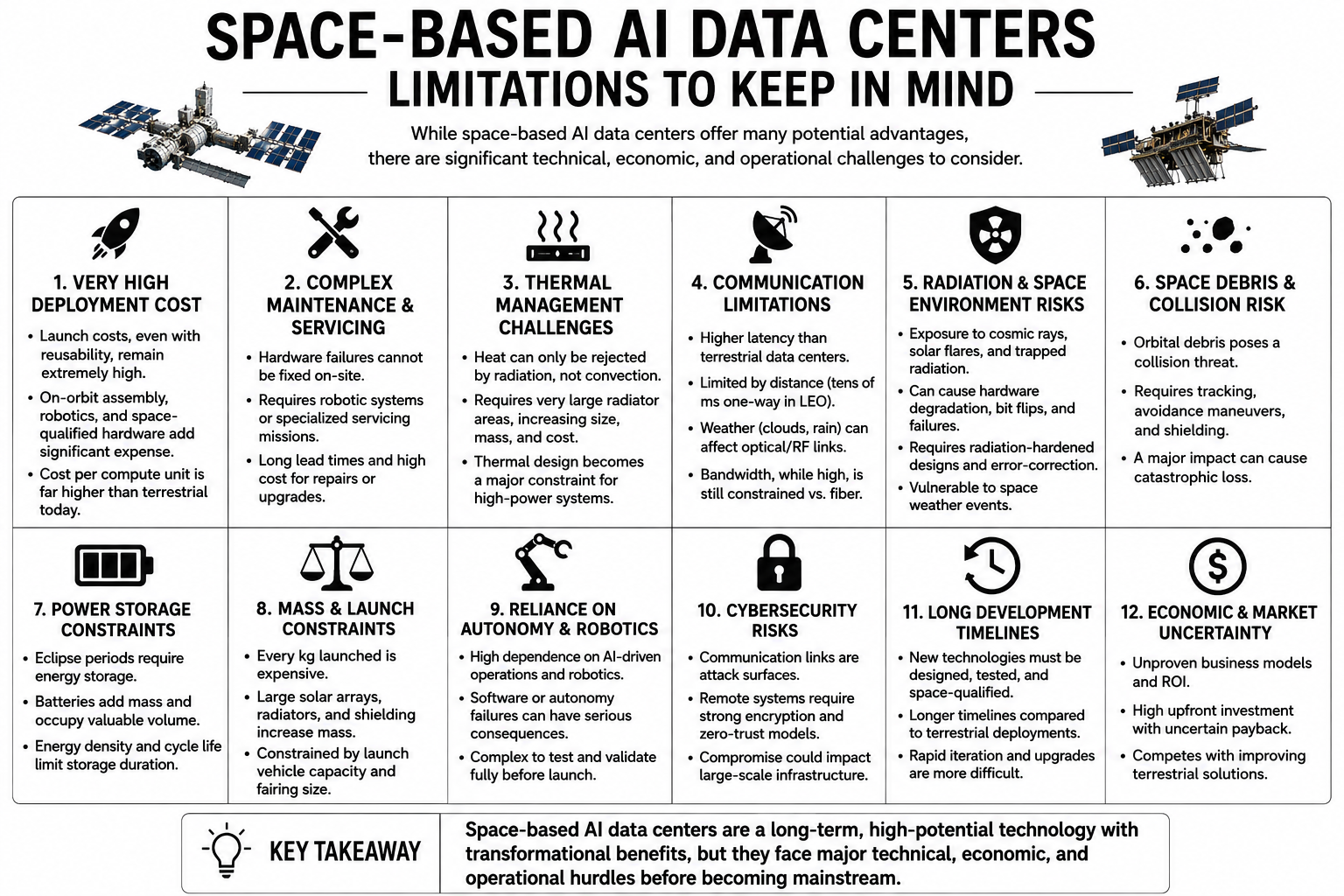 Figure 4. Limitations of constructing space AI data centers (Shashi Kadapa with Gemini)
Conclusions
Space-based AI data centers certainly will provide several benefits over terrestrial campuses. Advances in reusable heavy-lift launch vehicles, on-orbit assembly, high-efficiency solar arrays, free-space optical communications, autonomous robotics, and radiation-tolerant AI hardware could make orbital AI data centers increasingly feasible. As of now, commercial AI hyperscale data centers in space are not available.
Developments in space infrastructure indicate that modular, solar-powered orbital computing platforms could become an important complement to terrestrial AI infrastructure for specialized, power-intensive workloads over the coming decades.
About the author :
 Mr. Shashi Kadapa
Based in Pune, India, Mr. Shashi Kadapa is an engineer, MBA and has worked with leading IT and manufacturing firms. A multi-hyphenate, he has roles as a technical writer, and SEO content writer with a focus on IT and tech topics.
Creative fiction is his passion, and he serves as the managing editor of ActiveMuse, a journal of literature. His stories across multiple genres are published in more than 45 US and UK anthologies.
Mr. Shashi Kadapa can be contacted at :
E-mail | LinkedIn | Blog | Mobile : +91 7387492371
Also read Mr. Shashi Kadapa earlier article: