
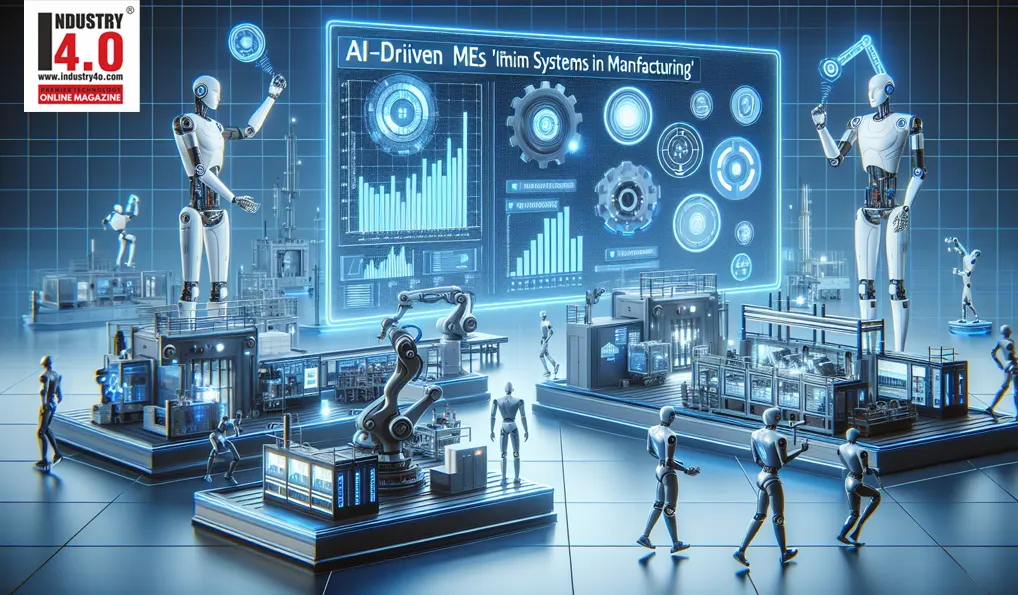
From Data to Action: How Closed – Loop MES and AI Are Transforming Manufacturing
The Gap Between Investment and Reality
Over the past few years, I’ve had countless conversations with manufacturing leaders about digital transformation. Almost all of them have invested, sometimes heavily, in systems meant to improve visibility, efficiency, and control. ERP upgrades, BI dashboards, machine connectivity, quality systems – on paper, everything is there. And yet, when you step onto the shop floor, a different reality often emerges.
Despite all the technology in place, production is still managed across multiple disconnected systems. Teams are still bridging gaps manually, and in many cases, the cost and complexity of maintaining these environments continues to grow without delivering measurable impact on the shop floor. So the question is not whether manufacturers are investing in digitalization. The real question is why so many are still struggling to translate that investment into operational results.

The Real Challenge Isn’t Data – It’s Fragmentation
One pattern I see again and again is fragmentation. Over time, different systems are implemented to address specific needs. There is one system for production processes and OEE, another for quality, separate tools for maintenance, digital forms or EBR, energy monitoring, material handling and weighing, and work-in-progress tracking. Individually, many of these systems function well. But because they operate separately, manufacturers struggle to get a truly unified, real-time view of what is happening on the shop floor.
Instead of having one clear picture, information is scattered across systems. Insights are not readily available and require manual analysis, cross-checking data, and time-consuming investigation. As a result, by the time issues are fully understood, the opportunity to respond in real time is often lost. This makes continuous improvement significantly more difficult, and in some cases, nearly impossible to sustain. What’s missing is not data. It is continuity.
What Closed-Loop Manufacturing Really Means
 This is where the concept of closed-loop manufacturing becomes critical, and also where it is often misunderstood. Closed loop is not just about collecting data, analyzing it, and taking action. At its core, it is about managing the entire production lifecycle within one continuous system where all processes are inherently connected. Production, quality, maintenance, materials, energy, and work in progress are not managed as separate domains, but as part of one operational flow.
When everything operates within a single environment, there is no need to connect the dots between systems because the dots are already connected. There are no gaps between planning and execution, no dependency on fragile integrations, and no disconnect between what is happening on the shop floor and what the organization sees.
What This Looks Like in the Real World
In one of the manufacturing companies we worked with, the situation was very typical. They had multiple systems in place covering quality, maintenance, and reporting, alongside manual processes used to manage production itself. From a management perspective, it seemed like everything was covered. But on the shop floor, operators were duplicating data, issues were identified too late, coordination between teams relied heavily on manual communication, and traceability required significant effort to reconstruct.
The problem was not a lack of tools. It was the absence of a unified operational structure. Once they moved to a closed-loop MES approach, production, quality, and maintenance became part of the same continuous flow. Data moved naturally across processes, everyone worked from the same real-time picture, and traceability became an inherent part of the operation rather than something that had to be built after the fact. The most significant change was not better visibility, but a fundamental shift in control and consistency.
Why We Built PlantSharp This Way
These kinds of challenges are exactly why we built PlantSharp the way we did. From day one, the goal was not to create another layer of software, but to rethink how manufacturing systems should actually operate. Instead of integrating multiple disconnected tools, we designed a platform where the full production lifecycle is managed as one continuous system. This approach reduces complexity, removes dependency on integrations, and creates a stable and consistent operational environment. It allows organizations to move from managing systems to managing production itself.
 From Closed Loop to Intelligent Operations
Once that foundation is in place, something else becomes possible. When all processes, data, and context are managed within a single system, data can finally be used in a contextual and actionable way. This is where AI comes into play, not as a buzzword, but as a practical layer built on top of a structured environment. Instead of navigating dashboards and reports, teams can interact with the system in a much more natural way, asking simple questions about production, understanding what is really happening, and identifying inefficiencies quickly.
More importantly, the system can suggest improvements, guide decisions, and over time enable more autonomous actions. This is not about replacing people, but about giving them the ability to operate with clarity, speed, and confidence in an increasingly complex environment.
A Shift That’s Already Happening
What I am seeing today is a shift in how leading manufacturers think. There is less focus on adding more tools and more focus on simplifying and structuring operations. Closed-loop MES is becoming the foundation, and AI is becoming the layer that unlocks its full potential. Together, they are redefining what operational excellence looks like in modern manufacturing.
Final Thoughts
Digital transformation does not fail because of a lack of technology. It fails when technology does not reflect how production actually works. The manufacturers who are moving forward are those who stop layering systems and start building environments where everything works as one. That is where real impact begins.
Expanding the Next Generation of Manufacturing Systems
 As demand for more connected and intelligent manufacturing environments continues to grow, we are seeing increasing interest from organizations looking to move beyond fragmented systems toward true closed-loop operations.
At Trunovate, we are currently expanding globally and actively looking to collaborate with partners who share this vision.
We see strong alignment with system integrators, industrial automation providers, and consultants working closely with manufacturing organizations. For many of them, the challenge today is not identifying the need for digital transformation, but delivering solutions that create real, measurable impact on the shop floor.
PlantSharp was designed exactly for that — to simplify complex environments, unify operations, and enable the next layer of AI-driven optimization.

If you are working with manufacturers facing these challenges, or looking to expand your offering with a next-generation MES solution, I would be glad to connect and explore how we can work together.
 About the Author:

Ms. Lea Tarshish
CEO
Trunovate | PlantSharp MES

Ms. Lea Tarshish is the CEO of Trunovate and leads the development of PlantSharp MES, a next-generation platform designed to unify and optimize manufacturing operations through a true closed-loop approach.
Ms. Lea Tarshish with a strong focus on bridging the gap between digital systems and real shop floor execution, Ms. Lea Tarshish works closely with manufacturers to simplify complex production environments and drive measurable operational impact.
Ms. Lea Tarshish work centers on enabling organizations to move beyond fragmented systems toward fully connected, data-driven, and intelligent manufacturing operations, combining real-time visibility with AI-driven insights and continuous optimization.
Ms. Lea Tarshish can be contacted at:
LinkedIn | E-mail (1) | E-mail (2) | Website

About Trunovate :
Trunovate, formally known as ContelITS, incorporates decades of manufacturing, hardware, software and planning expertise. Trunovate‘s mission is to facilitate a handshake between humans and machines to achieve fully optimized and automated production efficiency. Trunovate streamline each part of the manufacturing process using automated, secure, cloud-based and on premises software that tackles the industry’s strongest pain points. PlantSharp, our best-of-breed smart industrial Manufacturing Execution System (MES), brings the transparency, responsiveness and insights needed for the highest levels of ROI.
Trunovate’s smart industrial software suite enables humans and machines to collaborate as one unified team, so your manufacturing company can leverage the next wave of innovation, Industry 4.0, and soar to new heights of value.
E-mail | LinkedIn | Website | FaceBook | YouTube | Trunovate Website