

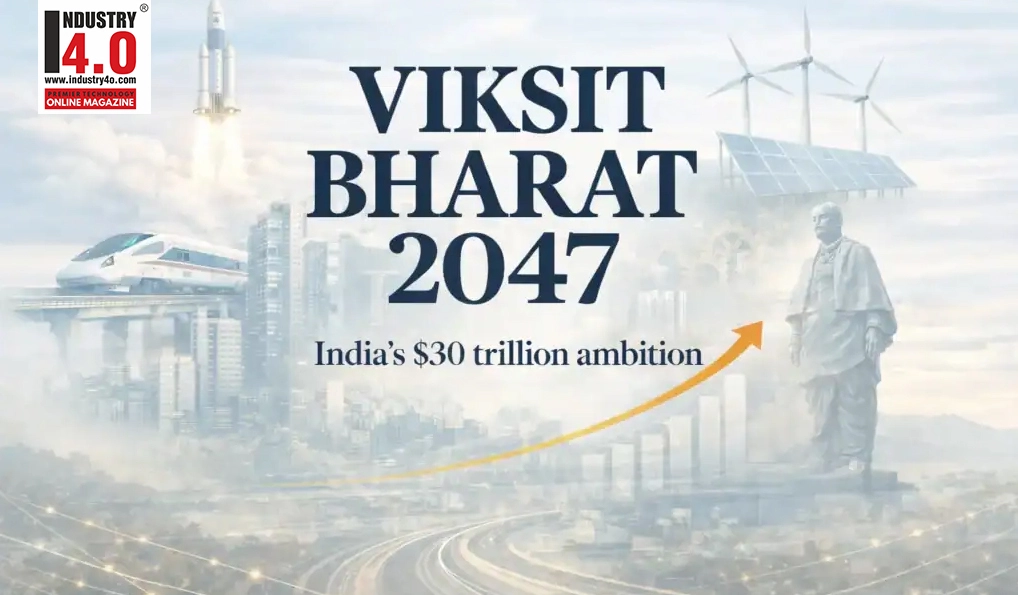
The Grid as Strategy : Powering India’s 2047 Transformation
As India approaches its centenary in 2047, the idea of a Viksit Bharat has shifted decisively from aspiration to obligation. A 30 trillion dollar economy, globally competitive manufacturing, integrated logistics, and digital universality are no longer distant goals. They are policy commitments.

Yet beneath every ambition lies a foundational truth. Development runs on dependable power. No country has crossed into developed-nation status on unreliable electricity. In India’s case, the transmission grid is not a supporting actor in this transformation. It is the stage itself.
The Grid That Holds the Nation Together
This transition from access to assurance has been enabled by a quiet but extraordinary expansion of India’s transmission network. India’s national power transmission system has crossed 5 lakh circuit kilometres, supported by 1,407 GVA of transformation capacity. Since 2014, the network has grown by 71.6 percent, with the addition of 2.09 lakh circuit kilometres of transmission lines and 876 GVA of transformation capacity. Integration at this scale has reshaped the energy landscape. The inter-regional power transfer capacity now stands at 1,20,340 megawatts, enabling electricity to move seamlessly across regions. This has successfully realised the vision of One Nation, One Grid, One Frequency and created one of the largest synchronized grids in the world. This architecture is not merely technical. It is economic infrastructure. It allows energy to flow from resource-rich states to industrial corridors without friction, strengthening productivity, investment confidence, and national competitiveness.
From Electrification to Excellence
India’s first power-sector revolution was about access, and that mission is largely complete. Saubhagya connected 2.86 crore households, while DDUGJY achieved universal village electrification by 2018. These were historic milestones.
However, access is only the starting point. Developed economies operate on a higher standard where power is always available, always stable, and always scalable. In a Viksit Bharat, outages must be exceptions rather than expectations. Voltage fluctuations cannot be built into business models. An industrial unit in rural Assam must receive the same quality of supply as one operating in an export hub in Southeast Asia. Reliability has now become the true benchmark of progress.
Rural India: From Load Centre to Growth Partner
 The impact of a strong transmission backbone is most visible in rural India. Average rural power supply has increased from 12.5 hours per day in 2014 to 22.6 hours in FY 2025. This improvement has fundamentally altered the economic potential of villages and small towns. Reliability is being reinforced by systemic reforms. Under the Revamped Distribution Sector Scheme, grid modernization has reduced national AT&C losses to 15.37 percent, improving the financial sustainability of electricity supply.
Digital tools are accelerating this shift. More than 4.76 crore smart meters have been installed nationwide, bringing transparency, efficiency, and real-time control to energy consumption. Targeted interventions continue to close the remaining gaps. The PM-JANMAN initiative is electrifying remote habitations of Particularly Vulnerable Tribal Groups, while PM-KUSUM is reshaping agricultural power by enabling reliable daytime electricity through solarization. With states tendering over 20 gigawatts of feeder-level solar capacity, farmers are increasingly becoming urjadatas, contributing power back to the grid.
Reliable transmission makes this participation possible. The tower standing in a farmer’s field is no longer just infrastructure. It is a direct connection to the national economy. With assured round-the-clock power, industries no longer need to cluster around congested urban centres. Cold chains, food processing units, automated MSMEs, and digital services can operate efficiently in Tier-2 and Tier-3 towns. This rurban transformation creates local employment, strengthens regional economies, and reduces migration pressures. In this model, rural India is no longer a subsidised consumer of power. It becomes a productive contributor to national growth.

Green Ambitions Need Grid Muscle
A Viksit Bharat must also be a sustainable Bharat. India’s commitment to achieving 500 gigawatts of non-fossil fuel capacity by 2030 reflects both climate responsibility and strategic foresight. Renewable energy, however, is geographically dispersed. Solar potential lies in deserts, wind along coastlines, and hydro resources in mountainous regions. Without a strong transmission backbone, clean energy remains stranded. The expanded grid, supported by investments under the Green Energy Corridor programme, has become the central enabler of renewable integration. Strengthened inter-regional links ensure that clean power generated in remote areas can reach demand centres efficiently. This capability allows India to pursue growth without compromising its environmental commitments.
Resilience as National Security
Recent global energy shocks and climate-induced disruptions have reinforced one reality. Energy security is inseparable from national security. The grid of a developed India must therefore be resilient, intelligent, and adaptive. Smart Grids capable of self-healing, predictive maintenance, and advanced demand-response management are no longer optional. They are essential. Equally important is social resilience. Right-of-Way challenges require a partnership-driven approach. Landowners must be treated as stakeholders in national progress, with fair compensation and transparent processes that build trust and cooperation.

The Backbone of a Developed India
As India moves steadily toward 2047, development will be measured not only by economic output or industrial capacity, but by the consistency and quality of its power supply. Every kilometre of transmission line laid becomes a conduit for productivity. Every additional GVA of capacity strengthens energy security. The quiet hum of high-voltage lines signals a nation growing with confidence. Connecting Bharat is no longer about lighting homes. It is about powering aspirations, enabling enterprise, and securing India’s place as a self-reliant global force.
The transmission grid is not merely supporting the vision of Viksit Bharat. It is sustaining it.
About the Author :
Mr. Varun Bhatia
Vice President – Projects & Learning Solutions,
Electronics Sector Skills Council Of India (ESSCI)
Mr. Varun Bhatia is a self-managed and result-oriented Project Manager/Engineer with vast experience in Project Management, Agile Process, Cost Estimating, Bid Development, Contract Negotiation/Administration, Budgeting, Warranty Management, Product Development / Launch, Training / Development, Crew Supervision, Technical Support and Client Relationship Management
Mr. Varun Bhatia is a strategic manager with strong interpersonal, communication, problem solving and decision making skills.
Mr. Varun Bhatia’s ability to establish and maintain strong alliances; lead and motivate teams; drive projects to successful completion; convey complex technical requirements/data; exceed customer expectations and achieve fiscal bottom-line results.
Mr. Varun Bhatia can be Contacted at :
Mobile : +91 99110 60388
About Electronics Sector Skills Council of India (ESSCI) :
The Electronics Sector Skills Council of India (ESSCI) is a not-for-profit organization established to create a skilled workforce for the Electronics System Design & Manufacturing (ESDM) sector in India.
As a leading contributor to fulfilling the talent needs of this vibrant and fast-evolving industry, Electronics Sector Skills Council of India (ESSCI) collaborates closely with industry partners, academia, and key government bodies such as the Ministry of Skill Development & Entrepreneurship (MSDE), Ministry of Electronics and IT (MeitY), National Skill Development Corporation (NSDC), and the National Council for Vocational Education and Training (NCVET).
Over the years, Electronics Sector Skills Council of India (ESSCI) has successfully skilled, upskilled, and reskilled more than 2.8 million professionals across India, building competencies aligned with industry standards and future technologies.
Formed in 2012 by six major industry associations — ELCINA, IESA, IPCA, CEAMA, MAIT, and ELCOMA — Electronics Sector Skills Council of India (ESSCI) is headquartered in New Delhi and works to establish a robust, outcome-oriented skilling ecosystem for the ESDM sector.
As an NCVET-recognized Awarding Body, Electronics Sector Skills Council of India (ESSCI) plays a pivotal role in the standardization, accreditation, and certification of training programs, ensuring global employability and competitiveness of India’s workforce.
Guided by its vision to enable a world-class electronics manufacturing industry, Electronics Sector Skills Council of India (ESSCI) continues to empower the nation’s youth through skill development, contributing to India’s growth as a global hub for electronics innovation and production.
Electronics Sector Skills Council of India (ESSCI) Objective :
Electronics Sector Skills Council of India (ESSCI) brings together all the stakeholders –industry, labor & the academia to develop a future ready skilled workforce for the ESDM Sector with following objectives:
* Aligning to the vison of the Honorable Prime Minister of creating “Aatmnirbhar Bharat” and supporting key flagship programmers like Make in India, Digital India, Electronics India, Startup India & Skill India.
* Conduct skill gap studies for quantitative & qualitative demand of work force in the ESDM Sector.
* Create Occupational Standards & Qualifications in Electronics Job roles.
* Affiliation, accreditation, assessment and certification for electronics specific job roles.
* E-Innovation & Training : Enabling creation of Innovation/ R&D Infrastructure in emerging areas of ESDM.
* Building Centre of Excellence & Model Training Centers.
* Adoption of best global practices for imparting skills and Certifications.
* Adoption of latest state of the Art technologies for online training delivery, Assessment & Certification, AR/VR Training Modules, Virtual Labs etc.
* Promote and support Micro entrepreneurship for sustenance of Livelihoods in relevant job roles like Domestic Electrician etc.
* Development of foundation courses for School & Colleges.
* Preparing future ready qualifications in IoT, Drones, Smart Technologies, EV, Solar and Green Energy, Automation, AI/ML, Smart Manufacturing, Industry 4.0 etc.
Electronics Sector Skills Council of India (ESSCI) Contacts:
E-mail | Website | Mobile : +91 84477 38501
Electronics Sector Skills Council of India (ESSCI) Social Media Platforms :
LinkedIn | Facebook | Twitter | Instagram | Youtube
Electronics Sector Skills Council of India (ESSCI) Corporate Video :