
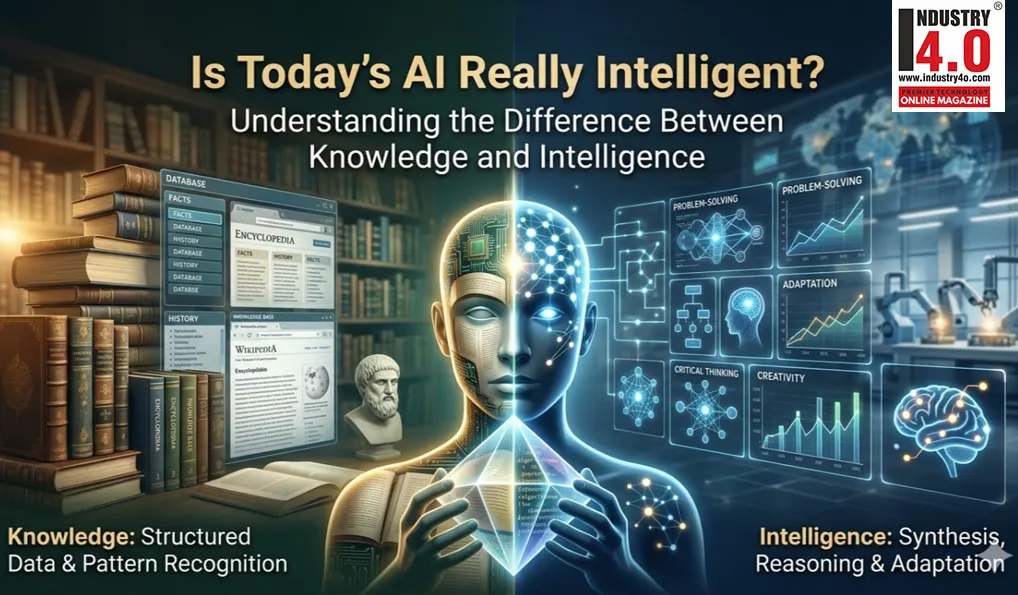
Is Today’s AI Really Intelligent? Understanding the Difference Between Knowledge and Intelligence
Week 3 : Is Today’s AI Really Intelligent? Understanding the Difference Between Knowledge and Intelligence
Over the last few months, I have spent considerable time learning about Artificial Intelligence and observing how rapidly it is transforming businesses across industries.
The capabilities are remarkable.
AI can analyze massive amounts of information, identify patterns, answer complex questions, summarize knowledge, generate content, and produce recommendations in seconds.
 Yet I keep returning to one question:
Is today’s AI truly intelligent, or is it simply highly knowledgeable?
At first glance, the difference may seem insignificant.
I believe it is one of the most important questions business leaders should consider as AI becomes increasingly integrated into everyday operations.
Knowledge and Intelligence Are Not the Same
Most discussions about AI focus on what it can do.
Far fewer discussions focus on how it actually knows what it knows.
Today’s AI systems are trained on vast amounts of information, including:
- Books
- Articles
- Research papers
- Historical records
- Human-generated content
- Publicly available knowledge
In many ways, modern AI represents one of the largest collections of human knowledge ever assembled.
But possessing knowledge and possessing intelligence are not necessarily the same thing.
A library contains knowledge.
A database contains knowledge.
An AI model contains knowledge.
The question is:
Does information alone create intelligence?
How Humans Learn
Human beings learn differently.
We learn through:
- Experience
- Observation
- Curiosity
- Failure
- Trial and error
- Adaptation
 Many of humanity’s greatest breakthroughs did not originate from historical data.
They emerged because people encountered situations they had never faced before and discovered solutions through experimentation.
Human learning is not confined to a predefined dataset.
It is a continuous process of interpreting, adapting, and responding to an ever-changing world.
The Strength of Current AI
Current AI systems excel when data exists.
The more relevant information available, the more capable they become.
AI can:
- Detect patterns humans may never notice
- Analyze years of historical information
- Compare thousands of variables simultaneously
- Process information at extraordinary speed
This makes AI incredibly valuable for improving productivity and supporting complex analysis.
However, most current AI systems remain heavily dependent on historical knowledge.
They learn primarily from what has already happened
The Challenge of Completely New Situations
Business history teaches us an important lesson:
Not every challenge has a historical precedent.
- New technologies emerge.
- Industries evolve.
- Consumer expectations change.
- Unexpected disruptions occur.
When circumstances change significantly, historical knowledge alone is often insufficient.
Humans possess an extraordinary ability to adapt when facing unfamiliar situations.
We can combine experiences from different areas of life, identify similarities, and develop solutions even when no clear precedent exists.
 This remains one of the most fascinating differences between current AI systems and human intelligence.
The Power of Cross-Domain Thinking
Consider:
- A manufacturing leader who moves into business strategy.
- A sales professional who learns Artificial Intelligence.
- An engineer who becomes an entrepreneur.
Humans routinely transfer knowledge between completely different domains.
Experience gained in one area often becomes valuable in another.
This ability to connect seemingly unrelated concepts is one of the reasons human innovations continue to evolve.
Current AI systems are becoming increasingly capable, yet most remain highly dependent on the domains in which they were trained.
The ability to apply learning from one field to solve entirely different problems remains one of the greatest challenges in artificial intelligence research.
The Next Evolution of AI
Many people assume the future of AI will be defined by larger models and bigger datasets.
I am not convinced.
The next breakthrough may not come from the quantity of data.
It may come from the ability to learn more like humans.
Future AI systems may increasingly:
- Adapt to unfamiliar situations
- Learn continuously from outcomes
- Transfer knowledge across domains
- Improve through experience
- Develop deeper contextual understanding
If that happens, the definition of artificial intelligence itself may begin to change.
 A Question Worth Asking
Perhaps the most important question is not:
“How much does AI know?”
Perhaps the better question is:
“Can knowledge alone become intelligence?”
Today’s AI is one of the most powerful technologies humanities has ever created.
But it is also a product of human knowledge, human experience, and human innovation.
As AI continues to evolve, the distinction between knowledge and intelligence may become one of the defining conversations of the next decade.
What do you think?
Is today’s AI truly intelligent, or is it one of the most knowledgeable systems ever created?
About the Author :

 Mr. Chandrakumar T
Enterprise Sales Leader
Honeywell Technologies

Mr. Chandrakumar is an Enterprise Sales Leader with 20+ years of experience helping organizations accelerate growth through telecom, IT infrastructure, AIDC, and automation solutions.
Mr. Chandrakumar has partnered with 60+ strategic enterprise accounts across India, consistently achieving 100–120% of quota targets while building long-term, trust-based relationships.
Mr. Chandrakumar approach blends proven sales methodologies such as Challenger Sale and Miller Heiman with deep expertise in SaaS, cloud, and cybersecurity platforms.
Mr. Chandrakumaris passionate about translating complex technologies into business outcomes that improve efficiency, reduce costs, and create measurable value for customers.
Mr. Chandrakumar believes in being a trusted advisor to customers – guiding them through digital transformation journeys and enabling sustainable success.
Mr. Chandrakumar actively share insights on automation, SaaS, and enterprise sales strategies, engaging with peers, customers, and industry leaders to exchange ideas and best practices.
Mr. Chandrakumar is Bestowed with the following Licenses & Certifications:
https://www.linkedin.com/in/ch
Mr. Chandrakumar can be contacted at :
Also read Mr. Chandrakumar‘s earlier article :