
Digitization: The Foundation of a Smarter, More Connected Business
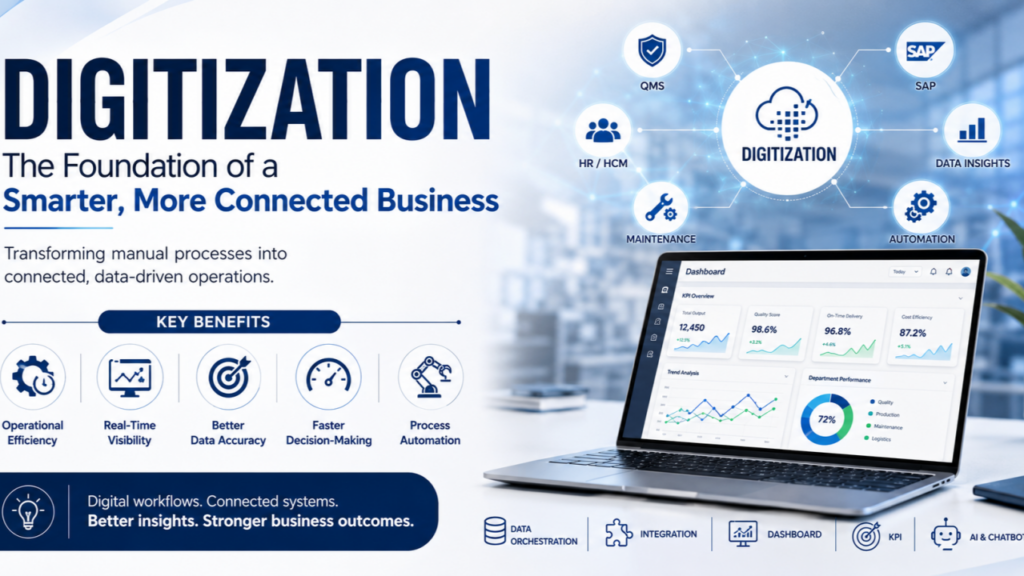
How organizations can transform manual processes into connected, data-driven operations
Businesses today generate enormous amounts of data every day – from production and quality records to HR information, maintenance activities, customer interactions, and operational KPIs.
But data alone does not create value.
The real advantage comes from digitization: transforming manual, paper-based, and disconnected processes into structured digital workflows that provide better visibility, faster decisions, and improved operational control.
 What Is Digitization?
Digitization is the process of converting information and business activities from manual or traditional formats into digital systems.
It can include:
- Replacing paper records with digital workflows
- Moving from spreadsheets to centralized applications
- Automating repetitive tasks
- Connecting different business systems
- Creating real-time dashboards
- Using data analytics for better decisions
- Integrating systems such as ERP, QMS, HRMS, and SAP
The goal is not simply to “go digital.” The goal is to make business processes smarter and more connected.
Why Is Digitization Important?
Traditional processes often create information silos.
For example, one department may maintain data in Excel, another may use paper forms, while another operates through a separate software system. This makes it difficult for management to get a complete and accurate picture of business performance.
Digitization helps organizations create a connected flow of information.
Manual Data → Digital Data → Connected Systems → Real-Time Insights → Better Decisions
 Key Benefits of Digitization
1. Improved Operational Efficiency
Digital workflows can reduce repetitive manual work, duplicate data entry, paperwork, and unnecessary follow-ups.
Employees can spend more time on activities that require analysis, problem-solving, and decision-making.
2. Real-Time Visibility
Dashboards and digital systems can provide managers with access to important KPIs and operational information without waiting for manual reports.
This enables faster identification of issues and quicker corrective action.
3. Better Data Accuracy
Manual data entry and spreadsheet-based processes can lead to errors, duplication, and inconsistent information.
Centralized digital systems can improve data consistency and traceability.
4. Faster Decision-Making
When reliable information is available at the right time, managers can make decisions based on actual data rather than assumptions or delayed reports.
5. Process Automation
Routine activities such as approvals, notifications, reminders, data collection, reporting, and task assignments can be automated.
Automation helps reduce delays and improves process discipline.
6. Connected Business Processes
Digitization can connect functions such as:
Quality → Production → Maintenance → Tooling → HR → Finance → Management
 When systems communicate with each other, organizations gain a more complete view of operations.
Digitization in Manufacturing
Manufacturing organizations can benefit significantly from digitization.
Consider a quality process.
A traditional workflow may involve:
Paper Form → Excel Entry → Manual Analysis → Email Follow-Up → Delayed Action
A digital workflow can transform this into:
Digital Data Capture → Automated Analysis → Dashboard → Alert → Action Tracking → Management Insight
This creates a more responsive and transparent quality process.
Digitization + Data = Business Intelligence
One of the biggest advantages of digitization is the ability to turn operational data into actionable insights.
Organizations can track:
- Quality KPIs
- Production performance
- Maintenance indicators
- Employee metrics
- Tool utilization
- Process performance
- Cost trends
- Corrective actions
- Customer-related metrics
The objective is simple:
Don’t just collect data. Use it to improve decisions.
The Role of AI and Automation
Digitization also creates the foundation for advanced technologies such as AI, machine learning, intelligent chatbots, predictive analytics, and automated decision support.
However, organizations should first establish reliable digital processes and structured data.
Good Digital Foundation → Reliable Data → Automation → AI → Intelligent Decisions
Without quality data, even advanced AI solutions may produce limited business value.

The Future Is Connected
The next stage of digital transformation is not about implementing isolated software applications.
It is about creating an integrated digital ecosystem where systems, people, processes, and data work together.
Integration with platforms such as SAP, ERP, QMS, HRMS, HCM, maintenance systems, and other enterprise applications can help organizations create a unified flow of information.
Final Thoughts
Digitization is no longer simply an IT initiative. It is a business transformation opportunity.
Organizations that digitize intelligently can improve:
Efficiency | Visibility | Quality | Productivity | Compliance | Decision-Making
The journey starts by identifying manual, repetitive, disconnected processes and asking one important question:
“What if this process could be simpler, faster, and completely connected?”
That question could be the beginning of your organization’s digital transformation journey.
ISYRA — Enabling Smarter, Connected & Data-Driven Operations.
About the Author:
 Mr. Prasad Dixit
Founder & Consultant
iSyra

Mr. Prasad Dixit empowers organizations to digitize and optimize processes across all departments – finance, HR, supply chain, and more.
Mr. Prasad Dixit, with his 15+ years’ experience has delivered SAP, RPA, and custom solutions for manufacturing, automotive, and diverse sectors.
Recent projects of Mr. Prasad Dixit include automating processes, digitization of various enterprise processes, HR skill matrix digitization and launching a real-time analytics platform.
To drive Digital Reinvention contact Mr. Prasad Dixit.
Mr. Prasad Dixit can be contacted at :
About iSyra :
At iSyra, they believe in empowering organizations to achieve more through technology-driven transformation.
iSyra is a trusted partner in digital innovation, iSyra specialize in helping businesses of all sizes harness the power of modern technology to drive growth, efficiency, and competitive advantage.
iSyra expert team brings together deep industry knowledge and cutting-edge technical expertise to deliver tailored solutions in digital transformation, IT consulting, and business process optimization.
Whether you are looking to modernize your IT infrastructure, adopt cloud solutions, or streamline operations with automation, iSyra provides end-to-end support every step of the way.
iSyra is passionate about enabling clients to unlock new opportunities, overcome challenges, and stay ahead in a rapidly evolving digital landscape.
iSyra collaborative approach ensures that they understand your unique needs and deliver solutions that are scalable, secure, and future-ready.
At iSyra, they don’t just implement technology – they empower your people, processes, and vision for sustainable success.
Join iSyra on your journey to digital excellence and discover how innovation can transform your business.
iSyra can be contacted at: