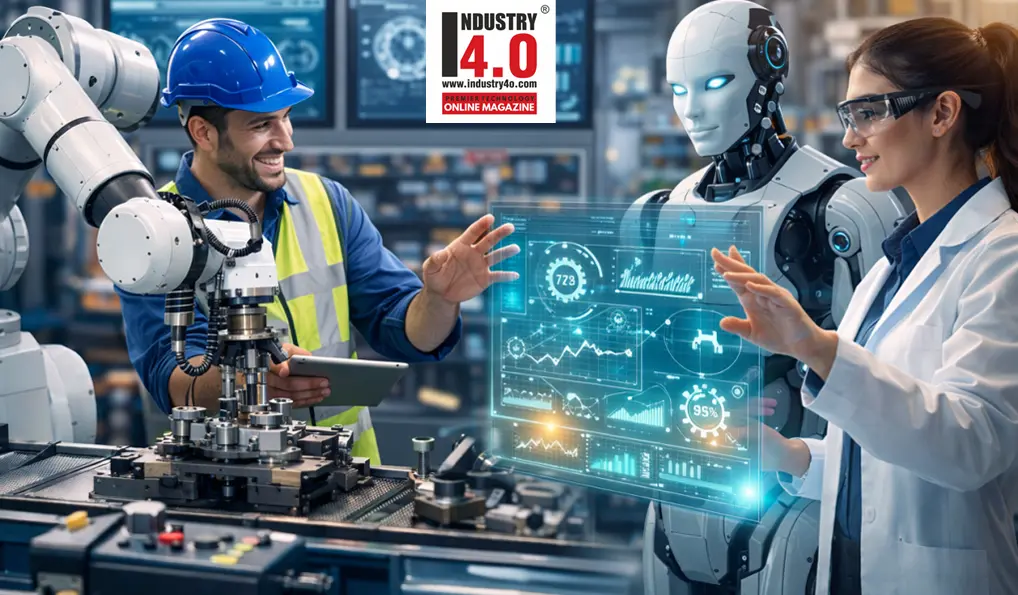
Industry 5.0 : Humans and Robots Don’t Compete Anymore, They Collaborate to Win
The productivity ceiling today is poor human-machine interaction, not lack of automation.
• The new reality
• Automation is no longer about replacing people
• Manufacturing complexity has exceeded what either humans or machines can handle alone
• Industry truth
• Robots are fast, precise, tireless
• Humans are adaptive, contextual, creative
• What has changed
• Industry 4.0 optimized machines
• Industry 5.0 optimizes the human–machine system
(Aligned with the European Commission Industry 5.0 vision)
➡ So what : The factories that win combine human judgment + machine intelligence, not one versus the other.

Industry 5.0 Changes the Goal of Manufacturing
Efficiency alone is no longer enough; human-centric value now defines competitiveness.
• Industry 4.0 focus
• Automation & connectivity
• Cost, scale, efficiency
• Technology as the destination
• Industry 5.0 reframes success
• Human-centric systems
• Resilient operations
• Sustainable outcomes
• Responsible AI & robotics
• The fundamental shift
• Technology is no longer the end goal
• Human value creation is
(Reinforced by World Economic Forum and EU Industry 5.0 frameworks)
➡ So what : Industry 5.0 is not more tech, it’s better alignment between people, machines, and purpose.
Humans and Robots Now Do What Each Does Best
Division of labor, not substitution, unlocks the next productivity curve
• The new operating model
• Robots: precision, repeatability, strength, 24/7 execution.
• Humans: judgment, creativity, contextual decision-making, problem solving.
• What collaboration looks like
• Cobots working safely beside operators.
• AI decision support guiding human actions.
• Humans supervising, correcting, and improving automated systems.
• Evidence from industry
1. Plants combining cobots + skilled operators see higher quality, lower fatigue, and faster changeovers. (International Federation of Robotics)
➡ So what : Industry 5.0 replaces the “automation vs jobs” debate with automation for better jobs.
 Where Human-Robot Collaboration Actually Works
Productivity gains now come from redesigning work, not just automating tasks.
• Robots excel at
• Repetition & precision
• High-speed execution
• Hazardous or ergonomically risky tasks
• Humans excel at
• Decision-making under uncertainty
• Process judgment & exception handling
• Continuous improvement & learning
• High-impact collaboration zones
• Cobots in assembly, kitting, material handling
• AI-assisted quality inspection (humans validate & improve)
• Robots handling fatigue-heavy work while humans focus on root cause & optimization
➡ So what : Productivity no longer comes from automation alone, it comes from designing work around collaboration.
Collaboration Delivers Resilience, Not Just Productivity
Resilient factories outperform purely automated ones in volatile conditions.
• Measured outcomes across industries
• 10–30% productivity improvement in hybrid human-robot lines
• Lower injury rates and fatigue-related errors
• Faster response to demand and product-mix changes
• Higher workforce acceptance vs “lights-out” automation
• Strategic advantages
• Reduced dependency on scarce labor skills
• Faster learning cycles on the shop floor
• Greater adaptability during disruptions
As highlighted by McKinsey and Deloitte, human-machine collaboration is now a competitive differentiator, not a cultural experiment.
➡ So what : Collaboration creates robust factories, not brittle ones.
Human-Centric AI Is the Real Breakthrough
AI doesn’t remove humans from the loop; it makes their decisions smarter
• From autonomy to augmentation
• Industry 4.0: automate decisions.
• Industry 5.0: augment human decisions with AI insights.
• Practical use cases
• AI recommends optimal parameters; operators approve or adjust.
• Computer Vision flags quality risks; humans decide disposition.
• Predictive Maintenance suggests actions; technicians plan interventions.
• Why this works
• Human-in-the-loop AI improves trust, safety, and adoption.
• McKinsey shows most AI value is lost without workforce integration.
(McKinsey)
➡ So what : The highest ROI AI systems are collaborative, explainable, and operator-centric. From autonomy to augmentation

Industry 5.0 Makes Factories More Resilient, Not Just Efficient
Resilience beats pure efficiency in a world of constant disruption
• The resilience gap
• Fully automated lines struggle with variability.
• Human-machine systems adapt faster to:
• Product mix changes
• Supply disruptions
• Unexpected quality or safety issues
• Collaborative systems enable
• Faster reconfiguration and recovery.
• Local decision-making at the shop-floor edge.
• Safer operations through shared situational awareness.
• WEF insight
• Lighthouse factories increasingly combine digital tech with empowered frontline teams. (World Economic Forum)
➡ So what : Industry 5.0 turns factories from brittle efficiency machines into adaptive, shock-resistant systems.
Industry 5.0 Is a Leadership Choice, Not a Technology Upgrade
Technology enables collaboration; leadership makes it real.
• What winning manufacturers do
• Redesign roles, not just workflows
• Introduce cobots where fatigue and variability hurt most
• Use AI as decision support, not decision replacement
• Upskill operators to supervise, adapt, and continuously improve systems
• What they avoid
• “Automation first, people later” thinking
• Ignoring change management
• Measuring success only in cost savings
• Recommended first step
• Identify one process where:
• Human fatigue is high
• Variability hurts quality
• Robots can assist without displacing judgment
➡ So what: Industry 5.0 leadership is not about choosing humans or robots.
It’s about designing systems where both win together.
Closing Takeaway
The future factory is not dark and empty. It is intelligent, collaborative, and human-centric.
Factories that understand Industry 5.0 won’t just be automated, they’ll be adaptable, resilient, trusted, and future-ready.
About the Author :
 Mr. Gulshan Kumar Saini
Senior Director
Samsung Electronics

Mr. Gulshan Kumar Saini is a global manufacturing, operations excellence, and smart factory transformation leader with over 30 years of leadership experience at Samsung Electronics, spanning senior roles across India, Vietnam, Korea, Russia, and the United States.
Mr. Gulshan Kumar Saini currently serves as Senior Director – Smart Factory at Samsung Electronics India, where Mr. Gulshan Kumar Saini spearheads enterprise-wide digital transformation initiatives across advanced manufacturing lines for consumer electronics and durables.
Mr. Gulshan Kumar Saini leads the deployment of AI-driven manufacturing systems, industrial robotics, IIoT platforms, machine vision, advanced analytics, and Digital Twin technologies to drive next-generation factory performance.
Mr. Gulshan Kumar Saini is widely recognized for delivering large-scale automation, step- change productivity improvements, and sustainable cost, quality, and efficiency gains in high-volume, high-complexity manufacturing environments. Across his career, Mr. Gulshan Kumar Saini has successfully led global NPI programs, greenfield and brownfield plant setups, capacity expansions, lean transformations, and multi-country manufacturing excellence programs.
Mr. Gulshan Kumar Saini is a PMP-certified professional and Six Sigma Black Belt, Mr. Gulshan Kumar Saini also holds an MBA in FinTech from BITS Pilani, combining strong digital, financial, and operational acumen to translate technology into measurable business outcomes.
Mr. Gulshan Kumar Saini can be contacted at:
Mr. Gulshan Kumar Saini is Bestowed with the following Licenses & Certifications
https://www.linkedin.com/in/gulshan-kumar-saini/details/certifications/
Mr. Gulshan Kumar Saini is Accorded with the following Honors & Awards
https://www.linkedin.com/in/gulshan-kumar-saini/details/honors/